
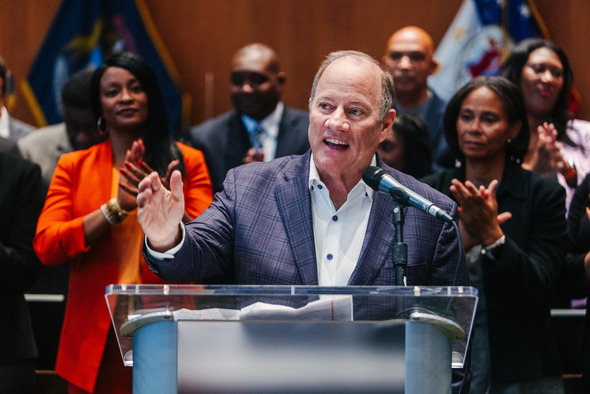

Independent gubernatorial candidate and former Detroit Mayor Mike Duggan has ended his campaign for governor, bringing a close to a candidacy that increasingly unsettled many Democrat voters and strategists across Michigan.
“I am so disappointed to have to write you this letter,” Duggan said in a statement posted to his website. “For the last 18 months I’ve worked every day to try to change Michigan’s toxic party politics. I’ve been supported by hundreds of volunteers who believe deeply that years of constant Democratic-Republican conflict in Lansing have led to our schools declining, our housing costs rising, and our young people moving out of Michigan in record numbers.”
He continued: “But for the public in general, our internal polling showed the intense anger over gas prices and Iran was boosting Democrats in every office nationally. The Chamber poll last week showing we’d fallen 11 points behind the Democratic candidate reflects that reality.
“Being down 11 points in May wouldn’t discourage me – I’ve been down worse than that in the past. But this time it’s compounded by our inability to build serious national fundraising support.”
Duggan’s departure arrives after months of mounting concerns that his independent bid threatened to fracture the Democratic coalition in a battleground state where razor-thin margins are likely to decide statewide elections this year.
While Duggan built much of his political identity over more than a decade in Detroit by aligning himself with traditionally Democratic priorities (including urban investment, labor partnerships, neighborhood redevelopment and expanded public services), his gubernatorial campaign gradually took on a different tone that left many longtime supporters questioning both his political direction and his broader impact on the race.
For many Democrats, the conclusion comes with a sentiment that can best be described as “better late than never.”
Duggan entered the governor’s race with undeniable political strengths. After serving 12 years as Detroit’s mayor, he left office with a national reputation as a pragmatic executive who oversaw major downtown investment, reduced blight, and helped stabilize the city’s finances following bankruptcy. His appeal to business leaders and moderate suburban voters initially created speculation that he could reshape the traditional dynamics of a Michigan gubernatorial contest.
But as the campaign unfolded, Duggan increasingly distanced himself from the Democratic Party identity that had long defined his political rise.
On the campaign trail, Duggan began emphasizing messages centered on government restraint, criticism of party “extremes,” tougher rhetoric around public spending, and themes that mirrored the language frequently used by Republican candidates courting moderate independents.
While he maintained that his campaign was focused on practicality rather than ideology, critics argued that his positioning gave political cover to conservative arguments while weakening Democrat’s unity ahead of one of the state’s most consequential elections in years.
That concern became particularly pronounced as Republican contenders such as Mike Cox and John James continued consolidating support among GOP voters. Political observers increasingly warned that Duggan’s independent candidacy could siphon moderate Democrats, Black voters, and independents away from the eventual Democratic nominee – likely to be current Secretary of State Jocelyn Benson – without creating a realistic path to victory for himself.
In practical terms, many Democrats feared the race was developing into a classic spoiler scenario where the Republican nominee could win a statewide election by receiving shy of 40% of the total vote.
Michigan’s recent statewide elections have repeatedly demonstrated how narrow the margin between victory and defeat can be. In that environment, even a relatively small percentage of crossover or independent support can dramatically alter the outcome. Duggan’s presence in the race threatened to create exactly that kind of electoral split that could have opened a clear path for Republicans to reclaim the governor’s office.
The irony for many longtime Democrat supporters was difficult to ignore, as even though many voters have expressed exhaustion over a two-party system, now was not the right time to fracture off the voter base.
Duggan spent years cultivating relationships within Democrat circles while leading the state’s largest majority-Black city. He often presented himself as a problem-solving Democrat focused less on ideology and more on results. Yet as his gubernatorial campaign evolved, some allies privately questioned whether he was running against Republicans or against the modern Democratic Party itself.
His messaging increasingly emphasized dissatisfaction with partisan politics broadly, noting that the only thing Democrats were good at was hating Republicans and hating Donald Trump and that Duggan’s criticism landed disproportionately on their side of the aisle. Progressive activists and party loyalists alike expressed frustration that Duggan appeared more eager to challenge Democratic priorities than confront the policy direction emerging from the Republican field.
The tension deepened as national politics became more polarized and control of state governments carried greater implications on issues ranging from abortion rights and education policy to voting access and labor protections.
By the final stretch of his campaign, Duggan faced growing skepticism about his chances of winning and about the long-term consequences of remaining in the race.
“I got into this race to try to change our politics, not to be a spoiler. I’m still hopeful our campaign will prove to have a real long-term impact. 23% support in the last poll means more than 1.6 million Michigan voters are today looking for a Governor candidate serious about reducing the toxic partisan politics. If the candidates on the ballot this year take that message to heart and truly reach out to those voters, we will have accomplished something important,” Duggan said in his statement.
“I will never be able to express the gratitude I feel for all your support and encouragement. I wish I could have done better for you.”
His exit now reshapes the political landscape heading into the general election. Democrat organizers who had quietly worried about vote fragmentation will likely view the decision as an opportunity to consolidate support and refocus attention squarely on the contrast between the Democratic nominee and the Republican field.
At the same time, Duggan’s campaign leaves behind broader questions about the future of political moderation and independent candidacies in Michigan. His run reflected a continuing frustration among some voters who feel disconnected from both major parties and attracted to candidates who position themselves outside traditional partisan structures.
But the campaign also underscored the structural difficulty independents face in statewide elections, particularly in highly polarized swing states where many voters ultimately make strategic decisions based less on ideological purity and more on preventing the opposing party from gaining power.
Duggan didn’t immediately announce plans for the next phase of his career, but his legacy in Detroit remains significant and will likely continue to shape conversations about urban leadership, economic development, and municipal governance for years to come. His brief gubernatorial run may also serve as a cautionary example of how quickly political coalitions can fracture when longtime party affiliations begin to blur.
While his supporters may argue that he brought important conversations about breaking from the traditional two-party system to the forefront, critics inside his former political base will likely maintain that his continued presence in the race risked delivering the governor’s office to Republicans at a moment when Democrats viewed the stakes as exceptionally high.
Now, with Duggan stepping aside, Michigan’s gubernatorial contest returns to a more familiar partisan battle, and one that Democrats hope they can fight without the threat of division from within their own ranks.