

Michigan voters rejected a proposal to convene a constitutional convention and approved a citizen-led initiative to restrict campaign contributions from certain utility companies and government contractors – commonly referred to as ‘Money Out of Politics’ – in Tuesday’s Nov. 3 general election, according to election results projected by the Associated Press.
The outcomes will preserve Michigan’s existing state Constitution while bringing new restrictions to political contributions and expanding disclosure requirements for certain political communications.
Michigan Democratic U.S. Senate candidate Dr. Abdul El-Sayed campaigned heavily on a promise to get money out of politics, especially following a democratic primary that saw his opponent Congresswoman Haley Stevens spend more than $70 million in a loss.
Proposal 1, which asked voters whether Michigan should hold a constitutional convention in 2027 to consider rewriting the state’s governing document, failed. Proposal 2, an initiative focused on limiting the political influence of regulated utilities and government contractors, passed.
The rejection of Proposal 1 means Michigan will retain the Constitution adopted in 1963 without convening a convention to review or revise it. The question is required to appear on the statewide ballot every 16 years under the state Constitution.
Had the proposal passed, Michigan would have moved toward electing 148 delegates, one from each of the state’s 110 House districts and 38 Senate districts. Those delegates would have gathered to consider changes to the Constitution and could have proposed a comprehensive revision.
Any document produced by a convention would still have required approval from Michigan voters before taking effect.
The convention process would have opened every section of the Constitution to potential revision, including provisions governing state government, education, taxation, voting rights, individual liberties and the relationship between state and local governments.
With voters rejecting the proposal, that process will not move forward. Michigan’s existing constitutional framework remains in place, and the next regularly scheduled opportunity for voters to consider calling a convention will come in 2042.
Proposal 2 will now introduce changes to Michigan’s campaign finance laws. The citizen-initiated measure targets political contributions from regulated electric and natural gas utilities, certain government contractors and individuals and organizations with substantial connections to those entities.
Under the proposal, regulated utilities would be prohibited from making specified direct or indirect campaign contributions to candidates and elected officials who have authority over matters affecting their businesses.
The restrictions also apply to government contractors receiving more than $250,000 annually in government contracts. Certain individuals and organizations connected to those businesses would be subject to the restrictions as well.
The measure is intended to limit financial contributions from entities that have business interests before state and local government officials, including those responsible for decisions involving utility regulation and government contracts.
The proposal also expands campaign finance disclosure requirements to cover additional political communications. Under the new provisions, certain communications that identify a candidate or ballot proposal could fall under disclosure rules even when they do not explicitly urge voters to support or oppose someone or something.
The changes also specifically extend disclosure requirements to political communications distributed over the internet, requiring greater transparency about who paid for covered political messages.
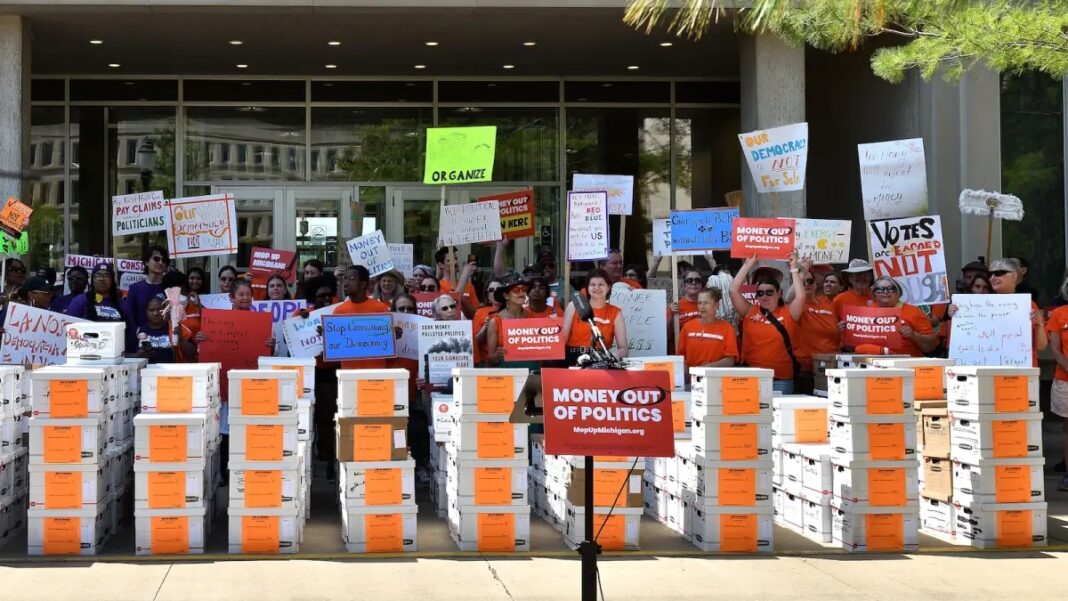
The initiative was organized by Michiganders Money Out of Politics, also known as MOP UP Michigan. Supporters gathered more than 560,000 petition signatures to qualify the measure for the November ballot.
Supporters argued that the restrictions were necessary to address the influence of corporate money in elections and strengthen public confidence in government. They maintained that companies with substantial financial interests in government decisions should face limits on their ability to contribute to the political campaigns of officials responsible for those decisions.
The proposal faced opposition from major utility companies, including DTE Energy and Consumers Energy.
Opponents argued that the restrictions could limit the political participation of Michigan businesses, employees and affiliated organizations while leaving other sources of political spending largely untouched. They also raised concerns that the measure could shift political influence toward wealthy donors and outside organizations.
DTE and Consumers Energy publicly opposed the initiative during the campaign, raising concerns about its potential effects on employees and their ability to participate in the political process through voluntary political contributions.
The measure’s approval places Michigan among the states taking steps to regulate certain financial relationships between businesses and public officials. Its implementation will require changes to how affected entities approach political contributions and how certain political communications are reported.
For voters, the passage of Proposal 2 means additional campaign finance restrictions will become part of Michigan law, although election-night approval does not mean every provision takes effect immediately without the required administrative and legal implementation.
The Michigan Bureau of Elections and other responsible state agencies will oversee the application of the new requirements under the state’s campaign finance framework.
The two proposals were the statewide ballot questions presented to Michigan voters in the November general election.
While the constitutional convention question will return to voters in 16 years, Proposal 2’s approval establishes new rules governing political contributions and disclosure that will affect future campaigns and political activity in Michigan.