
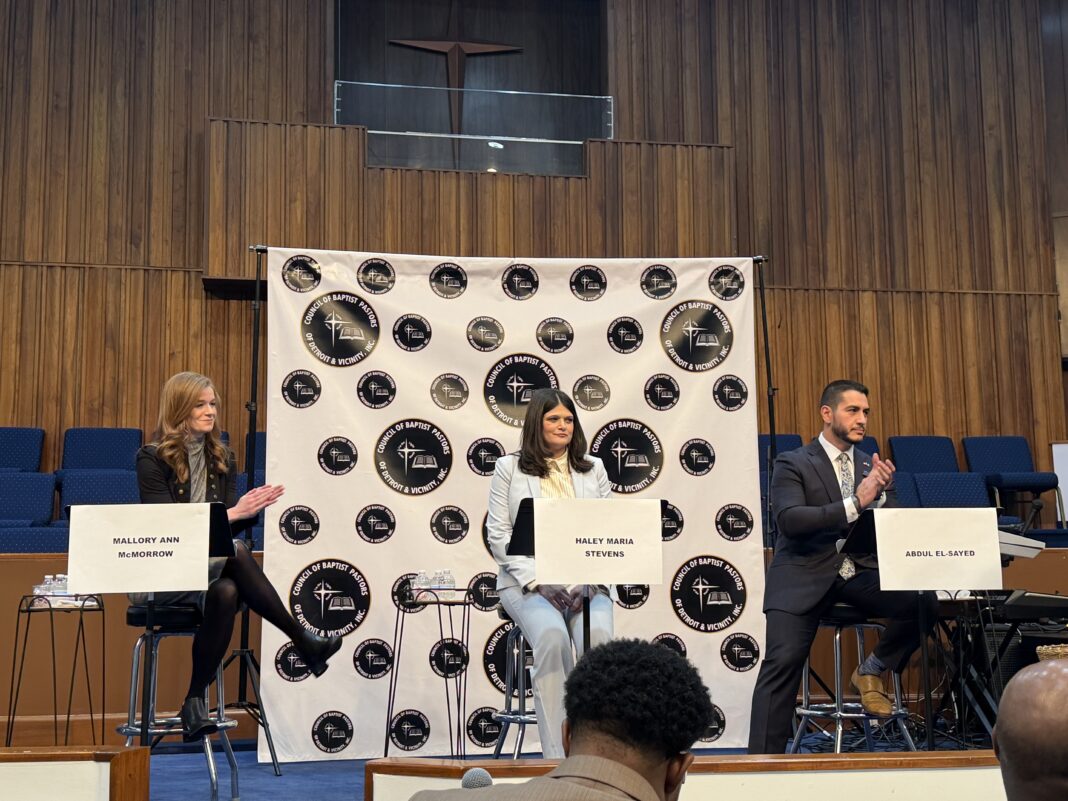


All three U.S. Senate candidates from Michigan made their pitch during a debate Friday evening inside of a West side Detroit church.
The debate, the first between U.S. Rep. Haley Stevens, state Sen. Mallory McMorrow and former Wayne County health director Abdul El-Sayed, was held at the Messiah Baptist Church on W. Seven Mile.
Pastor Orville Littlejohn and the Council of Baptist Pastors played host to the first debate between the Democratic primary candidates who each represent differing versions of Democratic identity.
The race has captured the nation’s attention as the Democratic Party recovers from its loss in the 2024 presidential election. In Detroit, the economy, the war in Iran and how to respond to President Donald Trump are shaping the dynamics of campaigns heading into a highly consequential midterm election.
Republicans will try to maintain their majority in Congress, and in the Michigan Legislature.
Those topics and more were points of contention between candidates, who were asked questions about public safety, economic justice, environmental racism and the influence of Israel.
“I’m proud to be the only person on this stage not supported by the Israel lobby,” El-Sayed said.
The debate surrounding the influence Israel holds over U.S. politicians has become ubiquitous with the race between the candidates from Michigan.
El-Sayed, who has slammed U.S. politicians of both parties for spending money for war instead of investing it into the communities they represent, criticized both of his opponents Friday over their positions on AIPAC, the largest political action committee that supports Israel’s interests.
McMorrow, who sits in between pro-Israel Stevens and pro-Palestine El-Sayed on the issue, has distanced herself from the controversial group.
“It’s an organization that has shifted very rapidly away from the organization — to be very clear there are a lot of Michiganders who historically had been members of AIPAC — as it existed 26 years ago,” McMorrow said. “My husband interned for AIPAC, he’s Jewish. 26 years ago it was an organization that represented bipartisanship in a two state solution and safety and security. Today, it is a far right pro-Netanyahu organization that has shifted wildly away from what it used to be.”
El-Sayed responded to McMorrow’s comment, mentioning a report from an online outlet, DropSite News, that reported she had drafted a position paper seeking an endorsement from AIPAC.
“I think it’s really important folks tell us who they’ve sought support from. If you don’t take money from AIPAC, you should be able to tell us if you have asked for money from AIPAC, especially if there is objective reporting that has shown you have written a policy paper for AIPAC,” El-Sayed said. “What did it say? What were you telling them? Did they reject you? And that’s why you’re not taking money from AIPAC?”
Stevens said she wanted campaign finance reform, but didn’t directly address the Israel-Palestine conflict in her answer, instead focusing on taking on the Trump administration.
Stevens has since the beginning of her campaign taken aim at Republican U.S. Senate candidate Mike Rogers instead of her Democratic primary opponents, who have mostly squared their ire at each other. Following the debate, Stevens campaign declared the congresswoman the winner.
“On stage, Haley made clear she’s the strongest candidate to beat Mike Rogers and hte only one with a real record of winning for Michigan workers and our manufacturing economy.”
While McMorrow and El-Sayed have appeared in photos with each other on the trail throughout the campaign, Stevens has positioned herself as the favorite.
“There are already 73 millionaires in the Senate, I don’t know if we want another one,” Stevens said.
McMorrow also criticized El-Sayed for making money doing paid speeches and hosting a podcast while he was serving Detroiters as health director.
“While my opponent was podcasting and selling speeches for money, I was helping a dozen candidates running for state Senate,” McMorrow said.
El-Sayed responded, saying he was rebuilding a health department, “and had a podcast.”
Focus turned to those in the room when candidates were asked about the economy as experts say Trump’s tariffs are especially affecting auto production in Michigan.
Throughout the debate, Stevens reminded the crowd of her work with former President Obama during the 2008 financial crisis, when the administration helped save auto jobs at General Motors.
“Detroit is the arsenal of Democracy,” Stevens said. “I call myself Michigan’s manufacturing geek.”
Stevens on stage said her campaign has what she calls the “Michigan hope agenda,” which also serves as “an accountability document to each and every one of you,” she said.
McMorrow mentioned her work bringing investment to businesses on Livernois, which she said contains the highest percentage of Black owned businesses in the country.
“Community Development Financial Institutions not only provide capital, but coaches and training. Some people need a little bit more than just a check,” McMorrow said.
El-Sayed said he’s the only person on stage who has never advocated for huge corporate tax breaks.
“Frankly, we should ban that system in which corporations give to politicians and those politicians turn around and give tax breaks to those same corporations only to rinse and return, that has to end — we have to invest into communities,” El-Sayed said.