

Pressure works — especially when it is rooted in community, clarity, and consequence.
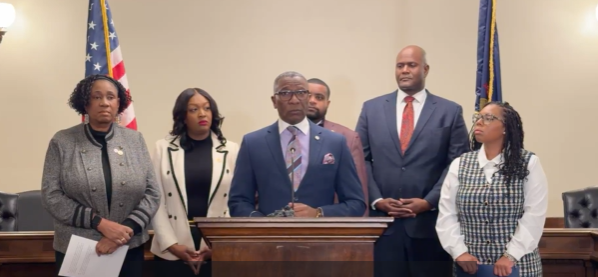
One week after a rare procedural maneuver by House Republicans wiped out hundreds of millions of dollars meant for Michigan’s most vulnerable residents, the Michigan Senate voted Dec. 16 to restore $634 million in work project funding. The reversal followed sustained pushback from impacted organizations, local governments, and a coordinated response led by the Michigan Legislative Black Caucus, which convened a press conference demanding accountability and an immediate course correction.
The Senate vote came after the House Appropriations Committee, controlled by Republicans, used a seldom-invoked provision of the state’s Management and Budget Act on Dec. 10 to unilaterally reject roughly $645 million in previously approved work projects. Those funds had already been appropriated in the state’s 2025 budget and were awaiting routine carryforward approval after remaining unspent at the close of the fiscal year on Sept. 30.
Five Republican senators joined Democrats in the 23–13 vote to restore the funding, signaling bipartisan discomfort with how the cuts were executed and who they harmed. The legislation now heads back to the House, where Speaker Matt Hall has defended the committee’s action while indicating some funding could still be reinstated.
For members of the MLBC, the issue was never abstract.
The eliminated projects cut across nearly every corner of Michigan life — funding for children undergoing cancer treatment, fire safety equipment in Hamtramck, environmental remediation, school infrastructure upgrades, and Rx Kids, the nationally watched maternal health initiative providing direct cash support to new parents. Many of the affected programs serve Black, low-income, rural, and medically vulnerable communities that already face structural barriers to stability.
Sen. Sarah Anthony, chair of the Senate Appropriations Committee, emerged as a central force in the reversal. She framed the House action as reckless governance that disrupted already-approved commitments and undermined trust in public institutions.
“The investments House Republicans so callously ripped away aren’t luxuries — they’re essential lifelines for people to survive,” Anthony said in a Dec. 16 statement.
Anthony also sent a letter to Dana Nessel requesting a formal legal opinion on whether the provision of state law used by the House committee to claw back the funding is constitutional. The move signaled that the fight extended beyond budget numbers into questions of process, authority, and precedent.
The original cuts blindsided grant recipients. Several organizations said they had already committed funds, entered contracts, or made purchases based on the state’s budget approval — only to be left without reimbursement or clarity once the funding disappeared. Because many work project line items bundle multiple grants together, state officials initially struggled to identify the full scope of what had been eliminated, adding to confusion across communities trying to plan for the new year.
“The rules of the game shouldn’t have been changed midstream or applied retroactively,” Michigan Community College Association President Brandy Johnson testified after funds were pulled back for a “Local Heroes” program that helps steer students into high-demand careers, including law enforcement.
“When we make promises to babies, we must keep them,” testified Dr. Mona Hanna, founder and director of Rx Kids, a Flint-based group that is expanding to provide cash aid to new parents across Michigan and had $18.5 million in unspent 2025 dollars pulled back in the action championed by House Speaker Matt Hall, R-Richland Township.
Hall has argued that work projects have ballooned since the COVID-19 pandemic and described the accumulated funding as potential “slush funds.” He said many of the eliminated projects were tied to initiatives he opposes, including green energy and diversity, equity, and inclusion programs. He also questioned whether some services should be funded by government at all, suggesting private charity or competitive bidding instead.
That framing drew sharp criticism from lawmakers and community advocates who noted that many of the programs targeted by the cuts were created through bipartisan agreement and address needs the private sector has historically failed to meet.
The MLBC’s response underscored that point. Standing alongside affected organizations, caucus members made clear that the funding fight was about survival, not politics — and about whose needs are deemed expendable when power is exercised without transparency.
Five Republican senators — Jon Bumstead of North Muskegon, John Damoose of Harbor Springs, Mark Huizenga of Walker, Ed McBroom of Vulcan, and Michael Webber of Rochester Hills — joined Democrats in voting to restore the funds, reflecting unease even within GOP ranks.
The Senate’s action does not end the conflict. With the legislation returning to the House, uncertainty remains about final implementation. But the vote marked a clear rebuke of unilateral budget cuts carried out without warning and without regard for their ripple effects.
For the communities affected — new mothers, children battling cancer, families relying on public media, neighborhoods waiting on infrastructure — the restoration represented more than a fiscal adjustment. It was a reminder that organized resistance, led by lawmakers rooted in community, can interrupt harm before it becomes permanent.
And it affirmed what Black legislators and advocates made plain from the start: budgets reveal priorities. When those priorities are challenged, solidarity matters — especially for the people most vulnerable and most often overlooked.