

By: Jasmine West
Michigan’s newly signed state budget will preserve Medicaid services, continue free meals for public school students and direct new funding toward child care and affordable housing as state leaders brace for the effects of sweeping federal policy changes.
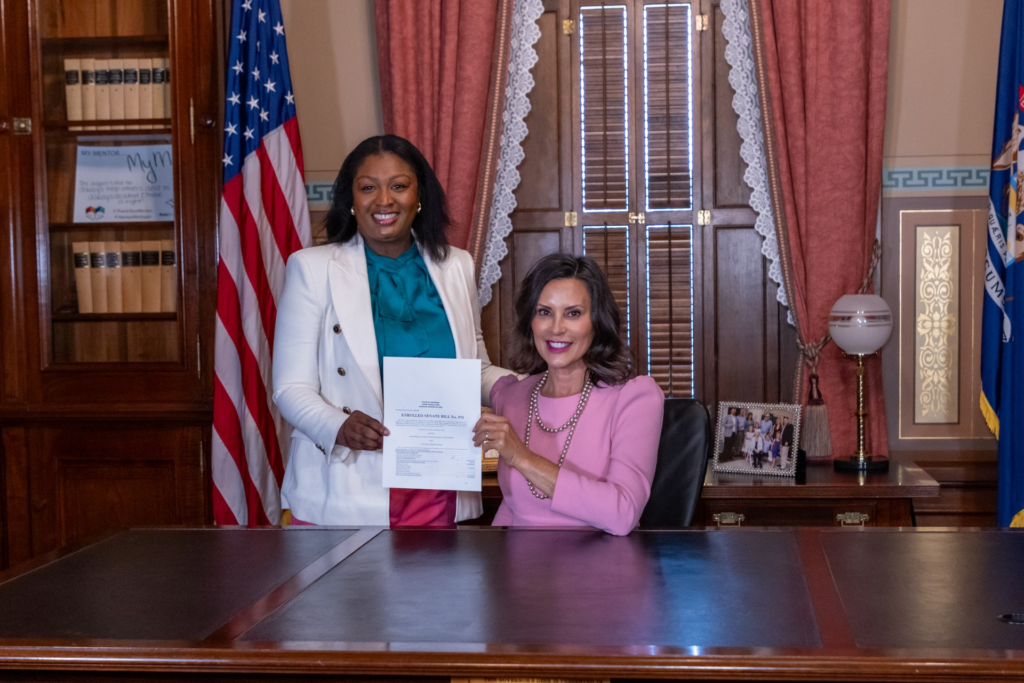
Gov. Gretchen Whitmer signed the bipartisan fiscal year 2027 budget into law Tuesday, July 21, marking the final state spending plan of her administration. The budget takes effect Oct. 1 and was negotiated as Michigan faces rising costs, shifting federal requirements and an estimated funding gap tied to changes in federal health care and food assistance programs.
Sen. Sarah Anthony, D-Lansing, who chairs the Senate Appropriations Committee and served as the Senate’s lead budget negotiator, said the spending plan was designed to give residents a measure of stability during a period of economic and political uncertainty.
“While politicians in Washington have stoked fear, chaos, and uncertainty across the state and nation, here in Michigan, we’ve worked across the aisle to deliver a budget that provides residents with financial relief, stability, and peace of mind,” Anthony said.
Anthony called the plan a response to challenges affecting families across the state, including the cost of groceries, health care, housing and child care.
“From protecting crucial health care and food benefits and tackling our housing and child care challenges to continuing to invest in programs that make a real difference for real people, the 2027 state budget is a promise to the people of Michigan — we’ve got your back,” she said.
The budget was approved without new state taxes or fee increases, according to Senate Democrats. It continues several programs intended to lower household expenses, including free school breakfasts and lunches, the Working Families Tax Credit, retirement tax relief and Rx Kids, a cash-assistance program for pregnant people and families with infants.
The state allocated $200 million to continue providing free breakfast and lunch to approximately 1.4 million public school students. State officials estimate the program saves participating families about $1,000 per child each year.
The budget also maintains the expanded Working Families Tax Credit, which state officials say provides an average of nearly $3,900 in tax relief to roughly 665,000 Michigan families. The continued rollback of the state retirement tax is expected to save about 500,000 seniors an average of $1,000 annually.
Among the most consequential parts of the budget is the state’s effort to protect Medicaid and food assistance following changes approved at the federal level.
The federal tax and spending law passed last year introduced new administrative costs and eligibility requirements for Medicaid and the Supplemental Nutrition Assistance Program, commonly known as SNAP. Michigan officials have warned that those changes could make it more difficult for residents to maintain health coverage and food benefits.
More than 2 million Michigan residents receive health coverage through Medicaid, while approximately 1.4 million rely on SNAP assistance.
Anthony and other Democratic leaders said the federal changes created a roughly $1 billion challenge for the state. The final budget avoids reductions to core Medicaid services while allocating money to help state agencies and residents navigate the new federal requirements.
The plan includes $184.3 million to address those changes, including increased state costs for administering SNAP. It also provides $40 million for staffing and implementation, $20 million for community health navigators and $28 million for Michigan Works agencies that are expected to receive additional referrals involving Medicaid and SNAP recipients.
The navigators will assist residents who must document their eligibility or comply with new work and reporting rules. The spending is intended to reduce the number of people who lose coverage because of paperwork, missed notices or confusion surrounding the federal requirements.
The budget also continues funding for food assistance rather than shifting the increased federal administrative costs onto families.
For schools, the plan establishes another record for per-pupil funding and begins implementing a weighted funding formula. Under that approach, schools would receive additional resources based on student needs rather than relying solely on a uniform allocation for each pupil.
The formula is intended to direct more money toward districts serving students from low-income households, English-language learners and children requiring additional educational services.
Funding also continues for school mental health programs, campus safety, literacy efforts and incentives intended to recruit and retain educators.
The state will maintain free prekindergarten access and higher-education assistance through the Michigan Achievement Scholarship and Michigan Reconnect. The budget directs $532 million to the Achievement Scholarship, which helps eligible students attend community colleges, public universities and private institutions.
Child care providers, many of whom have struggled with rising operating expenses and staffing shortages, will receive additional support through a newly established Childcare Fund.
The budget includes $30 million for child care and makes the state’s Tri-Share program permanent. Tri-Share divides eligible child care expenses among an employee, the employer and the state, reducing the amount paid by working parents.
Lawmakers have promoted the program as both a family affordability measure and a workforce development tool, particularly for parents who cannot return to work because the cost of care would consume much of their earnings.
The new fund is also intended to give providers greater financial stability in a sector where tuition payments often fail to cover the full cost of staffing, facilities, food, insurance and other operating expenses.
Housing remains another central part of the budget.
The spending plan continues a $50 million annual housing investment for the fourth consecutive year. It also includes funding for affordable housing development, home repairs, weatherization and supportive housing.
Part of the funding will support a continuum-of-care approach for residents experiencing homelessness. That model pairs temporary shelter with services such as case management, health care, employment assistance and help securing permanent housing.
The housing investments come as families across Michigan contend with rising rents, limited housing inventory and aging homes in need of significant repairs. Those challenges have been especially pronounced in Detroit and other communities where residents face older housing stock, high utility costs and longstanding barriers to financing improvements.
The bipartisan agreement also includes $343 million in additional local road funding, bringing total road spending to approximately $3.1 billion. Another $123.8 million increase will support public transit and rail programs.
Although Democrats emphasized the budget’s protections against federal cuts, Republican legislative leaders pointed to reduced spending, government accountability and the preservation of essential services as key elements of the final agreement.
House Speaker Matt Hall said the plan redirected funding away from government waste and toward roads, schools and public safety. House Appropriations Chair Ann Bollin said the budget maintained state reserves while protecting Medicaid and other priorities.
For Anthony, the agreement concludes her fourth budget cycle as Senate Appropriations chair and demonstrates that lawmakers can still reach a deal across party lines despite deep divisions in Lansing and Washington.
The budget will not eliminate the financial pressures facing Michigan families or resolve the state’s shortages of affordable homes and child care providers. It does, however, preserve several programs residents already use while positioning the state to respond to federal changes that could otherwise place health care and food assistance at risk.
“At a time when Michiganders are struggling with higher costs, this budget puts money in their pockets,” Whitmer said during the signing. “It continues free breakfast and lunch for all 1.4 million public school students, cuts taxes, fixes roads and protects Michiganders from the harms” of the federal law.