
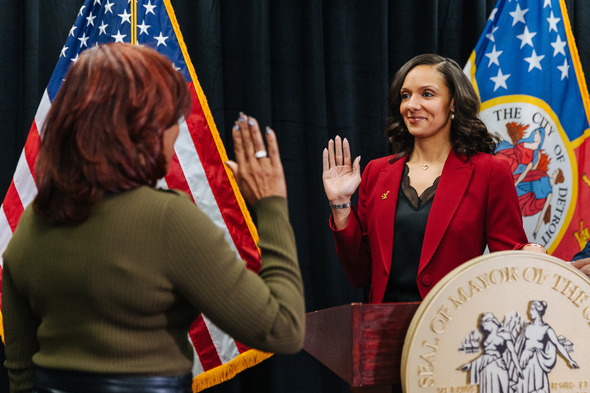


Mary Sheffield began her first day as Detroit’s mayor with the only requirement the city charter does not let anyone postpone. At 10 a.m. Jan. 1, Sheffield took the oath of office at the Coleman A. Young Municipal Center, becoming Detroit’s 76th mayor and the first woman to hold the office in the city’s more than 300-year history.
Detroit also has its first new mayor in 12 years.
Sheffield replaces three-term Mayor Mike Duggan, who is now running for governor as an independent. Sheffield arrives after 12 years on the Detroit City Council, including the last four as council president, with a governing résumé built inside the same building where she was sworn in.
The swearing-in was intentionally private and closed to the media.
City Clerk Janice M. Winfrey administered the oath. Family members attended, according to a city statement, along with a small group totaling about 20 people. Sheffield shared that the ceremony was “very private” and meant to satisfy the city’s charter-mandated requirements.
A larger public ceremony is scheduled for Friday, Jan. 9, at the Detroit Opera House.
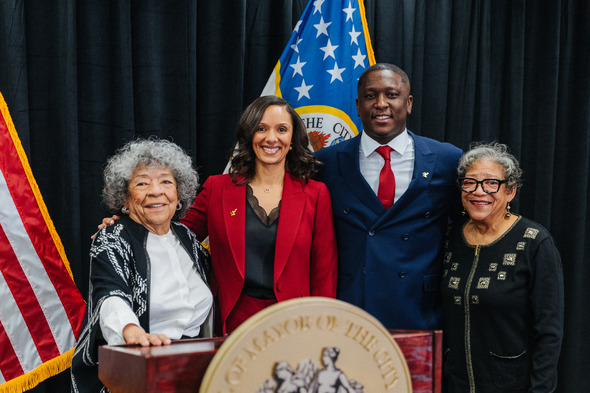
Mayor Mary Sheffield is joined by her grandmother Mary Coty (l), husband Rickey Jackson, and aunt Wanda Bush
“I am incredibly honored to serve as Detroit’s mayor,” Sheffield said in a statement. “This moment is bigger than me – it represents progress, possibility and the power of community. Together, we will work to ensure Detroit’s future is inclusive, equitable and rooted in opportunity for every neighborhood.”
Black women leading Detroit lands differently because Detroit is a Black-majority city in the clearest, measurable sense—about 77.7 percent of residents identify as Black or African American alone in the most recent decennial Census profile. Brookings has described Detroit as the nation’s largest Black-majority city, which means this isn’t representation on a technicality; it’s leadership that matches the people who have carried this city through every era, from factory-floor power to neighborhood block clubs to the long grind of rebuilding public trust.
New York City has the largest number of Black residents, but it is not a Black-majority city, which is why Detroit’s moment reads as governance that looks like the electorate and the workforce and the families most impacted by decisions on housing, safety, transit, water, and wages.
When a Black woman holds the mayor’s office here, it raises the standard in a city that has always been politically sophisticated: you don’t get to talk in slogans, because Detroiters will measure you by budgets, by streetlights, by response times, by whether “neighborhood investment” reaches the blocks that have been waiting the longest.
Sheffield’s first-day schedule moved quickly from the oath to city services that touch life-and-death realities. Her agenda included visits to a fire station, a police precinct and the Capuchin Soup Kitchen. Her first public appearances were at Detroit fire and police stations, and she said that order was intentional.
“I just wanted to make sure that my first stop was supporting the men and women of law enforcement, both police and fire,” Sheffield said to a gathered crowd. “There is no way we can move forward without investing in the men and women who sacrifice their lives every single day.”
Sheffield said she also planned to meet with homeless service providers and volunteers on Day One to thank them for serving Detroiters.
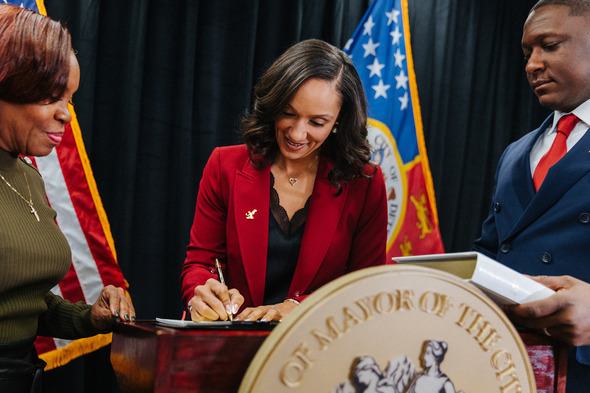
“My administration will be rooted in service to others. On my first day as mayor, it was important for me to thank those who quietly serve our community every day, particularly our first responders and those providing critical support to our most vulnerable residents,” Sheffield said. “Serving Detroiters and leading city employees effectively begins with meeting them where they are, listening and letting them know how much they are valued.”
Her start carries both symbolism and a clear political mandate.
After winning more than 77 percent of the vote in November, Sheffield begins her first term with broad political capital and a policy agenda that includes expanding affordable housing, continuing neighborhood development, and maintaining Detroit’s improved fiscal standing. Sheffield enters office with a $105 million budget surplus.
Sheffield repeatedly suggested during the campaign that she would retain Police Chief Todd Bettison, and she made that official just before Christmas. She has named David Bowser, a veteran of the Duggan administration, as her chief of staff. Brian White, her City Council chief of staff, will serve as deputy mayor. Speaking with reporters on New Year’s Day, Sheffield said several additional announcements are expected in the coming week, including policy and personnel decisions.
As mayor, Sheffield will become the newest resident of the Manoogian Mansion, the official home of Detroit’s mayor, with plans to move there in the coming weeks, according to a transition spokesperson. The 4,000-square-foot residence along the Detroit River is one of only a few official mayoral residences nationally, with published reports noting that cities such as New York City, Los Angeles and Denver also have them.
Her transition operation has been built with unusual scale and reach for a municipal handoff. A $2 million mayoral transition fund is taking shape to support talent recruitment, strategy setting and community engagement. As many as 15 philanthropic foundations have expressed interest or made verbal commitments pending final approvals from foundation boards. The Gilbert Family Foundation and Troy-based Kresge Foundation have made firm commitments. Additional foundations are expected to firm up commitments early in the new year. The effort follows a similar philanthropic model cited in New York City, where a separate transition fund has set a $5 million goal.
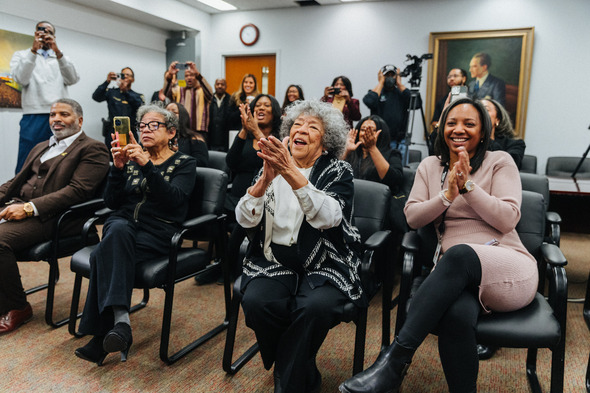
Family, Staff and supporters cheer as Mayor Mary Sheffield is officially sworn into office. Pictured in the front row (l-r) are Deputy Mayor Brian White, aunt Wanda Bush, grandmother Mary Coty and Paris Blessman.
Transition resources show Sheffield has tapped a mix of business, philanthropic and civic leaders tied to Detroit’s decision-making infrastructure, including Huntington National Bank Chairman Gary Torgow, Detroit Pistons Vice Chairman Arn Tellem, Detroit Future City Executive Director Anika Goss and Ann Arbor tech entrepreneur Dug Song. Transition committees include leaders connected to major philanthropic institutions such as the Community Foundation for Southeast Michigan, Kresge Foundation, Gilbert Family Foundation, Ford Foundation, Ralph C. Wilson Foundation and W.K. Kellogg Foundation, along with nonprofit and community organizations that span human services, housing, education, arts and workforce efforts across the city.
Friday’s public ceremony will bring cameras and crowds. Thursday’s private oath already locked in the fact Detroit will spend 2026 under new leadership, with Mary Sheffield holding the title and the responsibility that comes with it.