
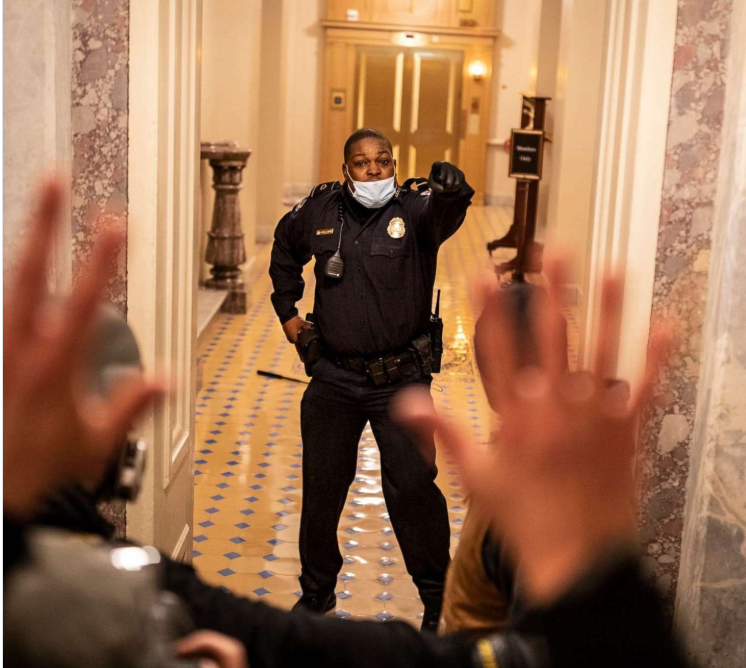

Photo credit: Ashley Gilbertson/VII via Redux File
People keep calling Jan. 6 “unthinkable.” Black Americans didn’t find it unthinkable. Black Americans found it familiar.
A crowd that looked like America’s default setting decided the rules were optional. They climbed walls, broke windows, shoved past police, and walked through the U.S. Capitol with the kind of confidence you only get when you believe the country belongs to you no matter what the votes say. That’s what Jan. 6 was. Entitlement with a mission.
Then a Black man stood in front of it.
Not in a symbolic way. Not in a “feel-good” way. In a real, physical, if-he-messes-up-people-die way.
U.S. Capitol Police Officer Eugene Goodman saw what was happening before the people with titles did. The video shows him on that stairwell with a mob in front of him, then behind him, then gaining. He gets to a landing and spots an unguarded access point near the Senate side. That is the part people skip past when they want to keep the story soft. He notices the vulnerability and he moves the threat away from it. He turns his body and turns them with him.
Black people respect that kind of bravery because Black survival has always depended on it.
Black people knows what it means to read a room fast, knows what it means to handle a crisis while somebody else is still deciding whether it’s even real, and knows what it means to keep your head when somebody else thinks chaos is a right.
And Black people also knows something else: the country loves Black labor when it’s useful and loves Black people less when we ask for protection, resources, or dignity.
That’s why Goodman’s moment hits deeper than a viral clip.
Because the U.S. Capitol is not neutral ground for us. Slaves helped build it. The federal government recognizes that history with a commemorative marker in Emancipation Hall. The White House was also built with enslaved labor hired out to the government.
So sit with what that means.
Descendants of the people forced to construct the “symbols of democracy” keep being the ones forced to protect it when democracy gets attacked by the people who always assumed it was theirs.
Jan. 6 made that contradiction impossible to ignore. A mob tried to block the certification of an election because Donald Trump lost. They were not confused about that. They were not “passionate.” They were not “concerned citizens.” They were attempting to override the outcome.
And a Black officer’s presence helped stop their next step from becoming bloodshed.
There’s another video moment Black people never forget when we talk about Goodman, because it says everything without needing extra commentary. Mitt Romney was walking toward danger, and Goodman redirected him away from the mob. Romney later said he was “very fortunate indeed” Goodman was there to guide him.
That’s America in one scene: a powerful white man gets saved from a mob of mostly white people by a Black officer doing his job.
Then comes the part America always wants to rush to: the honoring.
Schumer praised Goodman’s “foresight in the midst of chaos,” and said he was willing to make himself a target so others could reach safety. Goodman was awarded a Congressional Gold Medal. Biden later awarded him the Presidential Citizens Medal on Jan. 6, 2023.
Fine.
But Black folks doesn’t need Congress to tell us what we saw.
Because the point isn’t that Goodman got medals. The point is that Goodman had to make that decision at all. The point is how close the government came to being breached at its most vulnerable point while the people who preach “law and order” were the ones helping tear it down.
Goodman took a stand by staying upright.
He did not have to call himself a hero. He just did what so many Black people have done across American history: kept order when other people were busy disrespecting it, protected lives when other people were busy playing with them, and did it while knowing the country would argue later about whether the danger was real.
That’s why Black Americans call Eugene Goodman a hero.
Not because hero sounds good in a headline.
Because five years later, that footage still shows a truth this country refuses to face: when America is at the edge of its own failure, it’s often Black steadiness that keeps it from falling all the way apart.