
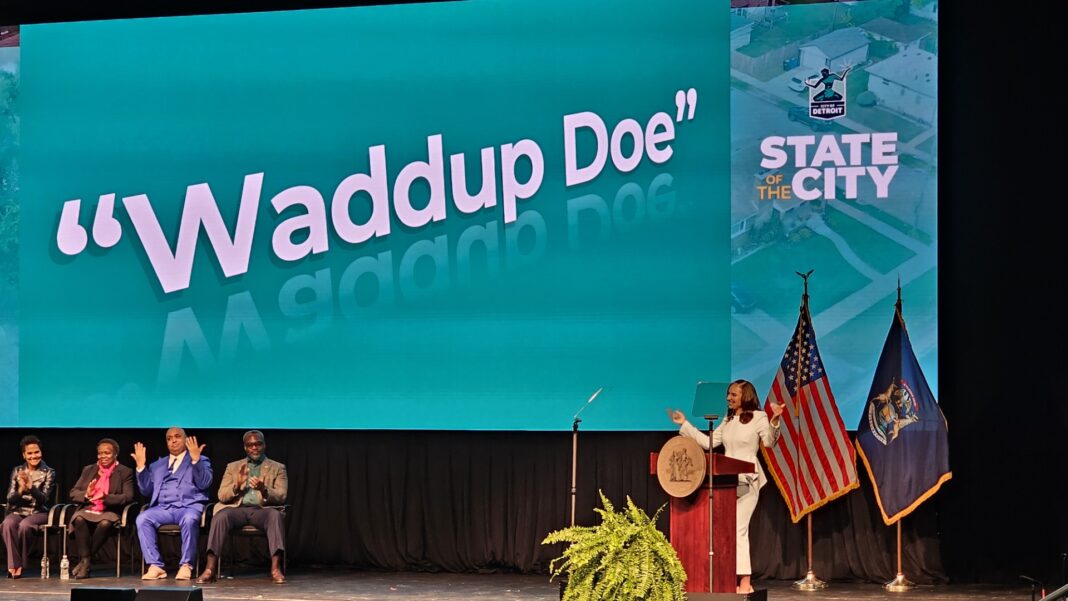

Detroit Mayor Mary Sheffield took her first State of the City back to the west side Tuesday night, delivering the address at Mumford High School in northwest Detroit and signaling that her administration intends to put neighborhoods, not just downtown development, at the center of the city’s agenda.
For Sheffield, a west side Detroiter now serving as Detroit’s first woman mayor, the location carried weight. So did the image on stage Tuesday night as she stood alongside all members of the Detroit City Council and City Clerk Janice Winfrey, honoring a long-held city tradition as she outlined plans tied to housing, youth investment, public safety, transportation, and wages.
Inside the Jemele Hill Auditorium in the Schulze neighborhood, Principal Nolan Proctor opened the evening with a welcome and thank you before Greater Emanuel’s youth choir serenaded the room with “The Star-Spangled Banner.” Sheffield then opened her speech by acknowledging her family, her husband, the city’s first First Gentleman, and journalist Jemele Hill, the Mumford alumna for whom the auditorium is named.
That setting mattered.
Sheffield did not bring her first State of the City to a downtown stage or a corporate hall. She brought it to the west side, where her own roots run deep, and used that backdrop to make a point about what kind of mayor she intends to be. Under the theme “Leading Through the Voice of the People,” Sheffield said the direction of her administration has been shaped by 18 committees and more than 300 community leaders, an effort she framed as a direct response to residents who want to see their own realities reflected in city policy.
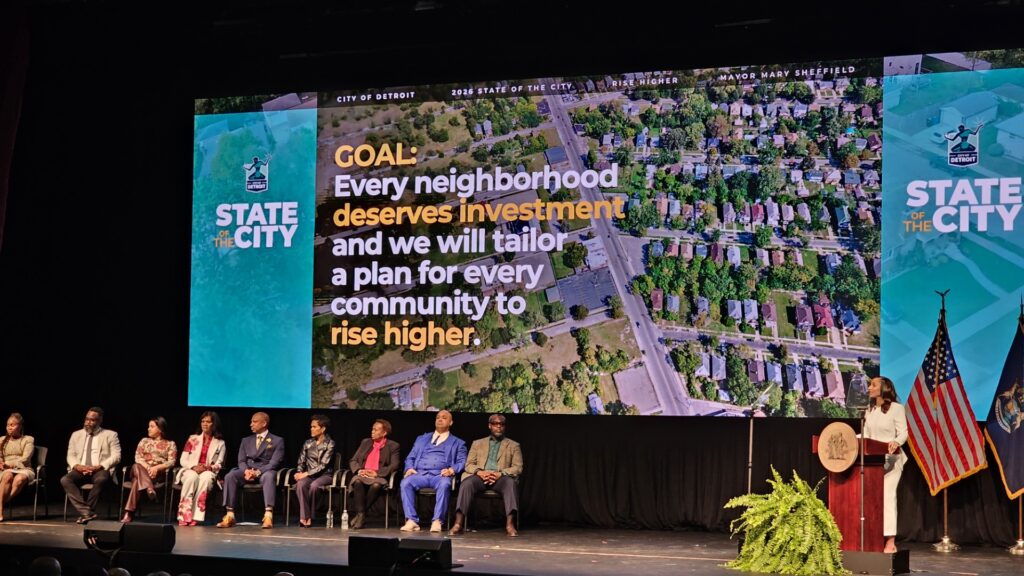
“This administration will ensure Detroit’s future is built block-by-block, neighborhood-by-neighborhood,” Sheffield said. “All too often, economic development is framed as a zero-sum game, where one neighborhood prospers at the expense of another. But we don’t have to pick winners or losers.”
For Black Detroiters, that line gets to the center of the question hanging over this administration. For decades, many residents have watched splashy investment capture headlines while neighborhoods still carried the burden of vacancy, crumbling infrastructure, overassessments, low wages, unreliable transit, and limited access to healthy food and retail. Sheffield’s speech attempted to answer that frustration with a long list of commitments, executive orders, and budget priorities aimed less at spectacle and more at the everyday conditions shaping life in Black Detroit.
One of the strongest parts of the speech centered on poverty and what it means to raise children in a city where too many families are stretched thin before a baby is even born. Sheffield returned to Rx Kids Detroit, a direct cash assistance program for pregnant mothers and babies that she has made a signature part of her opening months in office.
“Pregnancy should not mean poverty but all too often it does,” Sheffield said. “Detroit is now the largest city to participate in its first-of-its-kind cash assistance program to support maternal and infant health.”
She said more than 1,200 applications had been paid out and over $1.6 million had already gone to families. Figures shared from the administration also showed that by March 31, the program had delivered about $1.8 million and enrolled 1,353 families. In Detroit, where nearly half of children under age 5 live below the poverty line, that support lands as more than policy language. It is rent money, grocery money, diaper money, utility money, and breathing room during one of the most vulnerable periods in a family’s life. Sheffield also acknowledged the advocacy that helped bring the program to Detroit, reinforcing that this was pushed into place by people who understood the stakes and demanded action.
Sheffield tied that same economic urgency to wages. She said 64% of Detroiters working full time still do not earn a livable wage, a reality that continues to define life for many Black workers in the city.
In response, she highlighted her fourth executive order, which would ensure that effective July 1, no public servant in the city earns less than $44,616 a year, or $21 an hour.
“Detroiters who put in a full day’s work shouldn’t have to work 2 or 3 jobs just to meet their most basic needs,” Sheffield said. “As Mayor, I believe in the dignity a living wage can provide, and I’m leading by example.”
She said the increase will affect more than 900 city employees and credited Councilman Benson with partnering on the city employee raise. In a majority-Black city where public workers often hold together essential services while struggling to afford life in the communities they serve, that commitment carried both policy and symbolic weight.
Sheffield also placed young people squarely in the center of her speech, especially when it came to transportation and afterschool access. Beginning April 1, she announced, all K-12 students in Detroit can ride DDOT free through the city’s new “Show Your ID, Ride for Free” program. The rides will be available seven days a week, 365 days a year.
“The money currently spent on bus fare will go to afterschool programming,” Sheffield said.
Her administration is also investing $2.2 million in afterschool programming and says it is working to ensure those programs exist within a two-mile radius of all Detroit public schools. For Black Detroit families, that matters because transportation is often the hidden barrier sitting inside every other barrier. It affects attendance, enrichment, employment for older students, and whether young people can safely move through the city without placing one more financial burden on households already doing too much with too little.
Sheffield pushed that youth conversation further into violence prevention. She highlighted her executive order establishing the Office of Neighborhood Safety and announced “Occupy the Summer,” a summer violence prevention strategy backed by a $1.5 million investment. She also said recreation centers will stay open later, with evening hours extended until 11 p.m., alongside weekly programming across the city and midnight basketball.
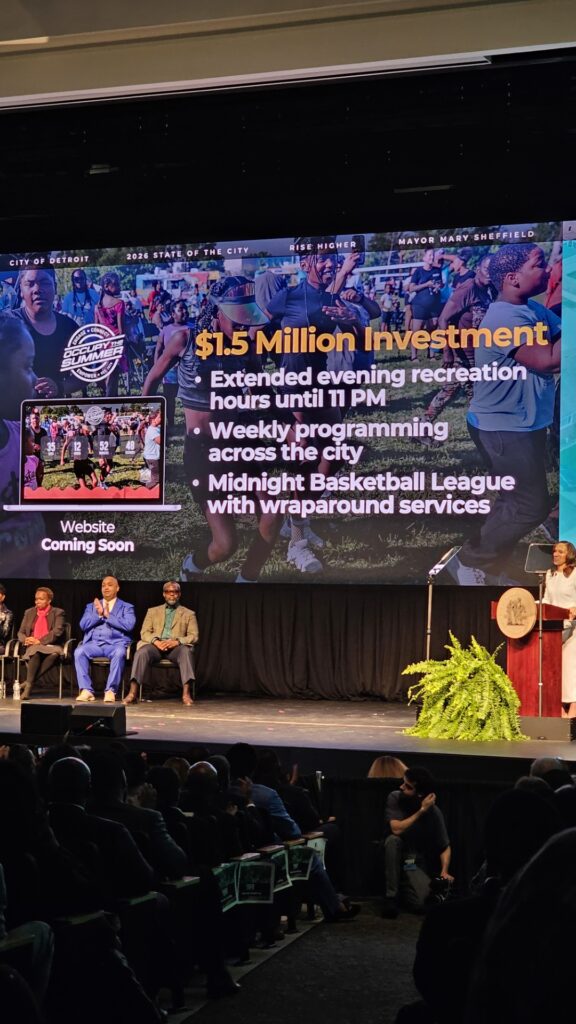
Those moves matter in Black Detroit because residents have spent years saying that safety has to be built before crisis, not only addressed after it. Open rec centers, structured programming, credible adults, and real summer investment do not solve everything, though they can interrupt the conditions that leave too many young people vulnerable when school is out and options are limited.
Still, Sheffield also leaned into more traditional public safety responses. She pointed to what city officials are calling a 60-year decline in crime and announced that the Detroit Police Department will establish a property crime squad in all 12 precincts.
“One of the things I’ve heard from residents is that they are also concerned with property crime, so I have directed DPD to create a property crime squad in all 12 precincts,” Sheffield said. “In addition to this new focus, our neighborhood police officers will be more visible and present in every neighborhood to build trust and enhance the overall quality of life for Detroiters.”
She also said the city’s mental health co-response team will expand to operate around the clock.
“For the first time, this blended unit of police officers and mental health professionals will be operating 24 hours, 7 days a week,” Sheffield said.
For Black Detroiters, that piece of the speech mattered because residents are often forced to navigate two truths at once. They want violence down and neighborhoods safer. They also want fewer situations where mental health crises are met with force instead of care. A 24/7 co-response unit signals at least some recognition that public safety has to be broader than policing alone.
Housing remained one of the clearest pillars of Sheffield’s address. She described the city’s housing agenda as rooted in the need for homes that are “safe, affordable, and accessible.” She noted that 3,000 new affordable housing units have been built over the last 10 years, though she made clear that the pace is still not enough for a city with mounting need.
“In just about every conversation I have across this city, I hear someone say, ‘Mayor, we need more affordable housing,’ and they’re absolutely right,” Sheffield said. “We need more housing that is safe, affordable and accessible because when families have stable housing, our neighborhoods grow stronger, our children are more successful in school and families can build generational wealth.”
She tied that need to several concrete moves: a fast-track PILOT process, a new round of down payment assistance now open to 450 more residents, and an executive order directing 100% of proceeds from the sale of city-owned commercial property into the Affordable Housing Development and Preservation Trust Fund. Sheffield said that change will add roughly $4 million this year to support affordable housing development and preservation.
She also pointed to the Detroit Housing for the Future Fund 2.0, a $50 million investment led by LISC, and signaled an intent to modernize zoning rules to make it easier and quicker to build housing. For Black Detroit, these are not abstract land use conversations. They touch families trying to stay in neighborhoods where they have deep roots, renters dealing with unstable costs, and longtime homeowners still living with the consequences of overassessment, tax foreclosure, and disinvestment.
Sheffield also highlighted an executive order aimed at making assessments better reflect the true value of property. That policy point may sound technical to some audiences. In Detroit, it is not. Property assessments have long been a source of pain in Black neighborhoods where inflated values contributed to overtaxation and the stripping of wealth from families who were already fighting to hold onto their homes.
The mayor broadened the housing discussion into a larger vision for neighborhood investment through what she called the Neighborhood Anchor Plan, built around three pillars: stabilize, strengthen, and grow.
“Every neighborhood deserve investment,” Sheffield said, returning again to the central message of the night.
That same neighborhood-centered framing showed up in infrastructure and quality-of-life commitments. Sheffield highlighted an $8 million investment to clear a backlog of 6,300 requested sidewalk repairs. She also committed to clearing dead and dangerous trees in neighborhoods, crediting Council President James Tate with pushing the tree cleanup effort, and pointed to a neighborhood beautification program designed to improve block-level conditions residents see every day.
Sheffield also announced “Brighten Up the Block,” a plan to install 3,000 new streetlights in neighborhoods this summer after residents and block clubs asked for more lighting.
“We also know that well-lit neighborhoods are safe neighborhoods,” Sheffield said. “Residents will have the opportunity to participate directly in community engagement sessions that will start next month. The goal is to begin installing these new streetlights this summer.”
In a city where far too many Black residents have had to organize for basic infrastructure that should already be there, those commitments go beyond appearance. Better lighting, repaired sidewalks, and cleared trees affect whether people feel safe walking home, whether seniors can move safely down the block, and whether neighborhoods are treated as places worth maintaining instead of simply managing.
Older Detroiters were also central to Sheffield’s speech. She announced senior advocates to ensure residents’ needs are being met, a plan to bring 65 senior buildings into compliance by August, and a senior food program that will provide free fresh fruits and vegetables to senior buildings citywide. In Black Detroit, where many seniors are aging on fixed incomes and often carrying the quiet burden of housing, food access, and mobility concerns, those promises carry real weight. City policy that overlooks seniors overlooks the people who helped hold entire communities together.
Transit remained another major theme. Sheffield said DDOT currently has 45 new buses in service and is scheduled to receive 80 more over the next two years, with a goal of having 240 buses operating daily. She also announced a $30 million increase in the transportation budget, along with plans to add 175 new benches and upgrade 100 bus shelters.
That matters because Black Detroiters are among the primary users of city transit. Reliable buses shape whether workers arrive on time, whether seniors make it to medical appointments, whether students get to school, and whether daily life requires impossible tradeoffs. Transit is not an add-on to equity in Detroit. It is one of its clearest tests.
Sheffield also made a direct pitch for small business growth, saying she wants Detroit to become “the best place to start and grow businesses.” She highlighted Motor City Match, the Detroit Legacy Business Project, the Detroit Startup Fund, and the Green Grocer program, which she said will help open five more small grocers this year. She thanked Councilman Coleman Young II for advocating for the grocer program and said many business owners are not simply asking for grants. They are asking for a city that moves with urgency.
Despite available resources, Sheffield said business owners need faster permitting, simpler zoning laws, and operational support to scale.
“Growth without access does not drive success,” Sheffield said.
That line may have been one of the most important of the night. Detroit has heard years of talk about growth. Black Detroiters have often had to ask who that growth is really for. Sheffield’s framing suggested that if city systems stay too slow, too confusing, or too uneven for neighborhood entrepreneurs, then development will remain concentrated in the same hands and in the same corridors.
She also tied the city’s future to a broader population strategy. Working with Dan Gilbert, Sheffield announced a “stay, return, move” growth plan meant to help current residents remain in Detroit, attract former Detroiters back, and encourage new residents to relocate to the city. She said applications are now open through movedetroit.com, with support that includes up to $15,000 for homeownership and business growth and $1,000 in relocation assistance.
“Whether it’s to stay, to return, or to move, it’s time to choose Detroit,” Sheffield said.
Detroit wants growth. Black Detroiters also want assurance that they will not be pushed aside by the very momentum they helped sustain through harder years. Sheffield tried to answer that concern by repeatedly returning to neighborhoods, affordability, wages, youth, and services rather than presenting growth as a downtown-only proposition.
She also stressed that the city’s finances remain stable, noting that the $3 billion budget is balanced “down to the penny.” She referenced the city’s 13th final budget and a 13th check for retirees, coupling new promises with reminders of fiscal discipline.
By the end of the night, Sheffield had offered a governing blueprint built around what Black Detroiters live every day: the cost of housing, the weight of low wages, the urgency of safe transit, the need for youth opportunity, the vulnerability of seniors, the pressure on small businesses, and the demand that city growth finally reach neighborhoods that have too often been asked to wait.
Her first State of the City did not unfold as a speech about downtown momentum.
It unfolded as an argument that the future of Detroit has to be measured block by block, bus stop by bus stop, school by school, and neighborhood by neighborhood. On the west side, in a school rooted in the life of Black Detroit, Sheffield used her first address to say that plainly.
Now comes the harder part: proving it.