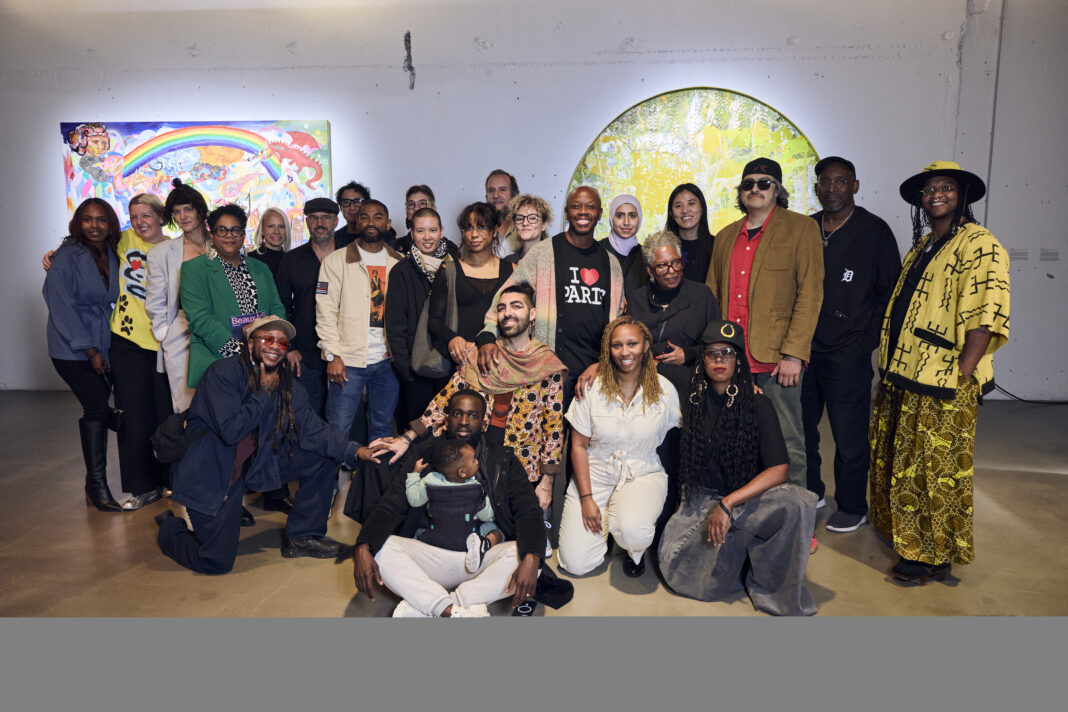

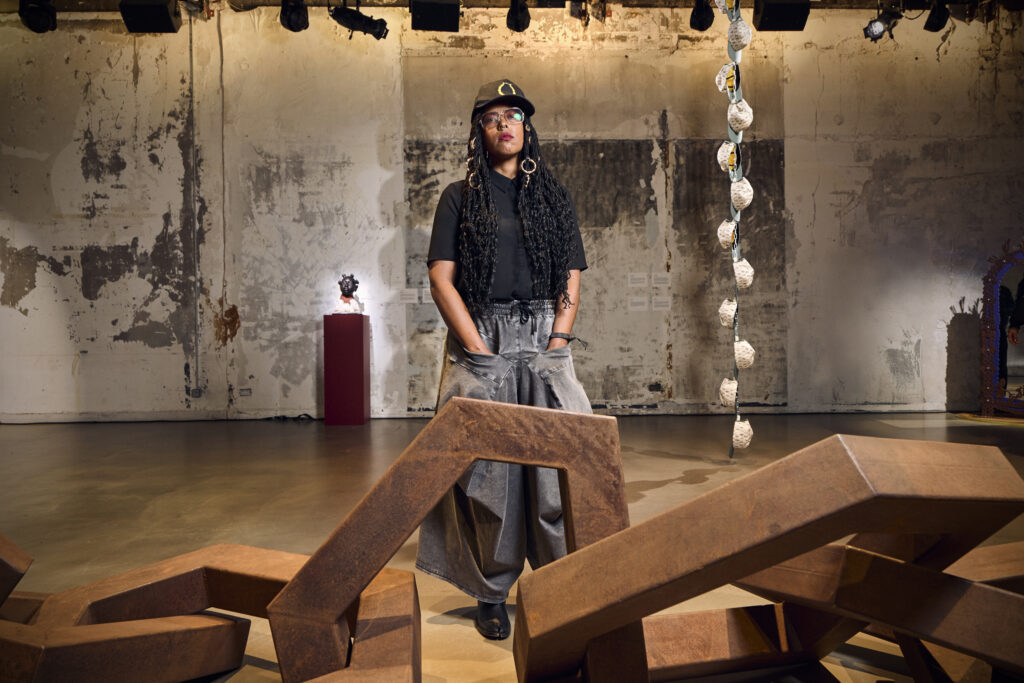
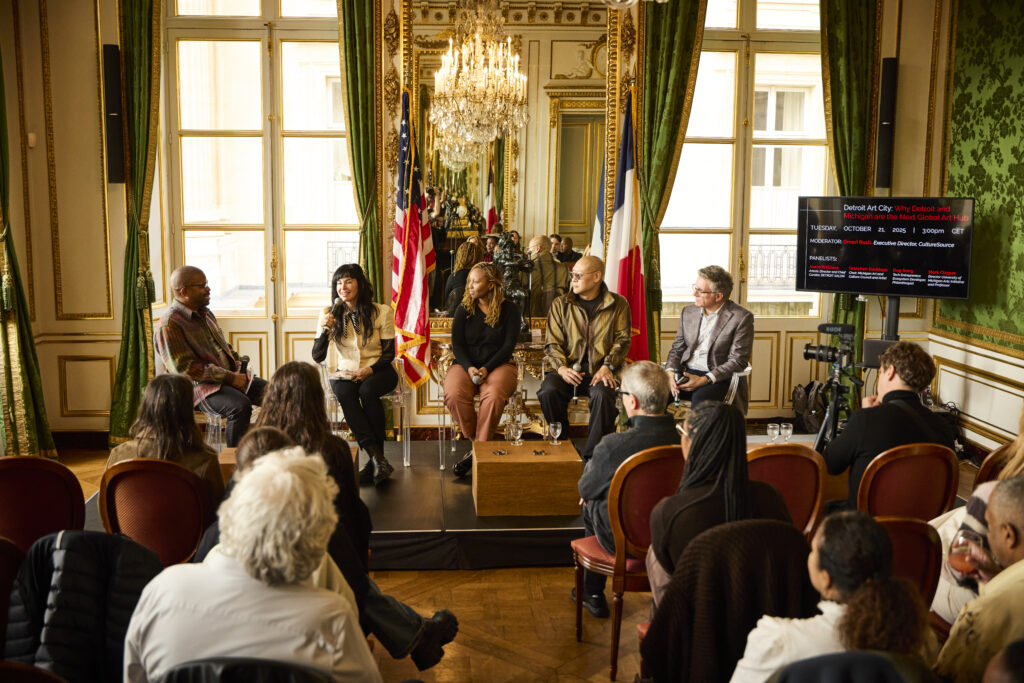
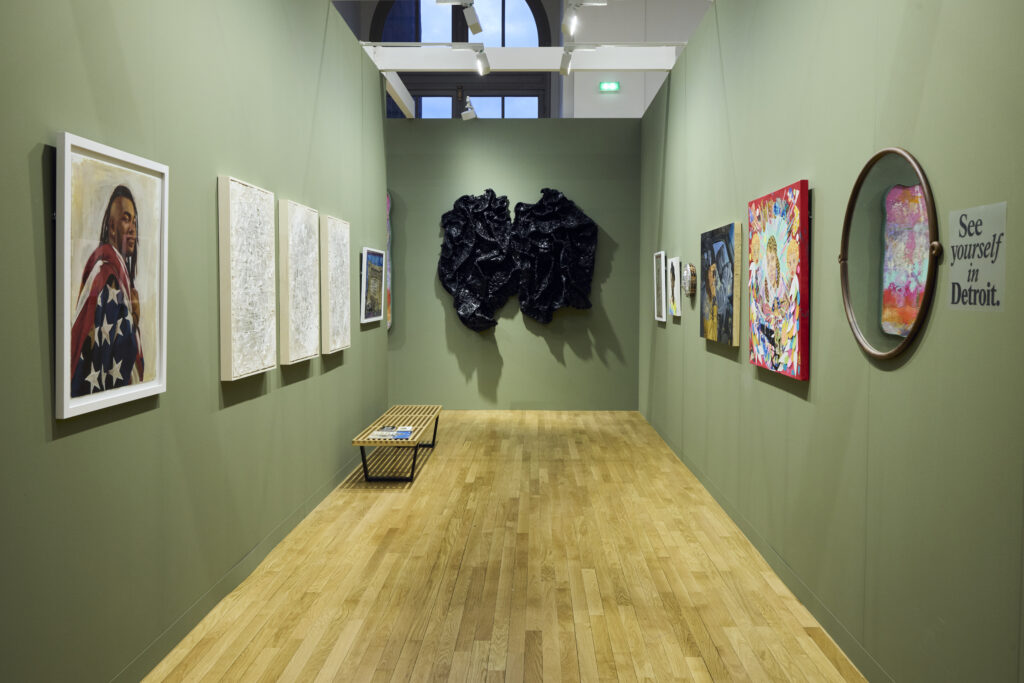
Installation Images | Detroit Salon Paris, 2025
Images courtesy of Bre’ann White (IG: @breannwhite) and Chris Saunders
(IG: @chrissaundersphoto)
On an autumn night in Paris, in the middle of one of the most competitive and crowded contemporary art weeks on the global calendar, hundreds of people chose to spend their time learning about Detroit.
Not its cars. Not its factories. Not even its music.
They came to encounter its artists, and for the people behind the Detroit Salon, that moment was not an accident. It was the point.
Detroit Salon is a long-term, citywide cultural initiative designed to position Detroit as a global center for contemporary art by elevating the city’s artists, institutions, and creative ecosystems on an international stage. Modeled after the historical idea of the salon as a place of gathering, exchange, and intellectual rigor, Detroit Salon brings together artists, curators, collectors, cultural institutions, philanthropic leaders, and civic partners to collectively tell Detroit’s story through art.
The initiative is rooted in the belief that Detroit has long been producing world-class contemporary art, even when it has lacked the visibility, infrastructure, or access afforded to cities like New York, Los Angeles, or Paris.
The project unfolds through a multi-year global strategy that includes exhibitions, artist exchanges, public programming, and partnerships in major cities around the world, culminating in a large-scale contemporary art event in Detroit in 2028.
Rather than focusing solely on a single exhibition or moment, Detroit Salon is designed to strengthen Detroit’s art ecosystem over time by creating new professional opportunities for artists, building international awareness of the city’s creative output, and inviting the global art world to experience Detroit firsthand.
At its core, Detroit Salon is both outward-facing and deeply local: it seeks to amplify Detroit artists globally while reinvesting that attention, energy, and opportunity back into the city and its communities.
“We were captured by founder Julie Egan’s vision to highlight Detroit artists for the world,” said Claude Molinari, president and CEO of Visit Detroit, one of the first investors in the effort.
“We’re known for a lot of things in Detroit. We’re known for innovation, we’re known for music, we’re known for engineering and architecture, but we’re also known for our fantastic artists.”
As the curator of Detroit Salon’s Paris exhibition, Juana Williams played a pivotal role in translating the city’s creative energy onto an international stage. She described the opportunity as a way for Detroit artists to be seen and recognized as part of the global contemporary art conversation.
“Part of the reason why we selected Paris for this pilot was to really test the waters and see if the world would engage with Detroit artists,” Williams explained. “We wanted to show that these artists could hold their own in one of the most competitive art environments in the world, and the response was overwhelmingly positive.”
Williams emphasized that the Paris show was as much about creating meaningful experiences for the artists themselves as it was about promoting the city.
“For the artists, it was about professional development and growth,” she said. “Being able to exhibit in a major museum in Paris, being able to exhibit in a major art show in Paris, it’s sort of career changing.” She highlighted how the exhibition allowed the artists to engage directly with collectors, curators, and international audiences, offering insights and connections that could shape the trajectory of their careers for years to come.
In curating the show, Williams sought to create a space that reflected Detroit’s communal and welcoming spirit.
She explained, “We wanted the exhibition to feel like a gathering, like a salon. It wasn’t just about the artwork on the walls – it was about the interactions, the conversations, the ability for people to meet the artists directly and learn from them.” This approach showcased the art itself, but it also conveyed the collaborative and inclusive culture that underpins Detroit Salon, demonstrating that the city’s creative community thrives when its members are connected, supported, and visible on a global stage – all with a sense of urgency.
And for Molinari, the urgency was clear. “I try to work with an unreasonable sense of urgency on everything,” he said. “I think it’s underappreciated, globally, just how much Detroit contributes to the art scene.”
The Detroit Salon’s fall trip to Paris – timed with Art Basel Paris and Paris Art Week – was designed to confront that gap head-on.
Egan described the decision as both symbolic and strategic.
“Paris has, for centuries, been known to be a place that welcomes artists from all around the world as, kind of, a center for cultural diplomacy,” she said. “But it’s also strategic in the sense that we knew this would be an incredible opportunity because all the world would be watching this in Paris. We really felt Detroit should be at the center of that, and that Detroit deserved to be at the center of that.”
The goal, Egan explained, is not just a single exhibition, but a long runway toward 2028, when the Detroit Salon plans to invite the global art world to Detroit for a major contemporary art event.
“Sometimes you have to go to the world before the world comes to you,” she said.
Paris was one of seven cities where Detroit artists will be showcased nationally and globally in the years leading up to that moment.
What happened in Paris exceeded expectations. Molinari, who traveled in from London, admitted he thought interest would build slowly.
“First of all, I was blown away by how many people were interested,” he said. “The exhibit was beautiful. It was really well done.” He recalled standing on a deck surrounded by Parisians and realizing, “All these people from France are here to check out Detroit. I mean, again, you’re in the city of lights on a Saturday night, and you’re saying, ‘You know what I could do? I want to come and check out this Detroit exhibit.’”
At the Palais de Tokyo, Egan said, crowds became so large that people had to queue outside. At Art Basel, Detroit Salon’s space saw as many visitors as any other exhibit.
“We heard over and over again: ‘We’re so happy Detroit is here. We’re so excited to learn more about Detroit. We didn’t expect to see Detroit here,’” she said. “It reaffirmed this idea that the world needs to get better acquainted with the breadth and depth and brilliance of what Detroit has always had to offer.”
That visibility mattered deeply to the artists themselves. Rather than relying on curators or intermediaries, Detroit Salon placed artists directly in conversation with visitors.
“Instead of having other people talk about the artist’s work, they were physically present in the Art Basel space, talking about their work with visitors,” Egan said. “You would walk into our space and it was like a party… and they would ask about a piece, and we’d be like, ‘Well, you can just ask the artist themselves.’”
For Angelique Power, president and CEO of the Skillman Foundation, that direct participation is inseparable from youth development. Skillman supported Detroit Salon’s Paris effort by investing in Detroit students who are musicians, not as spectators but as featured artists.
Skillman helped fund the Paris trip for Detroit Public Schools Community District’s All-City Marching Band, an ensemble made up of students from high schools across the city, such as Cass Tech, Martin Luther King Jr., Detroit School of Arts, and Renaissance.
“Art itself is localized travel,” Power said. “When you participate in art, it allows you to journey toward empathy of another… and travel itself is one of the best forms of education that there is.” She emphasized how transformative that experience can be. “You see how big and vast the world is. And it changes you. It changes everyone.”
Power spoke candidly about the consequences of removing arts from schools – a problem that has been plaguing districts like Detroit ever since funding began decreasing more than a decade ago.
She said that she hopes Detroit Salon will work alongside other programs in the city that showcase how important it is to invest in the arts.
“When we remove arts from students’ lives… we do not allow an individual or a school or a community to flourish,” she said. “Young people learn differently. I’m a visual learner. Some are kinetic learners.”
Detroit Salon represents both exposure and possibility, she said.
“For young Detroiters who are musicians to bring their music and their ideas into the mix of this world gathering… we knew that we had to be a part of that.”
That belief in art as both workforce development and civic investment echoes Molinari’s view. When asked about critics who argue that funding for arts initiatives should be diverted to more pressing needs of the city’s residents, he didn’t dismiss the tension. Instead, he reframed it.
“Investing in the arts, investing in events, investing in infrastructure, all of these things improve cities,” he said. “If what we’re doing is going to benefit Southeast Michiganders and put them to work, I think that’s worth investing in.” He added pointedly, “If Julie Egan wasn’t so indefatigable, and so committed to launching an event that can create circumstances where maybe a starving artist can become a well-paid artist, I think that’s a benefit.”
At its core, Detroit Salon is about breaking silos – between artists, institutions, funders, and cities. Egan said the very choice of the salon model was intentional. “The salon has always been more about gathering… many individuals sharing new ideas and having honest conversation,” she said. “We’re really trying to evoke the strength of Detroit’s broader art ecosystem rather than only a set of individuals.”
That ecosystem spans far beyond a single organization. Egan emphasized that Detroit Salon is powered by committees of cultural institutions, artists, patrons, and partners across Michigan. “It really is not at all about any person or any specific entity,” she said. “Something like this takes a whole lot of effort and thought and work and dedication.
Michael Shaw of Hudson-Webber, a longtime advocate for Detroit’s creative community, highlighted the importance of supporting young artists and ensuring that opportunities like Detroit Salon are accessible to emerging talent.
Reflecting on the city’s evolving arts ecosystem, he noted, “Detroit has historically operated in pockets, and in silos. Over the past decade, we’ve been able to strengthen partnerships, public-private partnerships, and cross-sector partnerships, and that’s really what’s helped Detroit emerge from where it was to where we are now.”
Shaw emphasized that initiatives like Detroit Salon both elevate individual artists and strengthen the broader cultural fabric of the city, creating cohesion among organizations, neighborhoods, and creative leaders.
Shaw also pointed to the significance of youth engagement and the role of philanthropic support in sustaining Detroit’s creative future.
“The opportunity is to take all of these successful projects that are happening right now across the city, but in isolation, and to create a cohesive vision for Detroit into the future,” he said. By connecting young artists with mentorship, funding, and professional platforms, Shaw explained, Detroit Salon helps cultivate the next generation of cultural leaders while positioning the city as a hub of innovation and artistic excellence on a global scale.
“And it’s just so Detroit,” he added.
As the city looks ahead to 2028, Molinari sees success not in metrics alone but in momentum. “Having one – like having a show – is the most important thing,” he said. “Launch the thing. And then you can build on that.” Whether the ripple is small or massive, he believes the act of showing up matters. “Number one, let’s actually do it.”
In Paris, Detroit did exactly that. And in doing so, it reminded the global art world – and perhaps itself – that Detroit’s greatest export may indeed be its artists, finally speaking in their own voices, on their own terms, and on a stage big enough to hear them.