

Two of Detroit’s leading historical institutions are coming together to urge voters in two of the three metropolitan-area counties this November to pass a millage that would fund their continued operations to stay afloat – a move that signals not only the precarious state of affairs for the region’s cultural offerings, but also reflects a widening distance from the one county glaringly absent from the conversation.
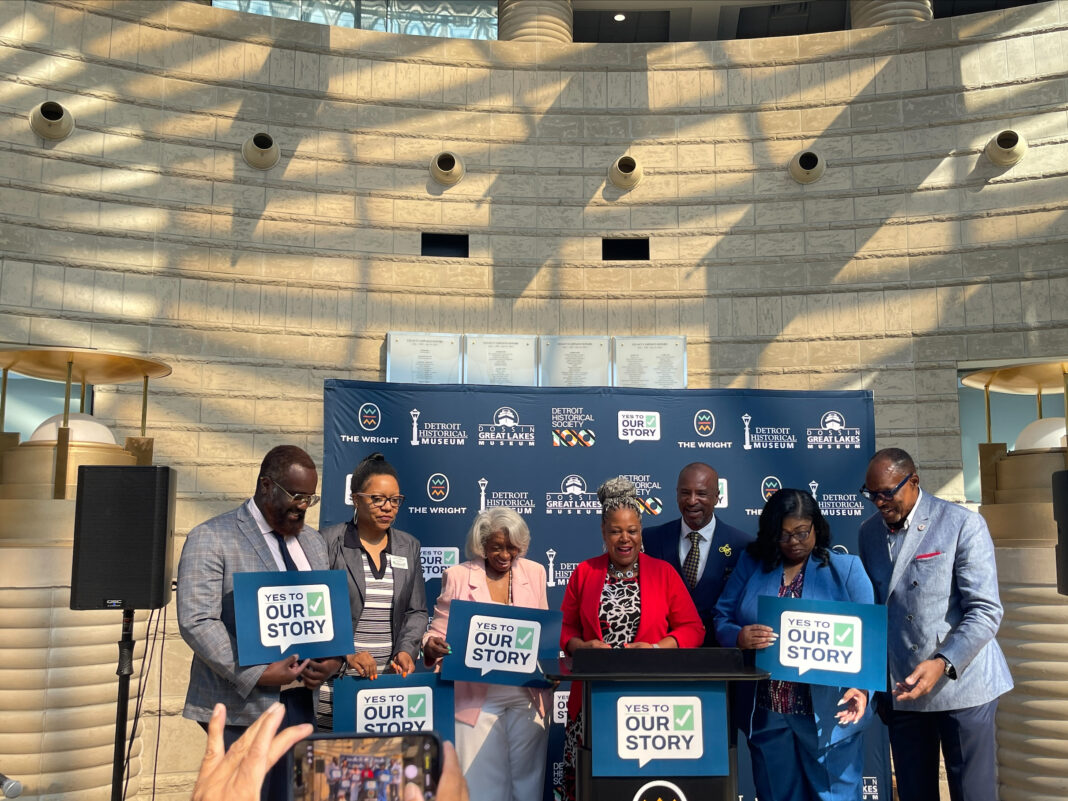
Leadership and supporters of the Charles H. Wright Museum of African-American History and the Detroit Historical Society, which operates the Detroit Historical Museum in Midtown and the Dossin Great Lakes Museum on Belle Isle, say they want to “spend less time worrying about survival” with a proposal that residents in Wayne and Oakland counties allocate a portion of their property tax value toward a fund that would “secure the financial future and stabilize these institutions.” Calling it the “Say Yes to Our Story” initiative, the proposal will be on ballots across the two counties on Election Day.
The proposal calls for 20 cents per $1,000 of taxable value for homeowners in the two counties; leaders at a Wednesday press conference at the Wright framed it as a $30 annual cost for a resident whose home is worth $300,000.
“It’s a reasonable amount — $3 a month – to keep these institutions alive,” Elana Rugh, president and CEO of the Detroit Historical Society, said.
The measure needs approval from 51 percent of voters in both Wayne and Oakland to pass. Should it come to fruition, a 10-year fund would be created to relieve costs of some day-to-day operations at the three museums, a pot for other smaller museums in the two counties to share from, and a boost toward transportation and other resources for students and seniors. Oakland and Wayne residents in turn would be granted free admission to the Wright, Detroit Historical and Dossin museums.
“Both of our institutions have carried this work for decades on budgets that were never served,” said Neil Barclay, president and CEO of the Wright Museum. “This method changes that. It keeps our doors open and free.”
Leaders say they have been working with elected officials in Metro Detroit’s tri-county area for almost a decade toward some solution toward boosting funding – or, as it seems, stemming losses – toward the three museums, all of which are publicly held through a partnership with the City of Detroit Government and governed by the Southeast Michigan Public Museum Historical Authority, a board that has oversight of public museums in Wayne and Oakland counties.
The lone — and now frequent, at least for discussions of these matters — holdout was Macomb County, which dignitaries in attendance at a press conference held Tuesday at the Wright say contributed to why a millage was not placed before voters sooner.
“We have friends from Macomb County, and they’re disappointed,” said Rugh, told the Chronicle in a sideline conversation.
Of the three counties in the region, the museums seeking a funding boost see the least attendees from Macomb. Attendees at Wednesday’s conference emphasized “a focus on Wayne and Oakland,” but did drop some occasional hints as to why Macomb County is not in view here.
Mentioned at least once publicly was the failure to pass a sweeping transit proposal that would have connected the tri-counties and Washtenaw County by adding new rail and bus commuter options along major corridors. The proposal was placed on ballots in all four counties in 2016 and approved by Wayne and Washtenaw residents, but narrowly lost in Oakland. Macomb voters, however, rejected the proposal by a stunning margin, a loss that has continued to loom large across any discussion of civic consensus a decade later.
“Right now, we’re going to focus on Oakland and Wayne counties,” Detroit City Councilman Scott Benson, who has been part of the years-long conversation about the museums’ future, told the Chronicle. “In the future, we’ll talk to Macomb. What they haven’t seen is an opportunity like this.
“Even though we have a history of division in some areas, this is an opportunity for us all to come together, and we’re showing it today,” Benson added.
Privately, some attendees who did not want to be identified pointed to Macomb County residents being less enthusiastic about cultural offerings as their wealthier, older-money neighbors to the west in Oakland, as well as persistent hesitation, or outright reluctance, to fund anything in or related to Detroit proper.
Some on-the-record comments lend to that sentiment.
“Macomb County has been the hardest to get,” Barclay told the Chronicle about support for the Wright. “Just look at the demographics and how many people we have.”
Macomb County suburbs in recent years have seen significant increases in Black residents. Much attention has been paid to Harper Woods, a Wayne County, inner-ring suburb whose population tipped past 50 percent in the last 2020 Census count — NAACP chapter and all. In the same time span, Eastpointe, the suburb once known as East Detroit renamed in 1992 to align with the Grosse Pointes, is now starting to look a little less like a Pointe and a little more like east Detroit, with its Black population rising to 52 percent at last count.
“We’re hopeful in the future. That door is definitely not shut,” Rugh says about Macomb County. “We do have many more visitors from Wayne and Oakland County, but Macomb’s next, right? But you know, there’s a significant difference…and so we had to make that tough decision.”
Macomb County voters did approve a millage alongside their neighbors in Wayne and Oakland to fund a millage for the Detroit Institute of Arts, something Rugh says is indicative for regionwide support of the arts. “I really believe that the residents of our region really do appreciate arts and culture and what we do, and they see the importance of it and its importance to a region – that vibrant cities have vibrant and sustainable cultural institutions in a city center.”
The proposed millage comes at a time when residents in all three counties have been asked frequently to allocate more funds to any public institution, including libraries, schools, public parks, and more. Detroit-area voters this November will also be asked to approve a renewal of funding for the Detroit Zoo. Both Barclay and Rugh acknowledge “we’ve got our work ahead of us,” and that informal polling ahead of Wednesday’s announcement suggested that asking for a modest amount would be appropriate, but not a total solution.
“It really doesn’t work to determine what need to be sustainable long-term,” Rugh says, pointing to a statute that allowed for the formation of the aforementioned dual-county museum board. The same statute allows for museums governed by the authority not only to ask for a millage, but to determine the amount; the three museums opted to ask for the minimum rate on taxable value.
“These institutions have struggled for decades, but we can only go for these millages every two years,” Barclay said. “But I think it’s a time where the polling suggests that people could be supportive of us.
“At this moment, it’s a modest ask. It’s not as big as the other millages, and we’ve been straightforward to the voters,” Barclay added. “And we think it’s also an important time in both the history of this city and of the region to have these institutions preserved.”