
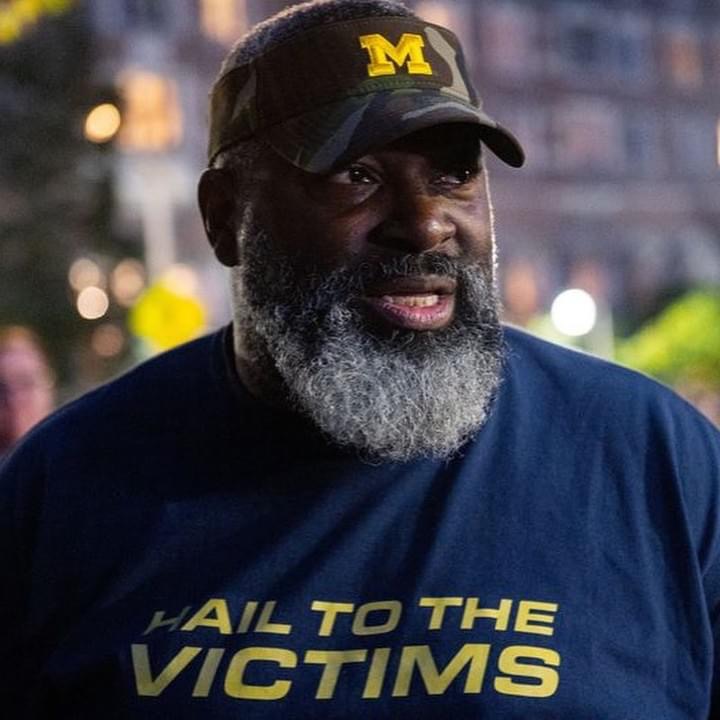


By Jon Vaughn, Guest Columnist
In 2021, I slept in a tent on the lawn outside the University of Michigan president’s house for more than a hundred days in a folding chair that became my office, through an autumn that turned into a winter I had not packed for. I was there because a team doctor had abused more than 2,100 of us across half a century, and because generation after generation, the people who ran that institution knew and decided its name was worth more than the bodies of the students it existed to serve.
I went into that fight knowing who the opponent was. Institutions protect themselves. That is what they are built to do, and anyone who has taken one on learns quickly how it works: the silence, the lawyers, the invitation to talk privately, the slow campaign to make the person asking questions look like the problem.
What I was not prepared for was meeting that same playbook inside the movement that exists to fight it.
I have seen it up close, at a high level of the advocacy world, inside an organization that has now been doing this work for more than two decades. I watched someone in its leadership, one of its most public faces, turn that position against the very people the organization exists to protect. I brought the evidence to the organization. That evidence goes back five years, a quarter of its life. Its leadership chose to protect that person, and to stay silent.
I will not name the people or the organization here. This is not that piece, and some things belong in other rooms. But I am writing because what I saw is not rare, and because it lands hardest on the communities that can least afford it. Ours.
Here is how it works.
The title becomes a shield.
We are taught, rightly, to believe the people who stand up for survivors. That trust is earned by the many who do this work honestly. But the same trust can be borrowed by someone who has learned that “advocate” is the most effective cover there is. Who questions the person leading the fight against abuse? Who audits the one holding the microphone at the rally? The title does what a uniform, a collar or a coach’s whistle has always done in the wrong hands. It puts a person beyond suspicion.
Survivors become currency.
Stories raise money. Access to survivors becomes power over their time, their platforms, their healing, and sometimes their silence. An organization that controls who speaks, when and to whom holds exactly the kind of power over vulnerable people that it was founded to prevent. When that power is not governed, it is only a matter of time before someone uses it.
The person who raises the alarm becomes the problem.
This is the part that should worry every donor and every board member reading this. When someone inside the movement brings forward evidence of harm, the response too often looks exactly like the response of the institutions we fight. Silence first. Then lawyers. Then the quiet suggestion that everyone sit down and talk it through not to address what happened, but to manage it. And if the person will not be managed, the stories start.
False accounts. Questions about character. Whispered doubts about motive. The same tactics used for decades to discredit survivors get turned on the people who defend them.
Credibility is not handed out equally.
I want to say this plainly, because the readers of this paper know it already. When the person raising the alarm is Black, and the person being protected is not, the benefit of the doubt does not fall evenly. Privilege does not have to announce itself to do its work. It only has to be believed a little faster, forgiven a little sooner, and trusted to tell the story first.
Why it hits us hardest
Every community has bad actors. But the damage is not distributed evenly, and the reasons are not mysterious.
In underserved communities there are fewer places to turn. When one organization shows up offering help, it often becomes the only door, and whoever controls the only door controls a great deal. People who have been failed by the police, by the school, by the hospital, by the court, by the caseworker who never called back and the principal who said he would look into it and the emergency room that wrote them down as difficult those people extend a deep, hard-won trust to whoever finally says “we believe you.” That trust is precious. It is also exactly what makes exploitation possible.
We have less access to the tools that expose abuse: lawyers on retainer, reporters who return calls, boards stocked with people who can afford to make trouble. The cost of speaking up is higher for us. The cost of staying quiet is higher still.
Money follows the story. Funders reward the organizations with the most compelling narratives and the most visible leaders. They rarely ask who gets protected when something goes wrong inside.
What we should demand
None of this is an argument against advocacy. It is an argument for advocacy that can survive contact with its own failures. If you give money, time or trust to an organization in this space, you are allowed to ask questions out loud, in the room, with the person who runs it sitting across from you. Here are the ones I would ask.
Who holds power over survivors here, and who checks that power?
What happens when someone on the inside raises a concern and has anyone ever been protected for doing it?
Is there a way to report harm that does not run through the people being reported?
Does the board act on evidence, or manage it?
If the answer to any of these is silence, understand what you have just been handed. Silence in a room like that is not an absence of information. It is information.
Funders, in particular, should start paying for governance with the same enthusiasm they pay for programs. An independent reporting line, an outside review, a board that answers to someone other than the founder. None of it makes a good gala video. All of it protects the people the gala is supposed to be for.
On silence
Some will read this and wonder why I have not said more or named names. The answer is that silence can be a strategy, not a weakness. There are rooms where the truth has to be established before it can be told.
But I will not be quiet about the pattern. I stood outside a president’s house for a hundred days because an institution decided its name mattered more than the people it hurt. I did not do that so our own movement could learn the same lesson.
This work is too important to be protected from scrutiny. Survivors are too important to be anyone’s currency. The people who tell the truth, inside or outside, deserve the same protection we promise everyone else.
Jon Vaughn is a former NFL running back, a survivor advocate for more than thirty years, and co-author of Co-Pay (ABA Publishing, 2027). This is the first piece in the series Weaponized Advocacy.