
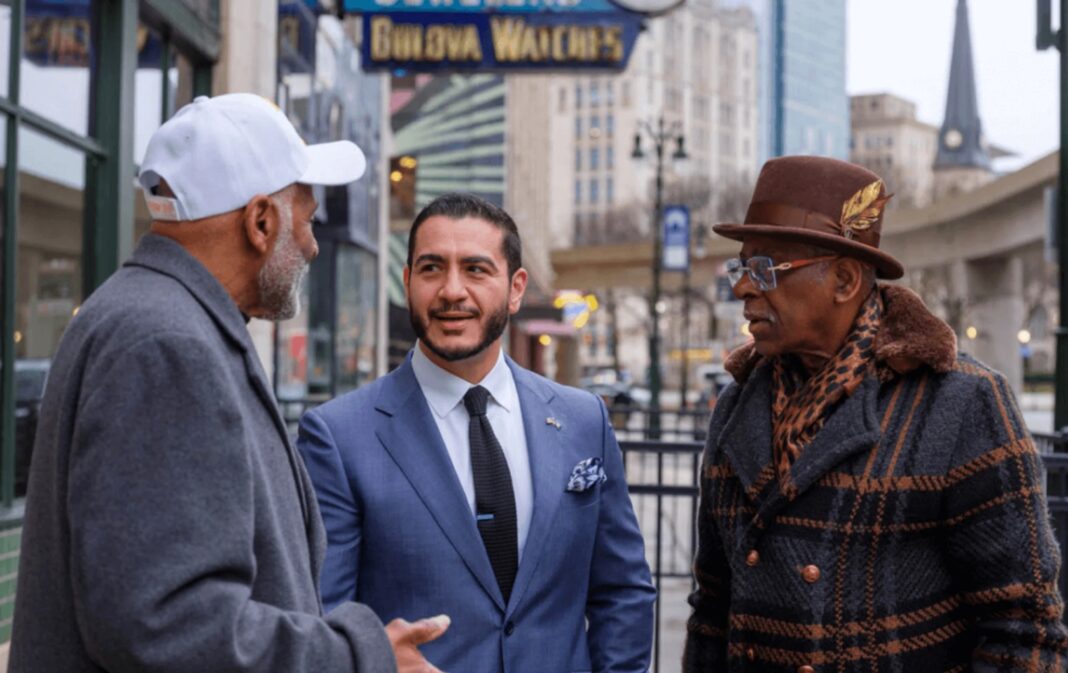

Despite coming out as the statewide winner in the Aug. 4 Democratic U.S. Senate primary election, Abdul El-Sayed didn’t come out victorious in Detroit or Wayne County.
Losing the city and county to his opponent U.S. Rep Haley Stevens sends El-Sayed into the November general election with a clear assignment: he has to find a way to get the state’s most populous county to rally behind him, and a huge part of that is winning over older Black voters.
First, let’s look at the numbers.
The former Wayne County health director won the statewide Democratic nomination with 743,455 votes, or 48.5%, according to election results. Stevens received 727,758 votes, or 47.5%, and state Sen. Mallory McMorrow, whose name remained on the ballot after she suspended her campaign, received 61,407 votes, or 4%. The three candidates combined for 1,532,620 votes.
Wayne County produced 293,464 votes in the Democratic Senate contest. Stevens received 150,593 votes, El-Sayed received 133,292 and McMorrow received 9,320. The countywide result left El-Sayed with 45.4% of the vote, Stevens with 51.3% and McMorrow with 3.2%.
Detroit sits at the center of that electorate. With roughly 700,000 residents in the city, the most recent Census data shows that more than 75 percent of Detroit residents are Black. And across the county, nearly 40 percent of the 1.8 million residents are Black.
Now let’s think about what he needs to do to win that bloc.
His shortcomings with regards to winning over the Black vote led him to link up with Frank Woods, the Chair of the Wayne County Democratic Black Caucus. Woods is hosting a public meet-and-greet with (and for) El-Sayed in Detroit on Aug. 21, from 6:30-7:45 p.m. at 6940 Outer Dr.
Woods said this is the first of what he hopes to be many post-primary public sessions around the county with El-Sayed between now and Election Day because there’s a lot of work to be done to get Black locals on his side.
“He lost, in my view, because of the lies and misconceptions that were put out about him,” Woods said in an interview with Michigan Chronicle.
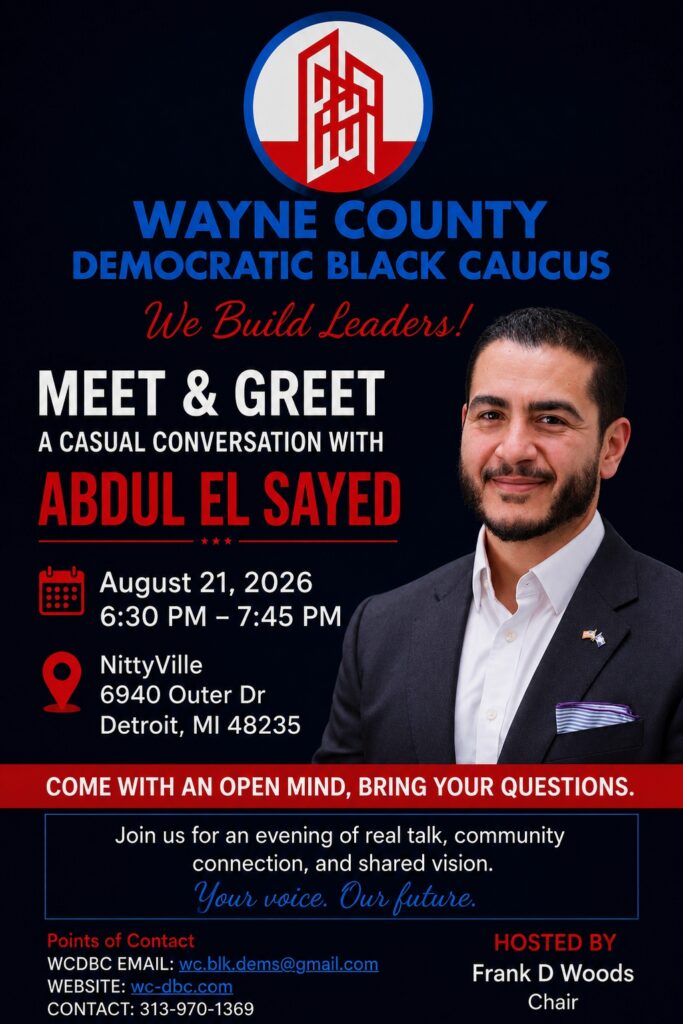
Woods said some of the resistance to El-Sayed during the primary involved claims about his positions and relationships. He specifically cited what he described as misconceptions involving former first lady Michelle Obama and former President Barack Obama.
“They said that he disrespected Michelle Obama. That was a misconception. Let’s put it that way. They said (Stevens) was endorsed by President Obama. That was a misconception, too. For some people, that was all they needed to hear. And that was not true. She never received his endorsement,” he said.
Woods also cited claims that people thought El-Sayed would impose religious policies on Michigan.
“They said he’s gonna have this Sharia Law and that he’s gonna do all these different things that is against our community, instead of finding out what he’s done and what he’s working on doing.He’s from our community. He understands our needs.”
Woods said political education has been a central priority since he took over the caucus.
“When I took over the black caucus, one of the things I want to make sure is that we have real good political education, and not just knee-jerk reaction to articles or things they hear on TV. It’sabout getting involved in the political process.”
Woods has known El-Sayed through his previous political campaigns. He said El-Sayed asked for his personal endorsement when he announced his Senate campaign.
“And so I told him, I endorse you personally, but I can’t get ahead of my caucus.”
Woods said the caucus then followed its own endorsement process, interviewing El-Sayed, Stevens, and McMorrow.
“When we started the endorsement process, we interviewed all three candidates – McMorrow, Stevens, and El-Sayed. He came out on top. It wasn’t even close when you sit down and hearwhat he has to say and what he’s about. We want to make sure we present that and give people the opportunity to know who he is,” Woods said.
The Aug. 21 event is open to the public and Woods has been making sure community stakeholders and caucus members have the information to inform other Wayne County residents about El_Sayed.
“I’ve been doing this stuff for 40 years. I want to make sure a lot of key stakeholders show up – the ones that I’ve been known in the community.”
Woods described the gathering as an opportunity for people to hear directly from El-Sayed and ask questions.
“It’s not a long period of time to talk to or to have everybody have 1,000 questions, but you’ll at least be able to get a sense of who this man is and understand why you should vote for him,”Woods said.
The effort comes after a primary campaign in which Black voters became a central focus of the Senate contest. A Detroit News/WDIV poll released in July showed Stevens with a 67%-21% advantage among Black voters.
CNN also reported extensively on the contest for Black voters in Detroit and Michigan, including a July 27 report that described El-Sayed as having a long list of Black supporters. In that report, El-Sayed attributed Stevens’ advantage among Black voters to advertising.
“It’s what $60 million in advertising does,” El-Sayed told reporters after a church visit. “There’s a reason they spend that money.”
El-Sayed also addressed his relationship with Black communities in a July 24 report from WDET examining the Democratic Senate primary. The station reported that the demographics at an El-Sayed rally featuring U.S. Sen. Bernie Sanders and Rep. Alexandria Ocasio-Cortez did not reflect Detroit’s majority-Black population. El-Sayed pointed to his professional history in the city and county.
“I’ve chosen to work in communities like Detroit and Wayne County, majority Black communities, to take on inequities my whole career,” El-Sayed said, according to WDET.
Woods said that history needs to be part of the conversation.
“We have to do a better job of getting your story out – we, as a Black people who support him. He is coming to our meetings. He spoke, he talked to people and shared his vision, and we needmore of that. But being involved is more than just voting. This whole thing – it’s a participation sport.”
For Woods, the relationship between candidates and voters extends beyond Election Day.
“If we don’t participate from the beginning, we do ourselves a disservice.”
Woods also said El-Sayed needs to approach Black voters directly and recognize that support has to be earned.
“He doesn’t take it for granted. That’s for one, he knows he has to earn our support.”
“Is it going to be difficult? Yes,” Woods said. “But when we line up what he’s up against –Mike Rogers – there’s a clear difference. And we should be supporting Abdul, not because he’s aDemocrat, but because he’s the right person to do the job, and he’s a Democrat.”
The Aug. 21 gathering will also give Woods an opportunity to continue the political education work he described as a priority for the caucus. He said voters should have conversations about candidates before making decisions.
“We have to be more strategic, and we used to be be more strategic. We used to go find out who we were voting instead of just relying on name recognition. That’s what we’re getting back to with this.”
He also connected the discussion to the Democratic Party’s changing political landscape.
“I’ve been telling people in the party that we have got to quit this gatekeeping status quo attitude. We have a mechanism to actually get the information to people through the caucuses and through meetings to say, hey, let’s have this discussion.”
Woods said Black voters should have a role in shaping the Democratic Party and its candidates, and said he is welcoming of the changing dynamics at play as the party shifts to a more progressive platform, as proof with the selections of both El-Sayed and 13th District winner Donavan McKinney, a self-described Democratic Socialist.
“We definitely have to make sure our voices in African Americans are heard within the party structure, and not just as mouthpieces,” Woods said. “I’m here I’m representing the Black people, but I also want the rest of the Black residents in the county to show up and represent Black people, too.”
He said the work ahead involves listening and participation.
“We need to not just say we recognize these other communities within our party, we have to actually work with and listen to the people within this party.”
For El-Sayed, the Aug. 21 appearance is an opportunity to continue a conversation that Woods said began before the primary. For the Wayne County Black Democratic Caucus, it is part of a larger effort to put political education, direct engagement, and community participation at the center of the 2026 election.
“El-Sayed needs to be our next senator, and we’re gonna be doing more with him going forward until Election Day to ensure that Black people in Wayne County know who he is, what he stands for, and they feel comfortable enough to go to the polls and give him a vote in November.”