

Healthcare access in Detroit has never been only about whether services exist. It has also been about whether people can get to them, afford to take time away from work, find childcare, secure transportation, or move through systems that too often feel built to keep everyday residents waiting.
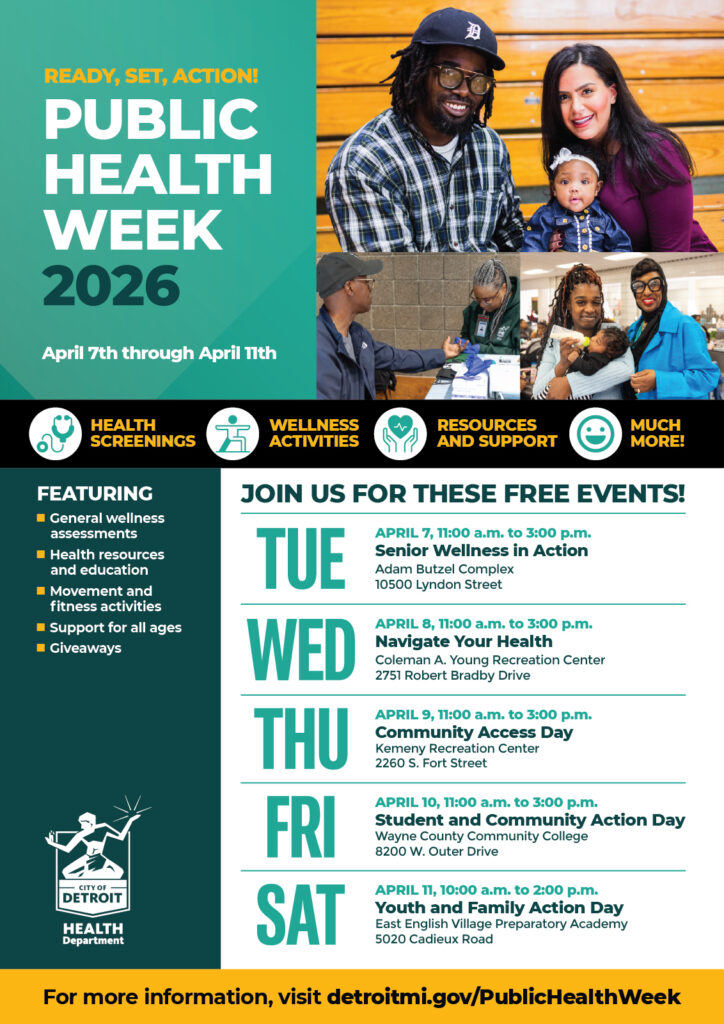
Public Health Week 2026, now underway across Detroit from April 7 through April 11, is being framed by the Detroit Health Department as a direct response to that reality.
This year, the department is bringing free public health services into neighborhoods across the city, setting up at recreation centers, Wayne County Community College, and partner sites so residents can get screenings, immunizations, overdose prevention resources, lead testing, and vision and hearing screenings without an appointment and without identification.
That matters because preventive care only works when people can actually reach it.
Held as part of National Public Health Week, this year’s local theme, “Ready, Set, Action,” centers prevention, early detection, and access. It also marks Chief Public Health Officer and Director Ali Abazeed’s first Public Health Week leading the department, with a citywide push that places proximity at the center of public health strategy.
“Public health only works if it’s close to people’s lives,” Abazeed said. “That means showing up in neighborhoods, removing barriers, and making it easier for Detroiters to access care. Public Health Week is both a call to action and a recognition of the public health workforce, especially the staff of the Detroit Health Department, whose daily work makes a healthier city possible.”
Public health cannot be treated like an abstract policy conversation while residents are still navigating preventable barriers to basic care. A screening does not help much if somebody cannot get across town. An immunization clinic does not mean much if a family has to miss work, find a ride, or produce paperwork they do not have on hand. Bringing services into trusted neighborhood spaces shifts that equation.
No appointment requirement. No identification requirement. No cost.
Those details may sound small on paper. For many Detroit families, they are the difference between getting care and putting it off again.
Throughout the week, residents will be able to access a range of services while also connecting with healthcare providers and community partners. Family-friendly activities are also part of the programming, creating a more welcoming environment for residents who may be coming for information, preventive care, or support resources for the first time.
That broader design reflects a deeper understanding of how health actually works in a city like Detroit. Health is not only shaped inside hospitals or doctor’s offices. It is shaped by housing conditions, environmental exposure, transportation, neighborhood infrastructure, and whether people can get help before a crisis deepens. Lead testing, overdose prevention, hearing screenings, vision screenings, and immunizations all sit inside that larger reality.
Detroit Health Department officials are presenting Public Health Week as more than a one-week outreach campaign. The effort reflects a broader approach to building a healthier city by bringing services directly into neighborhoods while improving coordination across city departments and community-based partners. That approach recognizes something Detroiters already know well: health outcomes are tied to the conditions people live with every day.
That includes the quality of housing. That includes environmental risks. That includes whether families can identify health concerns early enough to act. That includes whether public systems are designed to meet people with dignity instead of delay.
Public health work often goes unseen until something breaks. A virus spreads. A child gets poisoned by lead. An overdose happens. A chronic condition worsens because treatment came too late. Public Health Week offers a different model, one built around prevention instead of reaction.
By taking services into recreation centers, campuses, and neighborhood partner spaces, the city is also making a statement about trust. People are more likely to engage when care shows up in places that already feel familiar. That does not solve every structural issue facing Detroit’s healthcare landscape, though it does move public systems closer to the people they are supposed to serve.
That proximity matters.
A healthier Detroit will take more than one week of events. It will take sustained investment, responsive systems, and continued attention to the barriers that still shape who gets care early and who gets left to wait. Still, this week’s effort offers a visible example of what it can look like when the city tries to meet residents where they are rather than asking them to keep navigating around obstacles.
Detroit residents looking for the full Public Health Week schedule and more information can visit DetroitMI.gov/PublicHealthWeek.