
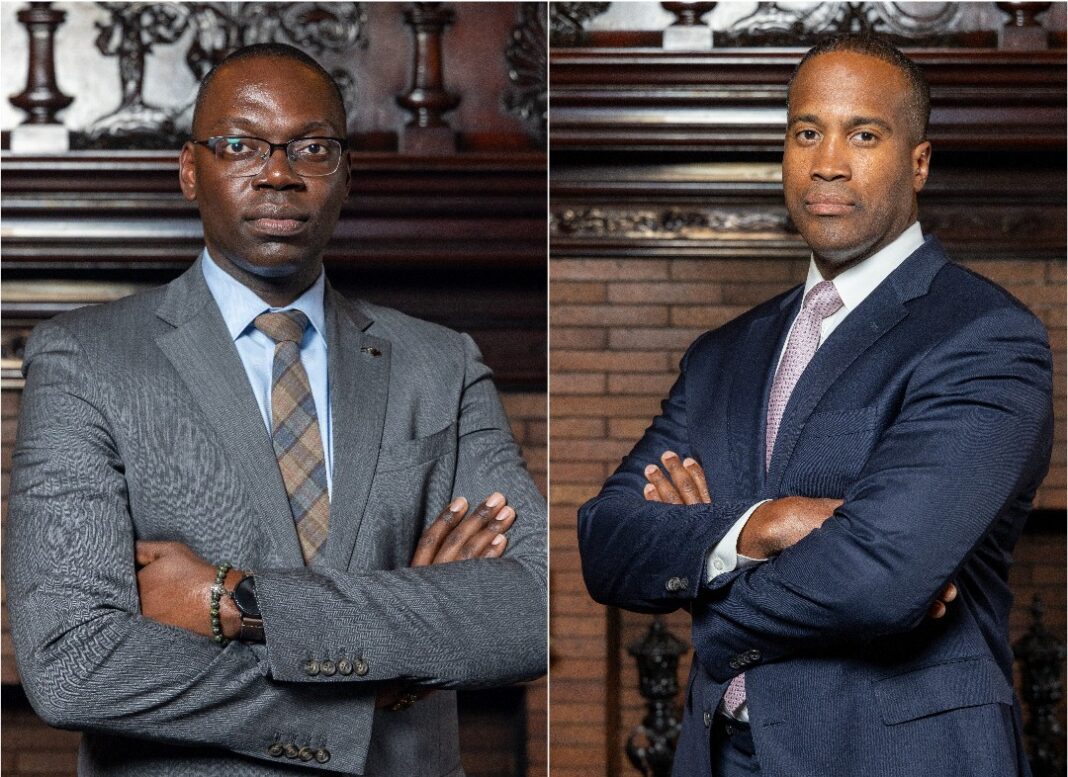

U.S. Rep. John James and Lt. Gov. Garlin Gilchrist would both make history with successful campaigns for their respective races governor and Secretary of State.
Both are Black men who grew up in Metro Detroit. But that might be where their comparisons end, because they hold much different perspectives.
James is a conservative Republican trying to prove to Michigan voters who are loyal to President Donald Trump (who has yet to endorse him) that he’s the best candidate to take on Jocelyn Benson, the presumptive Democratic nominee, or Genesee County Sheriff Chris Swanson.
Gilchrist is a Democrat who ended his own campaign for governor to instead run for Secretary of State, an office that has already seen a Black man at the helm when Michiganders elected Richard H. Austin in 1971. It’s the only statewide executive office ever held by a Black person in the history of Michigan’s government, and Austin held that seat for 24 years.
Should either win their elections it would mark historic wins for African Americans in state government this century, as fewer than 10 Black Republicans have ever been elected to state-level positions in Michigan history.
Kentucky Gov. Andy Beshear told Michigan Chronicle last month he believes that the difference in the 2026 elections will be whether Black voters show up at the polls.
“I believe that Black voters are going to be absolutely critical in ’26 and ’28, and that means the Democratic Party can’t take them for granted,” Beshear said. “I believe that a candidate like me — well, a governor like me — who will never be able to feel the pain of discrimination, will never be able to feel the scars left by the legacy of slavery and Jim Crow, needs to make sure he’s always surrounded by the right leaders.”
There have only been three Black governors in the history of the United States; Virginia’s L. Douglas Wilder, elected in 1989, Deval Patrick of Massachusetts elected in 2006, and Maryland’s Wes Moore, elected in 2023.
Michigan Democratic Party chair Curtis Hertel told Michigan Chronicle earlier this year that the party opened an office in Detroit with the goal of increasing the number of Black candidates for the many seats that are up for election this year and in years to come.
“We’re trying to build people from the ground up in so that we’re making investments early in people. And that’s what has to change,” Hertel said. “I think that for far too long, the people have a right to feel ignored. We showed up to Detroit (in 2024) a month before an election and asked people for their votes. To me, that wasn’t actually authentic. It wasn’t real, we weren’t part of their communities. We have a lot of work to do in that regard.”
James’ Throughout the Years
James Jr., a graduate of Brother Rice High School, who lives in Shelby Township, has deep roots in Metro Detroit.
His father, John James Sr., challenged discriminatory practices that kept African Americans out of the trucking industry, which brought on regulatory changes that opened the door for Black-owned businesses.
James Sr. currently sits on the Charles H. Wright Museum of African American History board as a member Emeritus.
“My father grew up across the street from Mississippi State & couldn’t attend the school because he is black,” James said in a post to Facebook last year. “Today, his son is the only black Congressman representing Michigan in our nation’s Capitol.”
He’s used his family history in campaign stumps in front of Republican crowds before.
But James has also received criticism from Republicans for the way he talks about his family history, identity, and connection to an era of this country in which Black people did not have the same rights as others. He received criticism from some in posts to social media honoring civil rights icon Jesse Jackson after his death earlier this year is filled. He’s also made comments sympathetic to Black Lives Matter protestors during the 2020 social justice movement.
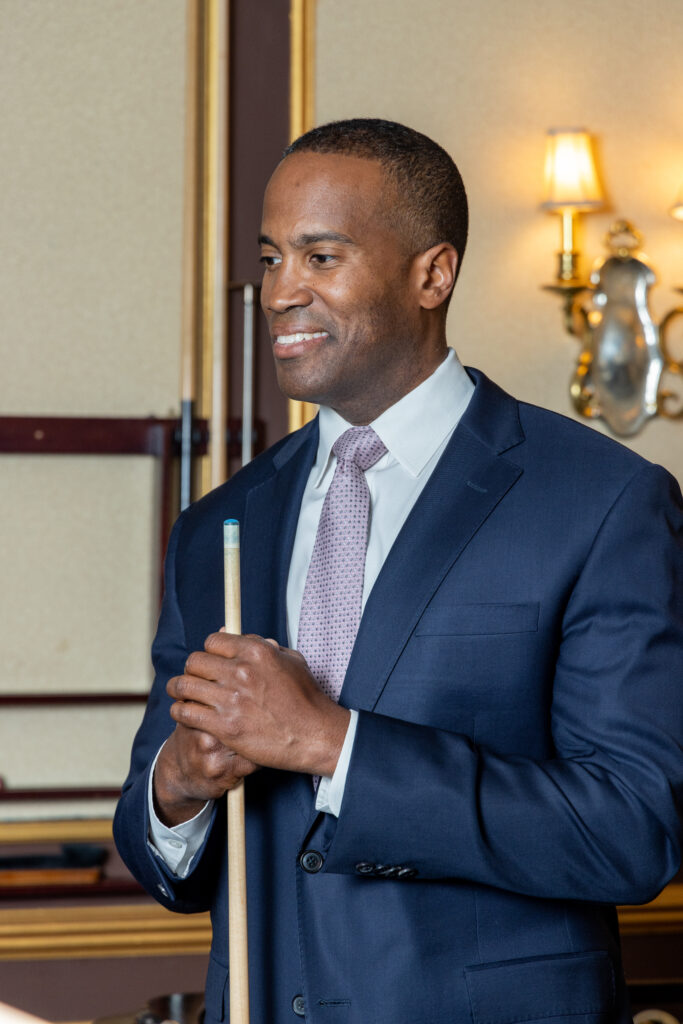
“America is a nation built by swollen hands on stolen lands,” James told WDET in the height of the protests, saying he was quoting Pharrell Williams.
James has also made comments during his campaigns that attack “wokeness.”
That term – which refers to the understanding of racial injustice and inequality –for the past decade has been deployed by Republicans as a pejorative for progressive values.
Republicans have been taking aim at voter protections from the Civil Rights era, gutting the Voting Rights Act this year allowing Republican states to redraw their political maps to do away with Black majority voting districts. Some conservatives, including James, were hostile to liberal Black Americans in May 2020, arguing protests against police brutality were attacks against police. Republicans and some moderate Democrats blasted those who were sympathetic to calls to defund police departments in major cities.
And in November of 2020, many Republicans, led by President Donald Trump, accused Black cities without evidence of somehow rigging the presidential elections in favor of former President Joe Biden, who won the 2020 election decisively.
“Woke don’t work,” James said on social media in 2022. “It’s not about black or white. It’s about red, white and blue!”
The pushback against race-conscious ideology has led to restrictions of race-related content in Republican states across the country like Oklahoma and Florida, which rejected an AP African American history course in state high schools and bars public universities from using resources toward Black identity groups.
James’ comment was a reaction to a Newsweek cover that showed several prominent Black conservatives like Herschel Walker and Candace Owens.
James is the first African American elected to the U.S. House of Representatives to serve Macomb County. In 1970, Macomb County’s population was approximately 625,309, with 1% identifying as African American (roughly 6,253).
In 2023, the U.S. Census Bureau reported Macomb had a population of 875,101 people, with 14.1% identifying as African American (approximately 123,389).
James’ campaign for U.S. House in 2024 followed a pool of Black Republican candidates that ran to be elected in 2022; James Craig, Austin Chenge and Articia Bomer, Trump-endorsed Secretary of State candidate Kristina Karamo, and state Rep candidate Daylen Howard.
“We’re fit to cheer but not fit to lead,” says Wayne Bradley, the former MIGOP Black outreach director, who left the party over his disagreements with President Donald Trump. “It appears like we’re here to give our support, but we’re not here to be the leaders of the other party.”
Bradley, now a consultant in Southfield, says he’s considering voting for James or former Detroit Mayor Duggan for governor.
Bradley believes James’ rhetoric that has pushed Black Democratic voters away has been shaped by the Trump era. Without having to worry about what the president does, he’d be more popular with voters on the other side of the aisle, Bradley suggested.
“John’s experience with politics has been where he’s shown that Black folks, in certain ways, are against him,” Bradley said. “So, he doesn’t necessarily trust folks the way, you know, he should.”
James’ father is one of the most successful Black business owners in Southeast Michigan, Bradley said.
“John’s dad is awesome — someone I can relate to in terms of his come up, his dad and my dad are close in age,” Bradley said. “He does a lot of stuff quietly for the Alpha House in Detroit, he’s what I would call 10 toes down.”
Gilchrist’s Bid at History
Gilchrist graduated from Farmington High Schol and has spoken about how race shaped his experiences, growing up in and being profiled by police in the affluent suburb.
Gilchrist, the first Black lieutenant governor, suspended his campaign for governor in January to run for Secretary of State instead.
Gilchrist would be the second Black Secretary of State in the history of Michigan.
Austin served in the position from 1971 to 1995. His administration as Michigan Secretary of State has been highly acclaimed for operational innovation and efficiency.
Austin was the first Secretary of State in the United States to create a program that allowed people to register to vote when getting a driver’s license. Austin was class valedictorian from Detroit’s prestigious Cass Technical High School and went on to become Michigan’s first African American certified public accountant.
Other states soon began adopting so-called “motor voter” laws. In 1993, Congress made his innovation a national law. He was re-elected five times, making him the longest-serving secretary of state in Michigan history.

“Unless you’re, like, a political nerd who cares about voting rights you probably don’t know who he is,” said Branden Snyder, the leader of Michigan’s Working Families Party, a national group that backs grassroots candidates rooted in social justice.
Snyder says either James or Gilchrist being elected would be important for the next generation of Black candidates, proving that they can win.
“If John James won, I’d have more questions than answers, but Black folks haven’t really been afforded a lot of those opportunities to run the statewide ticket, right? And, you know, we just had this entire debacle, particularly on the Democratic side, with Aghogho Edevbie and Garlin being knocked out of their two races. Garlin’s win would make the argument, at least on the Democratic side, that Black folks can run and win.”
The First Black Gubernatorial Nominee
Bill Lucas was the first Black person to receive a party nomination for governor, winning in the 1986 Republican primary. He was defeated handily by Democratic Gov. James Blanchard.
After a stint as an FBI agent, Lucas became a Wayne County undersheriff and eventually was appointed sheriff to fill a vacancy. He was twice reelected after being elected Wayne County Sheriff in 1970.
Lucas also won an election in 1982 for county executive, a new position at the time.
Republicans thought Lucas could get votes in Wayne County, where he was from. However, Blanchard won in a landslide.
“Bill (Lucas) should have stayed a Democrat, but he got talked into it by some Republicans and destroyed his credibility,” said Keith Williams, the chair of the Michigan Democratic Party’s Black Caucus.
Lucas, who passed away in 2022, remains the only Black gubernatorial candidate to earn either party’s nomination to make it to a general election.
The election of either Gilchrist or James would be historic. Both appear to be frontrunners of their respective parties for their respective campaigns. Michigan voters will decide their outcomes in about 10 weeks.