
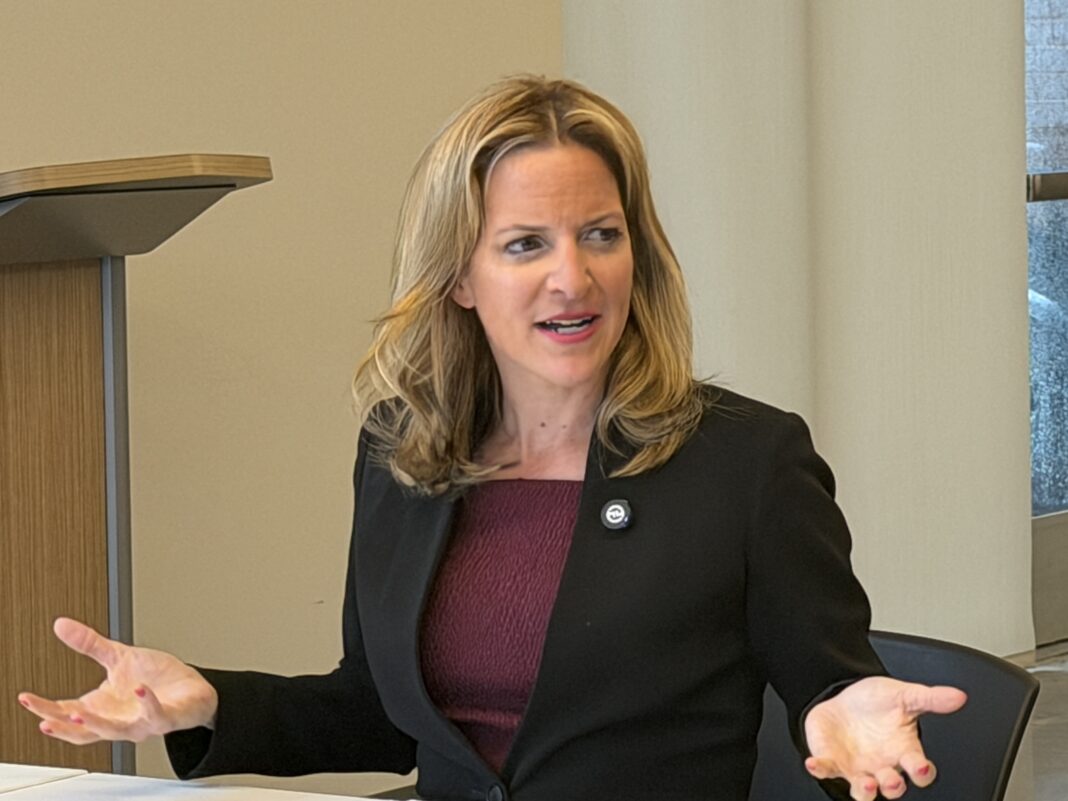

Secretary of State Jocelyn Benson is quickly consolidating Democratic support for her run for governor, but still faces tough questions from some within her own party.
Specifically, on the matter of data centers, and whether she can remain impartial while her husband’s company cashes in on the rapid expansion of the IT infrastructure warehouses in Michigan and across the country.
Ryan Friedrichs, a vice president of the company pushing a new Oracle and OpenAI data, center, recently terminated his lobbying license and announced he would recuse himself from any state related projects if Benson is elected governor.
In an interview with Michigan Chronicle last week, Benson said spouses don’t always agree and that she was pleased with Friedrichs’ plans to step into a new role with the company.
Development firm Related Companies is owned by billionaire Stephen Ross, who has donated to Benson’s campaigns.
“Thank you again to all of our community, state, regional, and national partners who worked tirelessly with us this year, and will into the future,” Friedrichs posted on LinkedIn last year in response to the announcement of the 1-gigawatt data center campus in Washtenaw County.
The relationship raises concerns over a potential conflict of interest for Benson’s potential administration.
“This is the largest economic investment in Michigan’s history – Ryan has been a valued member of our team working on community and stakeholder engagement,” a spokesperson for Related Digital told Michigan Advance. “Our plan is to begin full construction at the end of this year, and regardless of who wins the governor’s race and is sworn in come January 2027, we are not aware of any aspects of the project that would then be before the new administration for consideration.”
The other elephant in the room of Benson’s campaign is the $775,000 settlement her office doled out to former department director Angela Harness, after she filed a notice of intent to sue the department.
A racial discrimination lawsuit filed by four Black plaintiffs against the Michigan Department of State, which Benson’s spokespeople have called “absolutely false,” accuses the department of not having clear guidelines over state vehicle use and performance plans. The plaintiffs say the office cited unclear rules for disciplinary actions in an inconsistent way with other employees of different races/ethnicities.
The MDOS did not admit to wrongdoing, but said it settled as a was a way to avoid the cost of litigation.
Harness claimed in a written testimony that Benson’s chief of staff in 2023 reduced her authority and responsibility within the Bureau of Customer Service. Harness said the department treated differently “similarly situated White and male coworkers” and the decision was part of “a pattern and practice of unlawful racially discriminatory employment practices against its African American employees.”
Republicans have already pointed to the lawsuit, which names Benson and several state government subordinates, in attacks against her campaign to be Michigan’s next governor.
Gov. Gretchen Whitmer will finish her second four year term at the end of this year and cannot run again due to term-limits.
Benson, who has lived in Detroit for two decades, also faces a challenge from her former mayor, Mike Duggan, who is running for governor as an independent. Duggan, who left the party following the 2024 presidential election, is expected to earn a significant amount of his support in November from Southeast Michigan Democrats, including some who have supported Benson in the past.
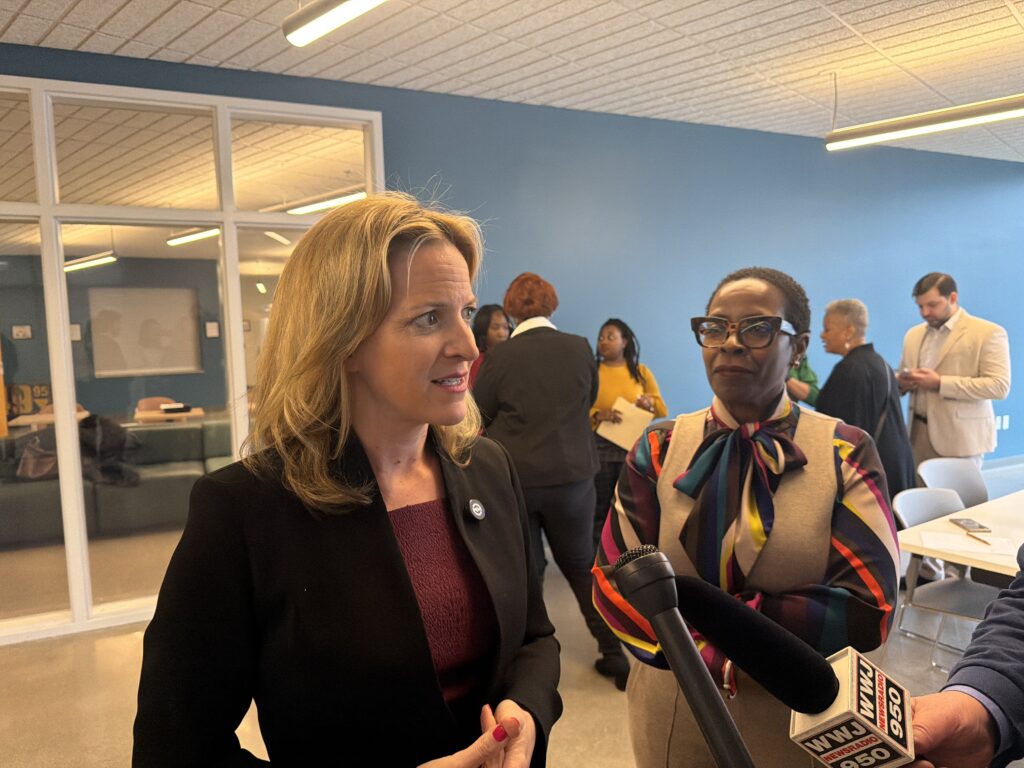
Question: Your critics point to your husband’s job at Related, a company part of the effort to build a massive data center in Saline, as a potential conflict of interest if you were to become Michigan governor. Is it?
Benson: “Number one, not everyone agrees with their husband, but that said I really appreciate his new role now, which is not going to be working in Michigan and working on affordable housing. I think he’ll continue to do good work as he’s always tried to do in any position he’s held. For me personally, I think the unchecked growth of data centers clearly, though they do bring well paying union jobs to the states that they come to, their unchecked growth clearly can damage the environment and the economy. The role of state government is to check that growth. To say, for example, you can’t come to our state if you’re going to use our water, you can’t built here if you’re going to only drive up energy costs, you actually have to show your plan to drive down energy costs, to invest in modernizing the grid and enter into community benefits agreements. If you’re going to build in a community, that you’re going to assure residents you’re going to invest in reducing the cost of living, improving their quality of life. If local residents, through a rigorous, transparent process, then allow data centers and the jobs they create, the union jobs they create, to come to their cities. Who am I to step in the way of that? But certainly, as a governor, I’ll be there to check or curb the growth of centers that would use our water or abuse our environment or otherwise drive up costs for Michiganders.”
Question: Why do you think you received the early support of lefty progressives like state Reps. Dylan Wegela, Emily Dievendorf or Tonya Meyers Phillips, despite Lt. Gov. Garlin Gilchrist’s campaign, which took on a more progressive framing?
“They’ve known me for a really long time. I was in church basements in Detroit organizing with Tonya Myers Phillips 20 years ago to help people caring about voting rights here in Detroit and around Southeast Michigan. So people who know my heart know that every decision I’ve ever made outside of public life and has tried to as Secretary of State, has been focused on economic justice and continuing the unfinished work of the Civil Rights Movement. For a lot of our progressive lawmakers, I also just really just value their voice. A lot of times, there are efforts through an effort for unity or something else, just sort of like asking members of our own party to not speak out against something or disagree with us. I welcome disagreement, I welcome that type of debate and conversation within our own party. I sat down with Dylan early on long before I was running for governor when I saw how committed he was to speaking his truth, and said, ‘Thank you.’ Because you need to keep doing that. We may not always agree, but I will always stand with you and hear you and listen to you and respect what you’re saying, because he’s coming from a genuine desire to serve his community well. There are far too many people in politics who curb what they say to go along or to do the political thing instead of doing the right thing. Whether I disagree with someone or not, if someone was acting with moral courage and with integrity and trying to do the right thing, I’ll always make sure their voice is heard and that they have a seat at my table. That’s why to me, frankly, their support means so much. But I will always support their leadership and their efforts to represent their districts and their views effectively.”
Question: Michigan Democratic Black Caucus chair Keith Williams said last week that ‘People want to get with Jocelyn, but they’re afraid of Mike.’ Williams said this in response to learning that Dennis Archer Jr., who moderated two conversations with you when you were promoting your book, is hosting a fundraiser for Mike Duggan’s independent campaign for governor. You and Duggan are familiar with each other — your husband used to work for him. Does it ever get awkward? How are you navigating those relationships?
Benson: “I think what we’re lacking right now oftentimes in politics is not just a desire to get things done, but real moral courage. Folks will stand up and speak out and stand with folks who are doing that same, and that’s how I’ve always tried to lead… One of the biggest distinctions I see in this race is who is funding who, and that I think will become more and more apparent to folks as we move forward. I’ve been proud to not take any corporate money — I’m running against people who are entirely funded by billionaires and corporations and that contrast is ultimately going to drive who we’re beholden to and what we represent. I also believe in this moment, this is my fourth statewide campaign, that the Democratic Party has a lot of work to do to ensure we are restoring our soul. Adn going back to that party that I joined, which is the party of the Voting Rights Act, the party of the Civil Rights ACt, the Fair Housign ACt, Medicare, Medicaid. So, for me, when I see a challenging moment, I don’t run from it and try to change who I am, I actually run towards the fire and try to put it out and try to rebuild something better. That’s why I’m running as a Democrat and I am working hard to lead this party in a way that helps us rebuilt and restore who we are. People will go back and forth and I’m proud to be leading in the primary race, and with that comes a responsibility to ensure our Democratic Party is truly showing up for everyone, moving the needle, getting things done. That’s what I think we need to do not just in this race but across the country in this election cycle.”
Question: Are you starting to hear from voters about the racial discrimination lawsuit against you and your office?
Benson: “What I hear from people is how hard they’re struggling to pay their bills, and how much they know that in my office, we actually have made their lives easier and what occupies my mind, even in this noisy political environment is that it is oftentimes like you’re walking through a fire. Everyone’s throwing stuff at you, everyone’s trying to tear you down as much as people are supportive and lifting up. But through this fire, what’s clear to me every day is the mom of four kids who’s going without healthcare because she can’t afford the premiums, the teachers who are my son’s teacher, who can’t buy a ome in the community where she’s teaching. That’s real life stuff, and I don’t know what we’re doing if we’re not showing up every day trying to see those struggles and do something about it. When I stay focused on that I’m good, because that’s my spirit. That’s the folks at the foot of the Edmund Pettus Bridge, who weren’t worried about the attacks. Viola Liuzzo, one of my heroes, who went to Alabama and was killed after the march— her family was attacked and she was ridiculed. It’s never lost on me that standing up for what you believe in and really fighting to change an oppressive system means you walk through the fire and get attacked, even from folks you think would be walking there with you. That’s what the people of the Civil Rights Movement teach us, that’s what Judge Keith showed every day.”
Question: You’ve been a proponent of government transparency, in ways some Democrats have not. One example is your suggestion that the spouses of lawmakers should be required to disclose financial information. If you’re elected governor, will you subject your office to public records requests?
Benson: “I don’t know any other way to lead an institution other than to be FOIA compliant, so I’m not going to change things now just because the law doesn’t require it. I’m going to do it proactively. I’ll require every department to do it and I’ll call on our lawmakers to do it as well. The more sunlight, the more transparency, the more education the more people can actually get done for the people, I’ve seen.”