
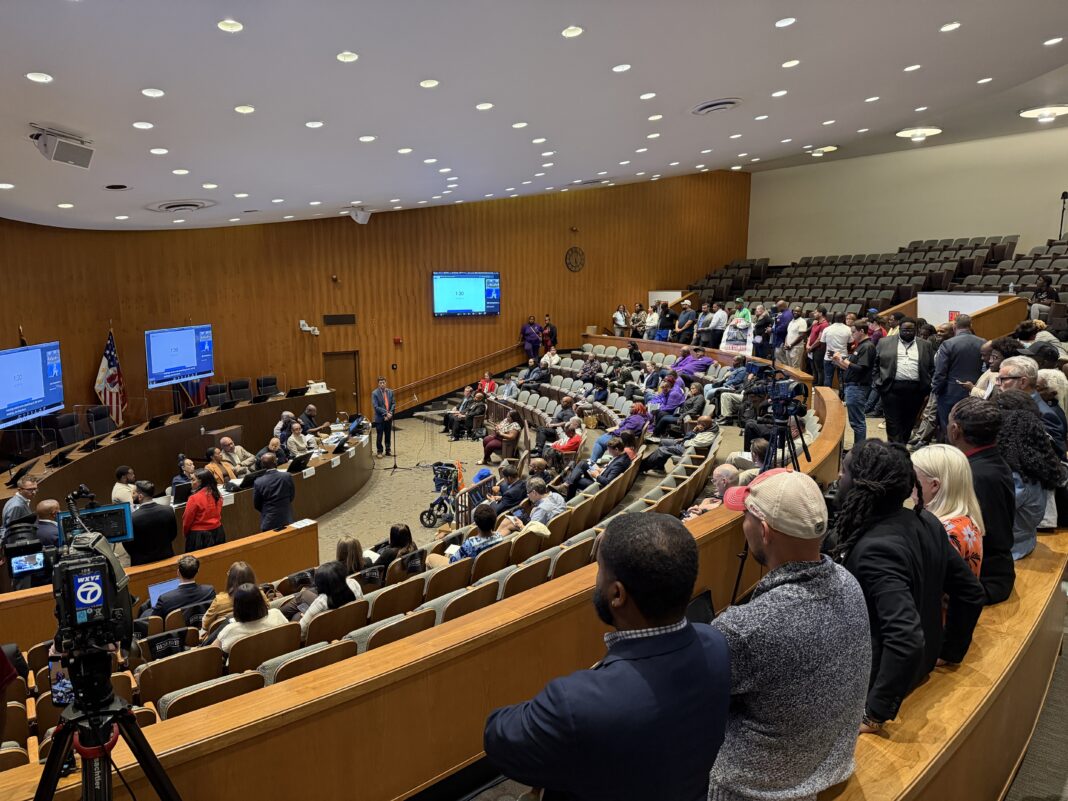

Bedrock and General Motors are asking for $472 million in public money for the $2.2 billion redevelopment of the Renaissance Center downtown.
Tearing down the two buildings closer to the riverfront would cost $1.6 billion, and the development of an entertainment park on what is currently more than 30-acres of surface parking lots would cost $664 million, officials said on Tuesday.
The $472 million would be in addition to $75 million from the Downtown Development Authority, making the total ask $548 million.
Officials working to support the project say incentives are necessary because of increases in construction costs and high city property taxes. A presentation detailing the incentives happened inside the Erma Henderson Auditorium Tuesday by Bedrock and the Detroit Economic Growth Corp. (DEGC) the city’s economic development agency, a 501-c4 that operates independently of city government.
David Howell, a DECG official speaking Tuesday said the proposal wouldn’t make enough money to pay back its debt, and that it wouldn’t get backing from lenders without using public taxpayer money. Howell said the project would bring a $301.5 million in net fiscal benefits to the city over a 30-year period. They said it would generate $3 billion over the same period.
Bedrock has pitched a vision of a new Renaissance Center that would anchor a thriving riverfront, similar to Chicago’s Navy Pier.
Council Pro Tem Coleman Young II, who’s dad became mayor as the Renaissance Center was first constructed, has said it would be exciting to bring his father’s vision for affordable housing to exist within the riverfront complex.
“What is the purpose of preserving this abandoned building with nothing in it?” Coleman Young II said last year. “I think the plan that Bedrock has laid out, the vision they have, the jobs, we need an analysis on the wages and how it will impact the economy. Once we have those type of statistics we’ll keep going.”
Detroit’s Community Benefits Process, which requires developers seeking tax incentives for large projects over $75 million.
How we got here
The plan was first revealed in November 2024.
Council members in March, 2025 voted 8-1 to reject the historic designation of the Renaissance Center, sought by a lone member, District 2 council member Angela Whitfield Calloway. The designation would have complicated GM and Bedrock’s goal of demolishing two of the towers that surround the multi-building complex.
At the time, Calloway echoed sentiments from members of the public who opposed the redevelopment plan. She recalled childhood memories shopping in stores throughout the Renaissance Center and going to the movie theatre it once housed.
“I am not anti-development,” Calloway said. “I grew up in this city. I enjoyed visiting the towers, I enjoyed how I recalled the maze, it was kind of hard to navigate… When you go downtown all you’re going to see is cookie cutter, Lego block designs. We are destroying our history. Why can’t we look at modernizing structures?”
The community benefits process has not always been a pleasant one for developers seeking public money for their large projects. Members of the public during the process in 2023 have slammed developers at Dan Gilbert’s Bedrock and Olympia Development, the real estate arm of the Ilitch family. The company faced staunch public criticism before being approved for another round of public money to continue building out the area around LCA, called District Detroit.
Residents that came to NAC meetings over the past few weeks have complained billionaire developers have underdelivered on past promises.
Olympia Development failed to deliver on lofty initial renderings dating back to a community benefits process that approved the construction of Little Caesars Arena in 2013. Original plans included restaurants and retail to compliment the area surrounding the arena.
Olympia and Stephen Ross’s Related Cos. received approvals for $797 million, more than half of the entire $1.53 billion budget for the projects, which include housing and a new hotel.
Last month, GM and Bedrock opened an engagement hub located at 521 Atwater, open Wednesdays through Fridays from 11am-6pm and Sundays from 11am-4pm. Officials with Bedrock told Michigan Chronicle they are seeking input from all Detroit residents.
What’s happening now
Last week, the nine-member board making up the neighborhood advisory council (NAC) went through an orientation process before electing the board chair to lead the body. NAC members were voted by those who also live in the project’s impact area downtown.
Teron Haynes Jr., a write-in candidate for board of police commissioner in 2025, said he is serving on the advisory council to represent Detroit residents from across the city. He accused fellow member Jermaine Dickens of a conflict of interest for his past work with Bedrock.
Dickens in his 90 second statement ahead of the vote to determine the board’s chair, responded to Haynes claims saying he is a consultant, “not a Bedrock consultant.”
Dickens served for former Mayor Kwame Kilpatrick’s office from 2002-2005, and worked as communications director for the House Democrats of the Michigan Legislature.
The city of Detroit said it was determined there were no conflicts of interest with any of the NAC members.
The body elected Dickens to serve as chair on Tuesday before the presentation began.
Public commenters speaking Tuesday said they wanted greater details related to GM and Bedrock’s projection for how much money the project will generate and bring to the city.
Dwayne Hoffman came to the meeting with a sign reading, “SAVE THE REN CEN!!!”
Another resident, Catherine Barnett, an SEIU member, told Michigan Chronicle she views the Renaissance Center as a symbol of Coleman A. Young’s mayoral tenure and Black local leadership.
Public commenters who spoke against the tear down of the towers said the building is Detroit’s most famous landmark.
“We don’t want our monuments being destroyed,” Barnett said. “I remember when they built that Renaissance Center, it was the most amazing thing.”
Demetrius Gaines, who work at the RenCen for 13 years said GM and Bedrock didn’t ask input from the employees currently working at the building, “The people who work there didn’t get surveys, I worked there for 13 years… Y’all didn’t think about the janitors.”
Editor’s note: A previous version of this story incorrectly reported Jermaine Dickens of working for Detroit Mayor Mike Duggan.