

By: Jasmine West
When Detroit Public Schools Community District students return to classrooms this fall, they will enter a district that has fought its way toward stronger academic performance, financial stability and renewed pride.
They will also return to a district still facing the weight of chronic absenteeism, student homelessness, special education needs, staffing pressures and questions from families who want to better understand how decisions are being made.
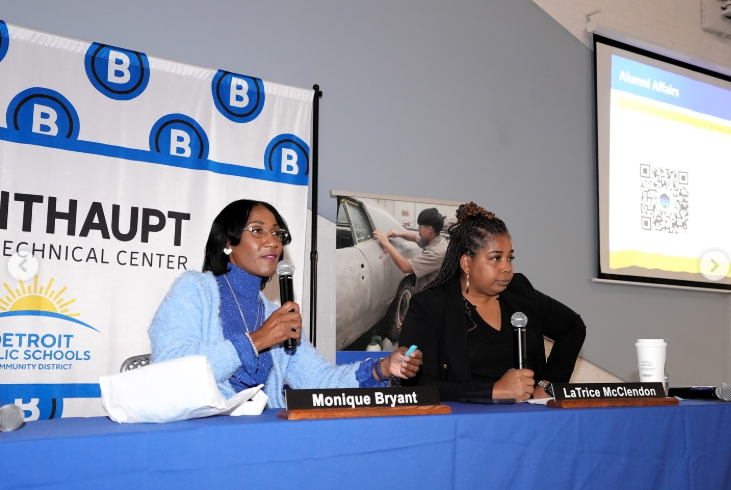
DPSCD Board of Education President LaTrice McClendon believes both realities deserve space.
The district should be able to celebrate how far it has come without pretending its work is finished. Parents should be able to raise concerns without being accused of tearing down Detroit’s public schools. And district leaders should be prepared to listen, explain their decisions and remain accountable to the families they serve.
“We have come a long way, but we have a long way to go,” McClendon told the Michigan Chronicle. “We can’t hide from that truth.”
For McClendon, the beginning of a new school year is not simply a moment for the district to speak to families. It is also an opportunity for families to step closer to the decisions shaping their children’s education.
That includes attending Detroit Board of Education meetings, reading meeting agendas, asking questions and learning what authority the elected board holds.
The board is the governing body of DPSCD, Michigan’s largest public school district, serving nearly 50,000 students.
“The school board really is the governance of the district,” McClendon said. “Our job is to hold [the superintendent] accountable, ensure that we are fiscally responsible, that we are writing policies to the benefit of our students and that we’re overseeing how the district is run.”
The board’s only direct employee is the superintendent. That means board members do not individually manage teachers, principals, custodians, security officers or central office staff. The superintendent oversees those employees and departments, while the board evaluates the superintendent’s performance and holds him accountable for how the district operates.
Board members also approve budgets, major contracts, curriculum and district policies. They receive academic and financial reports and help establish the standards by which the superintendent is evaluated.
McClendon said those responsibilities make the school board as consequential to Detroit families as many offices that receive greater attention during election season.
“People care about state representatives, senators, the mayor and City Council, but they forget about the least of them, which are our children and our future leaders,” she said.
Unlike many state or federal policy decisions that can take years to reach individual households, school board decisions can quickly shape a child’s everyday experience.
They can affect whether students have transportation, updated classroom materials, appropriate special education services, safe buildings, strong teachers and programs that allow them to explore life beyond their neighborhoods.
Still, McClendon said regular board meetings are often not filled with the parents and community members most directly affected by those decisions. With the upcoming meeting being held at Mumford High School, Aug. 11, she is in high hopes that there is a big turnout.
“I hope it is a jam-packed meeting, because typically our meetings are not,” she said. “It is important that our parents and those who are raising the children who attend our schools are educated and understand the decisions that the superintendent and the school board are making.”
DPSCD generally holds its regular board meetings on the second Tuesday of each month at 5:30 p.m., rotating locations between the east and west sides of Detroit. The district also holds committee meetings and study sessions throughout the year.
Meeting schedules, agendas, locations and additional Board of Education information are available on the district’s website at detroitk12.org/board-of-education.
The meetings give Detroiters a direct view into district business. The superintendent typically presents an academic report. The district’s chief financial officer provides an update on DPSCD’s financial position. Board members review contracts, policies and other matters requiring a public vote.
For McClendon, that process should not feel distant from the families the district serves.
She first began studying the role of the board during the COVID-19 pandemic after struggling to get an answer about something happening in her daughter’s classroom.
“I was calling. I couldn’t get anybody on the phone,” she said.
Her research led her to discover that no sitting board member at the time was the parent of a current DPSCD student. McClendon did not believe every board member needed to have children, but she saw value in adding the perspective of someone directly navigating the district as a parent.
She also brought professional experience that allowed her to examine the district’s roughly billion-dollar budget and ask questions about where money was being spent.
“You have to have school board members who are smart, who have some skill set they can actually bring to the table and create diversity of thought so everybody is not thinking the same,” McClendon said. “You need people who can challenge the superintendent and have critical-thinking skills.”
McClendon has three children attending DPSCD. She speaks about the district as a board president responsible for governance, but also as a mother whose children live with the results of the board’s decisions.
“If it was a failing district or a terrible district, my kids would be at another school because one thing I’m not going to do is sacrifice their education,” she said.
McClendon said her children have been challenged academically, developed a love for reading and received opportunities that extended beyond the classroom. Her son traveled to New York and visited the New York Stock Exchange through a district opportunity.
“There are so many great opportunities for our children in this district,” she said. “We want that to be the story for every student.”
DPSCD has recorded important gains after decades of instability and disinvestment.
Students have demonstrated notable academic recovery following the COVID-19 pandemic. Graduation rates have improved. The district has rebuilt its financial foundation and continued investing in student programming, teacher compensation, school facilities and wraparound services.
The district has also worked to confront barriers that cannot be solved through classroom instruction alone.
McClendon said DPSCD has identified nearly 4,000 students experiencing homelessness. Other students face hunger, transportation challenges, health needs or unstable access to basic necessities such as running water, clean clothes and safe places to sleep.
“It’s hard for a kid to come to school and learn and be there when they’re hungry, or they don’t have a bed to sleep on, or they can’t take a shower,” she said.
The district has responded through health hubs, transportation programs and attendance initiatives. DPSCD piloted yellow-bus transportation at Henry Ford High School and East English Village Preparatory Academy, two schools heavily affected by chronic absenteeism.
The district has also offered incentives to high school students for consistent attendance and established health hubs where students can access medical services, glasses, food and other support.
McClendon said those efforts reflect DPSCD’s commitment to educating the whole child, but she cautioned that the district cannot solve Detroit’s deepest economic challenges by itself.
“Chronic absenteeism can’t just be fixed by a school district,” she said. “There are a lot of things going on. It really takes the whole village.”
That does not mean the district is free from responsibility.
Students with disabilities remain among those requiring focused attention and accountability. McClendon said the board’s goal is for every exceptional student education student to receive the services and support required.
“That’s not negotiable,” she said.
She acknowledged that DPSCD still has work to do in completing individualized education plans and ensuring that appropriate staff and services are available. The board, she said, must continue requiring clear reports from the superintendent and measuring whether the district is closing those gaps.
McClendon also wants parents to communicate directly with district leaders when they see problems.
“Sometimes, on a board level, we may not know something is happening unless people communicate that to us,” she said. “We welcome parent participation. We welcome criticism.”
She said questions from parents can introduce ideas that board members and administrators may not have previously considered. Public criticism, when heard with humility, can push the district toward better solutions.
“We can’t, as a board, figure out what to do by ourselves,” she said. “It’s going to take all of us coming together and that diversity of thought to say what’s best for our children.”
That message carries added weight amid recent public debate surrounding DPSCD.
McClendon said the board understands that some community members have felt unheard or unseen. She said the appropriate response is not to retreat from difficult conversations, but to provide accurate information, answer questions and meet the public with greater transparency.
“These are public tax dollars. This is a public school,” she said. “It is our job to figure out how we meet our community where they are.”
McClendon is preparing to leave the board when her term concludes in December. She is not seeking reelection in November.
Five of the seven board seats will be on the ballot, meaning the next group of elected members will inherit responsibility for continuing the district’s progress while confronting the work that remains.
McClendon said the board must maintain stability, continue evaluating the superintendent’s effectiveness and keep students at the center of decisions about the district’s future.
She also warned potential candidates against seeking the position simply for recognition.
“This is not a job for show,” she said. “This is real work. It takes real time and real commitment and real sacrifice.”
Board members must study education law, governance, contracts, policies, budgets and the district’s academic performance. They must be willing to ask hard questions, withstand criticism and sometimes make decisions that are not popular.
“You have to be willing to tell the truth,” McClendon said. “You have to be willing to be transparent.”
The November election will help determine who carries that responsibility next, but McClendon’s call to Detroiters is not limited to Election Day.
Families can participate now. They can attend meetings, review public documents, question spending decisions, share what students are experiencing and recognize improvements when the district gets something right.
Supporting DPSCD does not require silence. Accountability does not require dismissing its progress.
Detroit children need adults who can celebrate their achievements while remaining honest about the systems that have yet to serve every student equally.
“Our kids are brilliant and they are resilient,” McClendon said. “They don’t need us telling them they’re not good enough. They need us telling them that they can do whatever they want to do.”
As the district begins another school year, the work of protecting that belief belongs to the superintendent, the board, educators, parents and the broader Detroit community.
DPSCD has moved the needle. The next responsibility is ensuring that every child can feel that progress in the classroom, in the services they receive and in the opportunities placed within their reach.