
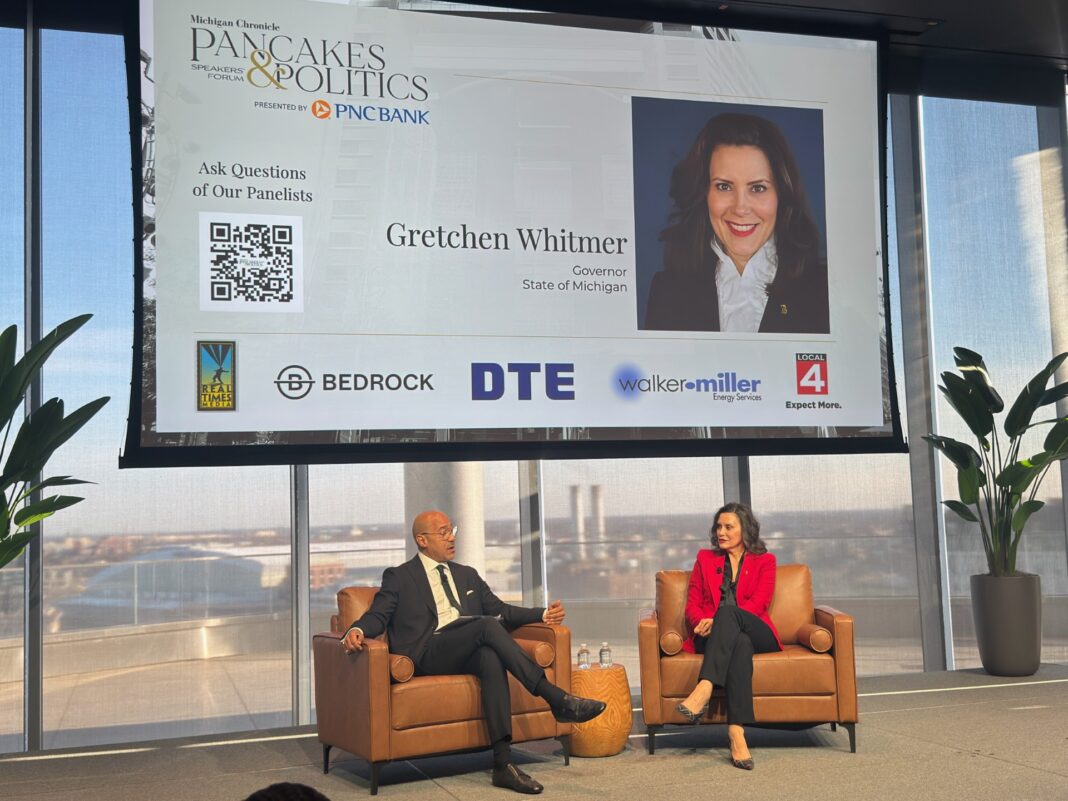


Photo by: Monica Morgan Photography
Michigan Chronicle’s Pancakes and Politics brought another heavy-hitting morning of power, policy and public accountability as Gov. Gretchen Whitmer took the stage for her final appearance in the forum with nine months left in office. Held during the second forum of the 21st season and moderated by Dennis Archer Jr., the conversation moved from personal reflection to pressing questions about leadership, racial equity, political hostility and what Michigan’s next governor will inherit.
Archer Jr. opened with condolences for her father, and the room met that moment with the kind of pause that only comes when power, grief, and public life all sit down at the same table.
Whitmer began by talking about her father in personal terms that also doubled as a political frame.
“Of all the public speaking that I do, to write a eulogy that encapsulates what my dad meant to me and what he accomplished was the most challenging, I was very lucky to land as Vic Whitmer’s daughter,” Whitmer said. “He taught us that when you are fortunate or lucky, you have a duty to help others who aren’t.”
She recalled that when her mother remarried and moved to Grand Rapids, her father remained in Detroit working for Blue Cross Blue Shield and drove hours every weekend to see his children. Whitmer told that story not as a sentimental aside, but as explanation. The lesson, as she laid it out, was about consistency. About showing up. About understanding responsibility as something lived, not just spoken.
“When you grow up with a larger-than-life father, you want to live up to that,” she said. “I am lucky.”
That sense of obligation stayed underneath much of what followed.
When Archer turned the conversation toward her record and asked her to grade herself on making Michigan a place where people want to live, work and play, Whitmer answered without hesitation.
“A,” she said. “We’ve got a place where everyone can see themselves reflected in places of power, people feel included, our population is starting to grow, investment is happening in Michigan. People move here because they see opportunity.”
That answer was Whitmer making a final argument for how she wants her time in office understood. Inclusion, representation, investment and growth were the measures she chose to elevate. She did not claim all of Michigan’s progress as the work of her administration alone, but she said the state has had “collective success on that front.”
Still, the morning’s strongest moments came when the conversation shifted away from scoring the record and toward what it has taken to survive the office itself.
When asked about governing in a deeply partisan and dysfunctional climate, Whitmer did not soften the answer.
“Very challenging. It’s a hard environment,” she said. “After the last election I was so disappointed. I took an oath to the people of Michigan to put them first before my feelings, interest, and my political interest.”
“All of that is why showing up even when you don’t want to show up is important,” Whitmer said. “I hope that whoever is elected next understands that you have to do the hard things.”
“Once you accept the fact that people are going to feel how they feel no matter what, it’s liberating,” she said. “Just do the right thing.”
Whitmer described leadership as endurance. As discipline. As a willingness to keep moving when public opinion is fractured, when the politics are bitter, and when there is no guarantee the work will be rewarded in real time.
Archer pressed that point further by asking about the threats, falsehoods, and attacks that have followed Whitmer through office.
“People have asked me before, why I was re-running for office, surviving 32 recall attempts, kidnapping attempt, legislation suing me,” Whitmer said. “The answer is even on the worst day I feel lucky being the governor of Michigan. There’s nothing compared to the satisfaction knowing that I’ve been able to really help the people of our state.”
Whitmer also spoke directly about the online ugliness that now shapes so much of public discourse.
“No person should have to deal with the horror that plays out online every day,” she said. “No child at school should deal with the ugliness online. We have to tackle that. We need good people to come into office who care about their community, who wants to help people.”
The conversation took another turn when Archer asked how leaders can ensure equitable access to education, opportunity and the American dream. Whitmer answered with the strongest and most direct line of the morning.
“Potential is universal, but opportunity is not.”
That named a truth Black communities, working families and historically excluded residents know on sight. Talent is everywhere. Access is not. Whitmer expanded on that point by arguing that leaders have a responsibility to remove barriers because doing so is both morally necessary and economically sound.
“We have a duty as leaders to recognize that every person represents a chance for us to do greatness and if we have the tools to level the barrier it is in all of interest to level it,” she said.
She also addressed the political retreat that has followed the period of more visible racial reckoning after George Floyd’s murder.
“It was very supportive work that surrounded the racial issues that is around our nation but within the last 13 months it has been very punitive due to the new administration. It’s gone quiet,” Whitmer said. “Here in state government, we have not.”
That may have been the most important takeaway.
At a time when diversity, equity and inclusion efforts are being targeted, stripped back or avoided altogether by institutions trying to read the room in Washington, Whitmer said Michigan should not follow that silence.
“It is better for our economy when we level our barriers,” she said. “We cannot go back and forth whether racial equity and diversity are the right things to do. We have to continue the work regardless of what’s going on in D.C.”
Archer closed by asking what a pandemic playbook should look like for the next leader who faces a once-in-a-century public health crisis. Whitmer’s answer stayed practical and unsparing.
“I would reconvene with all of the experts and make sure to get their input as well. One of the things that when you have a pandemic every 100 years it’s hard to prepare and though you can learn from the last one, viruses play out differently,” she said. “We were working from the 1918 playbook.”
She said future leaders must be nimble, listen to experts, and make sure the basic tools are already in place before crisis hits.
“We had to have refrigerated trucks outside of hospitals because there were so many deaths, not enough gloves for doctors. The lack of stockpile and strategy was detrimental,” Whitmer said. “Those are some things that I’d put in the playbook.”
Whitmer still has nine months left in office, but her final Pancakes and Politics appearance made clear that she understands the clock differently now.
The conversation was not just about what she has done. It was about what she believes the office demands from anyone who wants to hold it next. Duty. Discipline. Toughness. A willingness to walk into hard rooms. A refusal to let political backlash silence conversations about fairness, access and equity.