
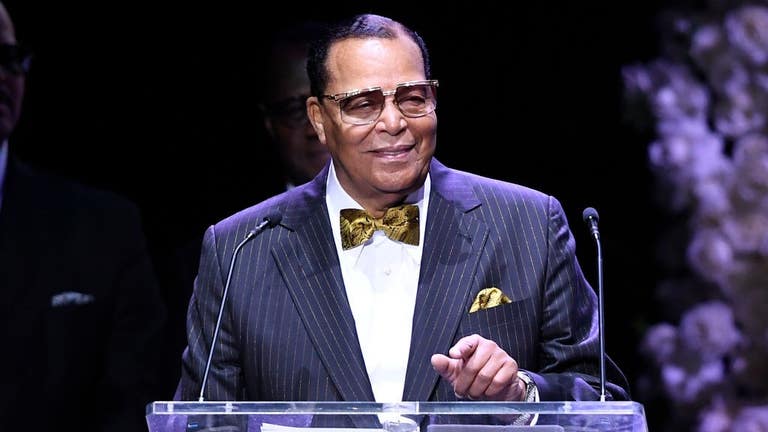

In January 1996, an unexpected geopolitical drama unfolded that would place the Clinton administration at the crossroads of race, international relations, and U.S. foreign policy.
Muammar Gaddafi, the controversial Libyan leader, made an extraordinary offer: a $1 billion gift to Louis Farrakhan’s Nation of Islam. The money was intended to advance the cause of Black Americans, at a time when the country was grappling with deeply entrenched racial inequalities.
For Farrakhan, whose relationship with both the U.S. government and mainstream African American leaders had long been contentious, this was an opportunity to change the tide and power structure in America – so much more than the “financial boon” it was painted out to be.
For the Clinton administration, it was a political nightmare. If he allowed for the acceptance of the gift, it would be seen as compromising with an enemy of the state, but if he denied the gift to Farrakhan on the grounds of politics, it would be seen by Black Americans as a denial of the American dream.
The response came swiftly: the Treasury Department blocked both the $1 billion gift and a separate $250,000 humanitarian award from Gaddafi, marking the beginning of a complex and nuanced controversy that would spark a fierce debate about race, foreign policy, and the U.S. government’s response to domestic inequality.
The backdrop to this dramatic moment in history cannot be ignored.
The mid-1990s were a period of growing frustration in the African American community, where disparities in wealth, education, and political power were glaring. The promise of a $1 billion donation from Gaddafi, much of which was earmarked for investment in Black-owned businesses and programs targeting minority empowerment, seemed to offer an unprecedented opportunity.
Beyond the immediate financial benefit, it was about a real chance to shift the balance of power, to create avenues for economic mobility, and to directly challenge the structural inequalities that had long hindered Black Americans. At a time when the country was still reeling from the aftermath of the 1992 Los Angeles riots and debates about affirmative action were escalating, Farrakhan saw Gaddafi’s offer as a potential game-changer.
For Farrakhan and the Nation of Islam, the $1 billion was the much-needed financial boost to grow his platform and help ensure a brighter future for the NOI and for Black people. Farrakhan’s vision was clear: the money would be used to build a robust financial infrastructure within Black communities, encouraging the growth of Black-owned banks, promoting corporate diversity, and supporting voter registration efforts. It was a pragmatic approach to addressing systemic issues facing Black Americans, one that recognized the limitations of traditional governmental solutions.
Farrakhan’s request to accept the funds, however, was far from simple. It was an open challenge to U.S. foreign policy and to the longstanding political narrative that tied Black advancement to American institutional structures.
Farrakhan was no stranger to controversy, having cultivated a reputation as a fierce critic of both U.S. domestic policies and Western imperialism. His international relationships – particularly his visits to countries like Iran, Nigeria, and Sudan – had already drawn sharp rebukes from the U.S. government.
But in making the request to accept Gaddafi’s gift, Farrakhan wasn’t just looking for financial support. He was placing a mirror to American hypocrisy, questioning why a country that professed to care about racial equality would turn down an opportunity to make meaningful investments in its most marginalized communities.
The U.S. government’s response to Farrakhan’s request was a swift, resounding, and unambiguous “NO!”
In a letter from the Treasury Department’s Office of Foreign Assets Control (OFAC), the administration made it clear that accepting the money was “inconsistent with current U.S. foreign policy.”
The rationale for this denial was grounded in the broader context of U.S.-Libya relations: Libya had been labeled a state sponsor of terrorism since 1979, and the U.S. had imposed strict sanctions in response to Gaddafi’s support for international terrorist organizations.
There was a deep-seated concern that Gaddafi’s overtures to Farrakhan were not entirely selfless and that they could be part of a larger geopolitical strategy to gain influence in the U.S. through a domestic African American movement.
But beyond this, there was a racial nuance to the decision that cannot be ignored. The denial of Farrakhan’s request was, in part, a statement about who had the right to determine the future of Black Americans.
Despite the promises of investment and empowerment, the U.S. government refused to entertain the notion that a foreign power could play a significant role in shaping the economic and political futures of its Black citizens. The message was that even if the money could benefit African Americans, the U.S. government was unwilling to allow foreign influence in a racial struggle it viewed as internal – a struggle that, in its eyes, could only be addressed by domestic means.
The denial of the $250,000 humanitarian award to Farrakhan further underscored the racial dynamics at play.
Gaddafi had established the award in 1989 to recognize individuals who contributed to humanitarian causes. Previous recipients included South Africa’s Nelson Mandela, yet the U.S. government blocked Farrakhan’s acceptance of the award, citing his contentious relationship with U.S. policies.
This decision, pundits say, was about more than money. It was about controlling the narrative surrounding racial progress in America. By blocking both the financial gift and the award, the Clinton administration sent a message that Black advancement, even in the form of international assistance, had to fit within the framework of U.S. political and racial norms. The refusal illustrated the deep-seated tension between American ideals of racial justice and the reality of U.S. foreign policy, where issues of race were often subordinated to broader geopolitical concerns.
The refusal to allow Farrakhan to accept Gaddafi’s offer ignited intense public debate.
Farrakhan, never one to shy away from confrontation, framed the government’s actions as a denial of Black Americans’ rights and a reflection of the country’s unwillingness to address the systemic issues of racism and inequality that still plagued African American communities.
Farrakhan argued that the $1 billion could have been used to build economic power in Black neighborhoods, revitalize Black businesses, and increase political representation, all goals that the federal government had, at best, only partially addressed.
In his eyes, the U.S. government’s decision was a tacit admission that it had no real interest in solving the problems facing Black Americans.
His response echoed a broader frustration that had been simmering in the Black community for decades: that true empowerment would never come from a system that had historically kept Black people at the margins of American society.
From the U.S. government’s perspective, however, the blocking of the gift was a necessary step to maintain control over the political dynamics of race in America. The concern wasn’t just about the potential political ramifications of accepting foreign funds, but also about the broader implications for American sovereignty. To allow Gaddafi to provide such a substantial gift, even under the guise of humanitarian aid, would have opened the door for other foreign powers to attempt to influence U.S. domestic affairs – particularly around issues as contentious as race. The government feared that such gestures could embolden extremist groups and challenge the traditional political and social order.
Looking back on this episode, the ramifications of the U.S. government’s decision are still felt today.
While the $1 billion gift never materialized, the controversy underscored the deep-rooted contradictions in the U.S. approach to race and foreign policy. It revealed how race, politics, and international relations can collide in unexpected ways, and how the U.S. government’s refusal to address the real economic needs of Black Americans could be seen as a form of political control.
The decision also foreshadowed future debates about foreign influence in domestic racial issues, and discussions that continue to evolve even today as the country grapples with its legacy of inequality.
In the end, the rejection of Gaddafi’s offer was more than just a denial of financial support. It was a statement about the ways in which power, race, and politics intersect in the American experience, and how that American experience can look different to every American – especially Black ones.