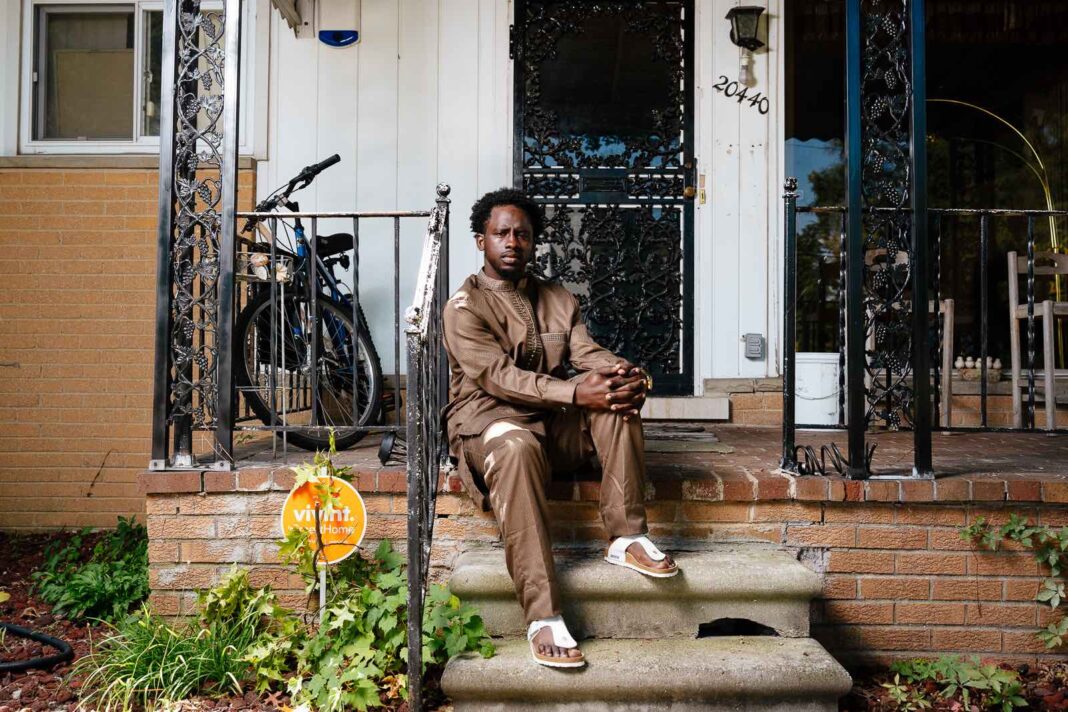

Abstract: For immigrants from Senegal, Detroit’s religious communities are a source of spiritual grounding and practical support. The westside of Detroit has become a destination that many Senegalese now call home.
By Carole Hawke-Diop
On August 13th, the courtyard of Khadimu Rassul Foundation is a colorful scene of men in kaftans and women in sequined robes and bright headwraps. It is Magal Touba, a feast commemorating the life and teachings of Ahmadou Bamba, a revered saint and leader for Senegal’s Mouride Muslims. On this day, a large group of worshippers from West Africa have gathered to celebrate together. For west Detroit’s sizable and growing population of Senegalese migrants, local religious communities are a source of spiritual grounding and practical support.
From Senegal to Detroit
Detroit has been home to Senegalese immigrants since at least the 1990s. When author and educator Abib Coulibaly moved to Detroit with his wife in the early 2010s, they were attracted by the feeling of home.
“I had some connections living in Detroit. When I came here, I had a safe feeling. I said, ‘Oh, this is a Senegalese community.’ I felt at home right away. There were a lot of Senegalese. This was something I was not expecting.” says Coulibaly.
This small community was bolstered by more recent arrivals, whose numbers have swelled in the past half decade. An initial group arrived to Detroit via Brazil, where a large Senegalese population was hollowed out by an increasingly inhospitable economic and political climate in that nation.
Crossing seven countries by foot, bus, and taxi and traversing Panama’s perilous Darien Gap, this wave of migrants journeyed for several months to reach the United States’ southern border, which they did beginning in 2020.
Mhamadou Diop arrived in Detroit in 2021. Originally from Kaolack, Senegal, he lived in Brazil for seven years before leaving for the United States. Connections with the imam at Khadimu Rassul mosque brought him to Detroit.
“When I came [to the United States], I didn’t know anybody here. I have one friend, whose friend [the imam] lived in Detroit. He said, ‘When you get there, he’s going to allow you to live there. They will help you with everything that you need.’ That’s why I came [to Detroit],” says Diop.
Soon a new route opened for migrants looking to avoid the Darien Gap. Many Senegalese who arrived between 2022 and 2024 flew from Senegal to Nicaragua and made the shorter trek through Central America and Mexico to the southern border.
Adama Sow Ndiaye recounts three planes and countless taxis, motorcycles, and miles of walking as part of his journey before arriving in the U.S. in January 2024. Once here, he joined his mother, who was already living in Detroit.
Many who selected Detroit as a destination cite family and community support.
Coura Ndiaye is an example. She says, “I came first to New York City in 2021. After that I came to Detroit because it is safe and less busy. When I came here I saw that there are very nice people, like Muslim people, they are together and aid each other. They help you. There are a lot of African people and people from other countries. That’s why I stayed here.”
While the border is shut to new migrants and immigration concerns threaten the status of many asylum seekers, activist Seydi Sarr anticipates that the West African population in Detroit will grow in the short term as Senegalese in other parts of the United States find their way to Detroit.
“Right now we are seeing more people coming. It doesn’t look like a crisis how it was seven months or a year ago because the community here has found their bearings and are now helping others,” says Sarr. Sarr references a span of months in 2023 and 2024 when local shelters and agencies were unable to keep up with the need for housing and services for the many migrants arriving in Detroit.
“They are even telling their cousins to come here. ‘It’s too expensive in New York. Come here. I’ll talk to my boss, and we’ll make it happen. We live with 7 other people now, but once you start working, then me and you and so-and-so can move out.’ Now they know the network, they know how to move, they know how to regulate themselves,” says Sarr.
Spiritual and Social Support
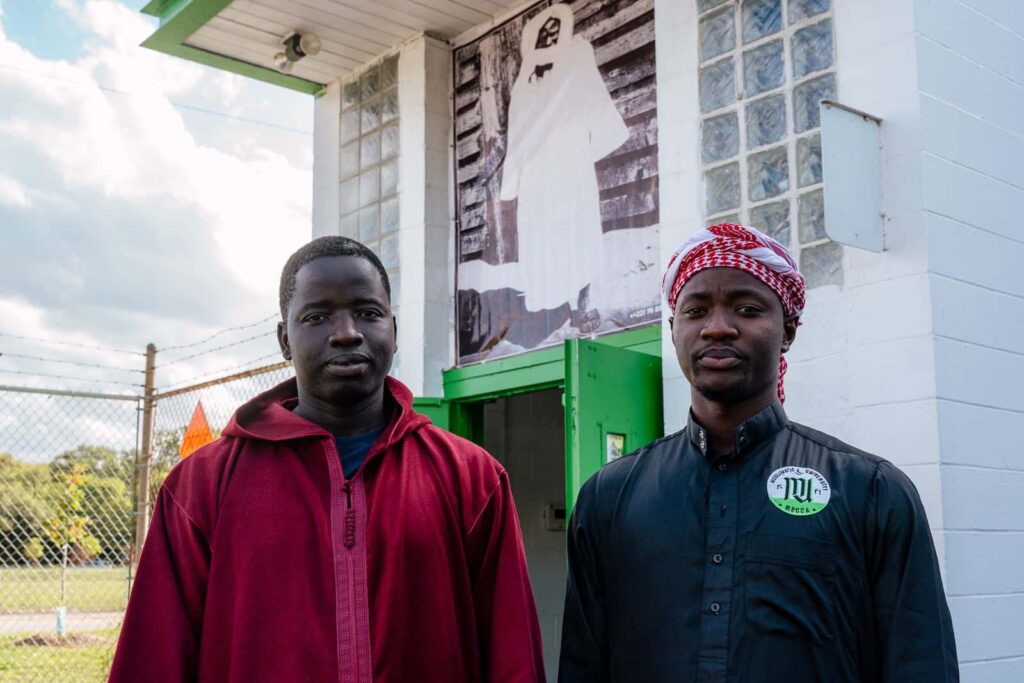
Khadimu Rassul Foundation serves as a hub of religious and cultural life for many of the city’s newest residents from Senegal. Located on Schoolcraft and West Outer Drive, it is one of several Islamic Centers in West Detroit which serve the African population.
Khadimu Rassul Foundation is part of a network of Mouride community centers throughout North America. Several orders of Sufis, a branch of Islam which emphasizes personal religious devotion, predominate among the large majority of Senegalese who practice Islam. Mouridism is one such order, founded in 1883 by Ahmadou Bamba, who was also known as Khadimu Rassul, or the servant of the prophet. Members of the order are called Mouride, and their goals include establishing centers throughout the country which can promote religious teaching and mutual care.
Abib Coulibaly describes the role of Khadimu Rassul Foundation, saying, “In every big city [the Mouride] go, they have a building. We have a mosque, a conference room, and a classroom where people can learn religion. We can welcome people when they first come and have no place to sleep. We have a day in the month when we gather and talk about a religious theme. It reminds us where we come from, why we are here, and why we should help one another as a community. That’s why people know where to go. This is a place that puts us together. Sometimes it is what prevents most of us from being lost and confused. We can get spiritual help, financial help, and advice.”
Although the property was purchased and dedicated in 2014, newly arrived migrants from Senegal have breathed new energy into the space. Whereas Friday prayers were once sparsely attended, now they are “full to the brim,” according to Seydi Sarr. The center hosts year-round food giveaways and special meals for the community during Ramadan. When local immigration agencies were overwhelmed by the number of newcomers in 2023, Khadimu Rassul hosted a townhall with city leaders.
Networking promotes connections outside the structures of official religious activities. Apart from the charitable activities at Khadimu Rassul, many community members report giving and receiving help with transportation, employment, and housing from one another.
Alongside these practical helps, newcomers attest to the significance of spiritual resources for withstanding the difficulties of migration. When asked how his religion helps him, Adama Ndiaye paused and reflected on the many challenges he has faced – hardships in Senegal, detention during his journey through Mexico, anxiety from his program of surveillance through ICE, and poor treatment from some Detroiters.
Sustaining him in this has been a verse from the Qur’an, which Ndiaye explains to mean “Nothing bad can happen today that is not decided by God.” Ndiaye says, “Everything that happened to me, dealing with what I’ve been dealing with– if you rely on religion then you’re going to deal with those situations in a different way.”
Something of Value to Bring to Detroit
Although many Senegalese have been in Detroit only a short time, the grounding of spiritual and practical support of their religious community bolsters their positive contributions to life in the city.
The economic contributions of the new migrants are undeniable – they hold jobs as welders and construction workers, in factories, laundromats, restaurants, and community centers. Many have certifications or college degrees from Senegal and are working to transfer these to the United States. Many work multiple jobs.
Serigne Bassirou Lo has lived in Detroit since 2022. He cites work ethic and kindness as two unique characteristics of Senegalese in the city. “People sometimes say, ‘Senegalese people, they are good. They are good, and they are good at work,” says Lo.
Adama Ndiaye agrees, adding that Senegalese culture emphasizes respect for elders. He recounts lifting a heavy load of laundry for a senior citizen at the laundromat. What was natural for him was a surprise to the woman, who said that this was the first time anyone had helped her in this way.
Coura Ndiaye beams with pride when asked how she helps people, listing her love for cooking for others, the translation she offers for friends as they seek jobs and healthcare, and the many people she has helped register for English classes.
Coura encourages her fellow Senegalese to see that they also have something of value to give to Detroit right now. She says, “I want to help people to understand what they have to bring for the United States. We are not here just for finding money. The best thing we have to bring is our own experience, because we live here now. We can help people to find a good and safe place to live.”
AUTHOR NOTE: For disclosure, Mhamadou Diop is my husband. I interviewed seven migrants who came to the U.S. between 2021-2024 for this article, but he was the only one who came via the Brazil route.
Resilient Neighborhoods is a reporting and engagement series that examines how Detroit residents and community development organizations are working together to strengthen local neighborhoods. This story was originally produced and published by Model D Media and is reprinted in New Michigan Media newspapers through a partnership supported by the Kresge Foundation.
Photos by Nick Hagen