
Photo credit: Monica Morgan Photography
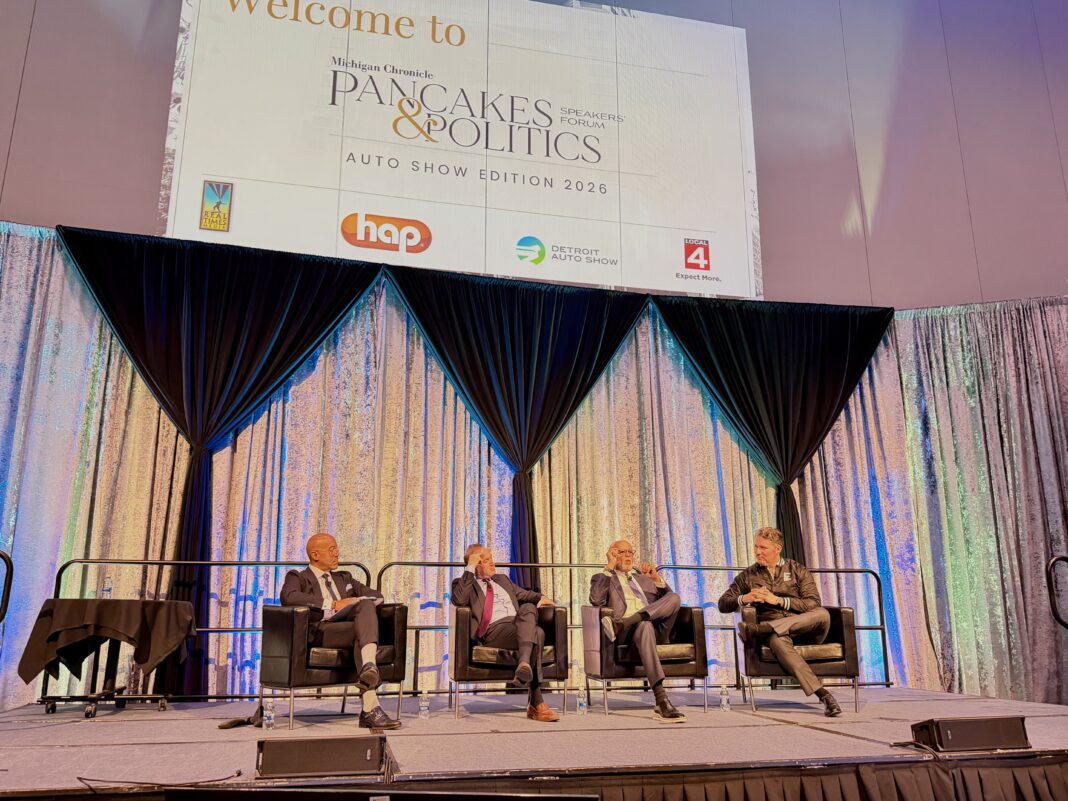
Huntington Place already had its annual Detroit Auto Show energy moving through it, the kind that pulls in families, executives, union folks, and tourists all at once. Michigan Chronicle’s special edition of Pancakes & Politics brought a different kind of traffic into the building — people who came for the region’s next chapter, not just the displays.
This year marks the Michigan Chronicle’s 90th anniversary, and the paper opened by telling the truth about its roots the way Black institutions do when they are still standing after generations of disruption.
Thursday morning came with snow and a 7 a.m. start. Huntington Place was packed anyway — almost 300 deep for the Pancakes & Politics Auto Show edition 2026.
“Welcome, fearless warriors.” said Real Times Media CEO and Michigan Chronicle publisher Hiram E. Jackson. “Thank you for being here despite the weather this morning. We’re serious about informing and entertaining our community. Pancakes & Politics is all about a series that talks about the most important issues thats happening right here. This is our 90th year of the Michigan Chronicle. In 1936 a young man came to detroit with $5 in his pocket and set up shop in Paradise Valley and today, we still own the land that was bought.”
He also nodded to a Chronicle legacy tied directly to Detroit’s mobility story. “For 10 years we had a program called Driven, we had a 10 year run and hopefully we can bring that back one day. We are really excited about being here.”
That framing mattered in a room built around Detroit’s signature industry. The panel that followed was moderated by Dennis Archer Jr., who has been doing Pancakes and Politics for years, and it stayed focused on what this show means beyond nostalgia — investment, workforce, land, and the question that keeps coming back in Detroit no matter how many cranes go up: who is being brought up with it.
Sam Klamet placed the Chronicle partnership alongside the show’s regional reach. “I’m really proud of this partnership and this relationship. We know what this show means to the region and to have a relationship with an institution like the Michigan Chronicle is crucial to have conversations about how to move us forward.”
The panel included Jared Fleisher, CEO of Bedrock; Wayne County Executive Warren C. Evans; and Chris Thomas, co-founder and partner at Assembly Ventures.
The discussion opened on the scale of Detroit’s automotive influence. “The global impact of the automotive industry and the auto show is historical,” Archer mentioned. From there, the conversation turned into a direct question about history and responsibility — and what the region is doing with the power it claims.
Fleisher spoke about the way the auto industry still anchors Detroit’s global identity, tying that legacy to Bedrock’s downtown footprint and the corporate presence moving into Hudson’s. “Tomorrow we have an event at the hudsons site to welcome GM and i’ve been thinking about what to say but what has dawned on me is pride and thankfulness. We have three of the greatest auto corporations in the world. GM is in our building and Ford made a tremendous contribution to the Michigan Central Station.”
He called the industry foundational to the country’s economic story. “We need to remember that this is a foundation of our country’s industrial base.”
Evans took that foundation and pushed the conversation toward the people Detroit history often leaves behind when development starts getting celebrated. When Archer posed the question about the importance of the evolving automotive industry, Evans reached back to the early promise of industrial work and contrasted it with the barriers many residents face now.
“The automotive industry has been doing well with the assistance of the municipality but what sticks in my mind in terms of the new automotive industry, is early on for $5 a day you didnt have to have skill, people worked and was able to buy automobiles because they worked,” Evans said. “The skills training today is critical they’re lots of programs around but whether or not the programs reach the people who actually needs them is faint. We can’t gloss over the chronically unemployed folks that’s out there, that’s where we have to focus on going forward.”
Thomas grounded the moment in a larger identity question Detroit has been wrestling with for years — how to respect what Motor City built without letting the city get trapped inside its past.
“Automotive cannot be what it was and I love that. There’s only one motorcity and that’s true but what are we going to be next? For our city and our people to thrive we have to think bigger we need to be very focused on what we’re going to be today?”
Evans pressed the workforce point again, naming what often gets buried inside broad “skilled trades” messaging.
“I strongly believe somebody has to be in charge of the process. We’re fooling ourselves if we think K-12 and the skilled trades are working the way they should. The trades still don’t include minorities the way people claim. A lot of young Black men try to get into those jobs, get washed out along the way, and then folks label them like they aren’t trying to work,” he said.
He also described gaps between education and actual labor needs. “If i look at K-12 and the relevance of community college classes to the jobs that are needed, there’s a real gap there.”
The conversation moved into development priorities and what it takes to move a regional economy forward. Fleisher pointed to Detroit’s core as an engine and described Bedrock’s development focus as part of building a stronger city, linking that to the riverfront as a “big play.”
Simply put, Archer asked, “So, how do we move our regional economy forward?”
“A huge part is relative to training programs and taking it to the next level and for Bedrock, it’s building a strong Detroit,” Fleisher said. “We have a city that has a decade of comeback but that’s after 50 years of decline and now we have a new mayor , mayor Sheffield who gets it. The urban core is still the economic engine so we continue to take our core to the next level and the riverfront is part of that. Imagine what our visitation would look like if we had the best riverfront in the country, this is a big play. Whatever we are doing we want to do it in partnership. Let’s build more, let’s build faster, and let’s bring more people up as we do it.”
Then the room got to a subject Detroit doesn’t let anyone skate past: displacement tied to infrastructure, specifically I-375.
Evans laid out his frustration with how the project was framed and rolled out.
“MDOT does a good job of building roads and selling projects,” he said. “So, the whole issue of 375 started out from a phony premise that pissed me off from day one because they tried to sell it as a reparation.”
Evans described promised communication that did not happen and questioned whether the resources make sense given other needs. He also rejected messaging he viewed as insulting. “I do get offended when you get a project like that and try to sell it as reparations,” Evans said. “I’m not trying to be a naysayer im trying to be a team player but I need a team that isn’t playing class-A bull.”
Fleisher offered a measured take on the project’s current version.
“On a scale to 1-10 I’m a five and what the executive mentioned about the prior plan he is right but the new incarnation is fine because it is no longer saying its the reparation of the century. The project is ¼ scale of ambition from gratiot to the riverfront, i share the view of, is this the best use of resources, but in it of itself its become a better project,” he said.
By the end of the discussion, the theme was clear.
Detroit can celebrate the auto show and still ask harder questions in the same breath. The region can talk about growth and still be pressed on whether the growth reaches the people who need it most. That’s what Pancakes & Politics has always been built for — a place where Detroit gets to hear leaders speak plainly, and where the Chronicle keeps doing what it has done since 1936: document the stakes while the city decides what it’s going to be next.