

By Dr. Anthony O. Kellum
There are moments in history when progress stalls not because people forget how to move forward, but because Donald Trump is actively working to push them backward. We are living in such a moment. Since taking office on January 20, 2025, Donald Trump has advanced a policy agenda that systematically undermines Black Americans under the guise of neutrality, legality, and “anti-wokeness.” These policies do not merely target programs or language; they target infrastructure the systems that allowed Black people to gain limited but meaningful traction in education, employment, housing, and wealth accumulation over the last sixty years.
This moment should deeply concern anyone who understands how fragile Black economic progress has always been and how tightly it is tied to property ownership, access to capital, and institutional equity.
The question before us is not simply political. It is structural: What happens to the Black housing gap and the Black wealth gap in 2026 when equity is no longer protected, diversity is criminalized, and silence is rewarded?
Trump’s current agenda is neither accidental nor symbolic. It is deliberate and systemic. By dismantling diversity, equity, and inclusion initiatives, the administration is removing the scaffolding that partially corrected generations of exclusion. The attack on institutions like the National Museum of African American History is not merely cultural it is strategic.
Removing Black historical figures from national websites, rolling back Department of Education funding that disproportionately affects HBCUs, and terminating DEI offices, equity-related grants, and workplace protections represent a coordinated effort to constrict Black mobility pipelines. These pipelines directly feed education attainment, income stability, and ultimately mortgage eligibility and homeownership.
When equity mechanisms disappear, access disappears with them. The housing gap is not simply a matter of credit scores or interest rates. It is the downstream result of education access, job security, wage growth, and institutional support. DEI initiatives particularly in higher education, federal contracting, and corporate hiring played a measurable role in expanding Black participation in professional sectors that make homeownership attainable.
By terminating these initiatives through executive orders and legal threats, the administration tightens the funnel that leads to ownership. Fewer promotions lead to fewer stable households. Fewer stable households lead to fewer qualified buyers. In 2026, this will not be abstract. It will show up in declining Black homeownership rates, increased rental dependency, and heightened vulnerability to displacement.
The wealth gap widens when ownership becomes harder to reach. Wealth in America is built through assets, not income, and the most common asset is housing. The repeal of decades-old executive orders requiring federal contractors to take proactive steps against discrimination signals a return to passive inequality where discrimination need not be proven, only permitted.
This environment rewards incumbency and inherited access, both of which have historically excluded Black Americans. Without intentional equity measures, wealth compounds upward and away from our communities. The absence of protection is not neutrality, it is regression.
Perhaps most dangerous is the reframing of equity as illegal and immoral. By forcing federal contractors and grantees to certify that they do not operate DEI programs, and by threatening corporations, universities, nonprofits, and foundations with legal action, the administration has created a chilling effect designed to silence institutions before they act. When corporations retreat from equity initiatives, Black professionals lose pathways. When philanthropic foundations withdraw equity grants, Black entrepreneurs lose capital. When universities scale back access programs, Black students lose opportunity. And when opportunity contracts, property ownership contracts with it.
This is why the current moment demands Black political, civic, and economic voice. Silence has never preserved Black progress participation has. At the same time, political awareness must be matched with economic action. We must intentionally build and strengthen parallel systems of support. If federal equity mechanisms are dismantled, community-driven capital and Black-led financial institutions must remain visible and engaged across professional, educational, and civic spaces.
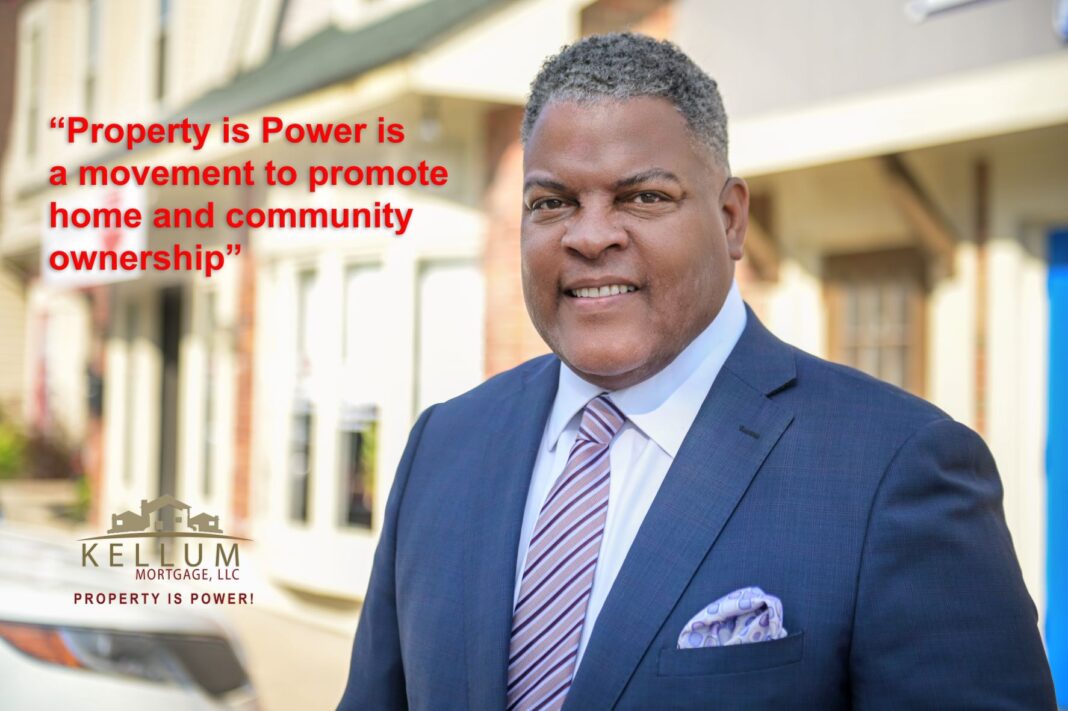
Property is Power! is a movement to promote home and community ownership. Studies indicate homeownership leads to higher graduation rates, family wealth, and community involvement.