
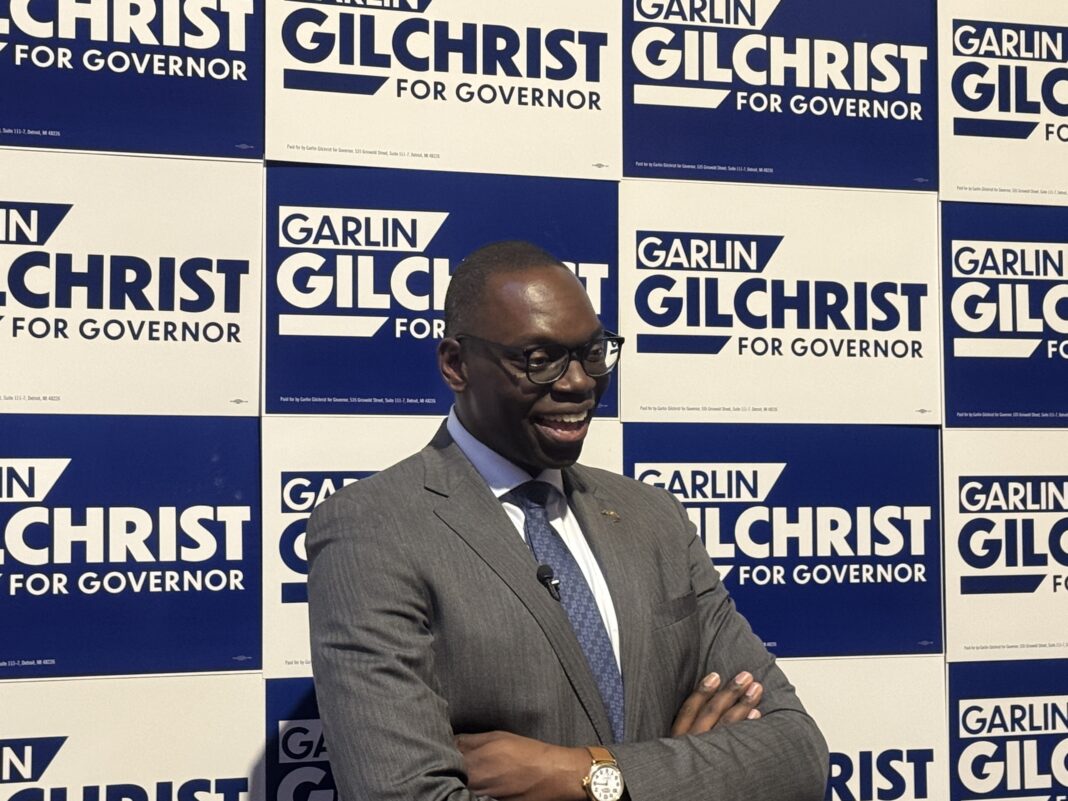

When Lt. Gov. Garlin Gilchrist II announced Monday, Jan. 12, that he was suspending his campaign for governor and instead running for Michigan secretary of state, it was framed as a strategic redeployment in defense of democracy.
But beneath the mechanics of campaign math and party strategy is a more sobering reality: for the first time in this election cycle, there is no Black Democratic candidate for governor of Michigan.
And with Gilchrist’s departure, the only Black candidate remaining in the gubernatorial race is Republican John James.
That fact alone should give Democrats – particularly Black voters, organizers, and power brokers – pause.
Gilchrist’s gubernatorial run carried weight that extended far beyond policy proposals or electoral viability. As the highest-ranking Black elected official in Michigan history, his candidacy represented the possibility of something long deferred: not just Black participation in statewide leadership, but Black ownership of the Democratic Party’s future at the top of the ticket.
For many Black voters, particularly in Detroit and other urban centers, Gilchrist’s campaign was about whether the Democratic Party would meaningfully invest in Black leadership when it mattered most. A win would have been wonderful, but even seeing the potential investment into a Black candidate at the state level would have felt like a win.
That moment has now passed – at least for this cycle.
In an interview with the Michigan Chronicle, Gilchrist was clear that his decision was not driven by party pressure or internal dissent.
“This was about conversations I’ve had with people in Michigan,” Gilchrist said. “Alongside the consistency about expensive childcare, housing, and healthcare, I heard a deep concern about the dangerous extremism of the Trump administration and attacks on our voting process.”
For Gilchrist, the threat to democracy and voting rights outweighed personal political ambition. He framed his move to the secretary of state race as a return to first principles, recalling his early run for Detroit city clerk and his belief that elections are “sacred.”
“My grandma came up from Jim Crow,” he said. “And this is a year when the Voting Rights Act could be gutted. Michigan is ground zero.”
That framing matters. But so does what his exit leaves behind.
Historically, Black voters have been the backbone of Democratic victories in Michigan — delivering margins in Detroit, Flint, Saginaw, Benton Harbor, Pontiac, and beyond. Yet when it comes to gubernatorial power, Black leadership has consistently been relegated to the margins: lieutenant governor, mayor, legislator, organizer — but rarely the top of the ticket.
Gilchrist’s candidacy disrupted that pattern. His departure restores it.
The irony is hard to miss. As Democrats rightly argue that democracy itself is on the ballot, Black voters are once again being asked to mobilize, turn out, and defend the system without seeing themselves reflected in its highest stakes contest.
Meanwhile, Republicans now have a monopoly on Black representation in the governor’s race through James, a candidate whose policy positions, party alignment, and voting coalitions stand in sharp contrast to the priorities of most Black Michiganders.
It would be easy to say that this is just a symbolic problem, but it’s not. It’s a strategic one.
Representation shapes enthusiasm. It shapes turnout. It shapes whether young Black voters believe the system is responsive to them or merely extractive.
Gilchrist acknowledged the disappointment directly.
“I appreciate that excitement,” he said, referring to the energy around a potential Black Democratic nominee for governor. “That time and opportunity may come for me again — just not in 2026.”
Still, he urged engagement rather than retreat, arguing that a strong secretary of state can expand access, convenience, and turnout, particularly in Black communities long underserved by the electoral process. And he’s absolutely right.
And that is where this moment becomes a test, not just of Gilchrist, but of the Democratic Party itself.
If Democrats are serious about protecting democracy, they must also be serious about who democracy is seen to work for.
Gilchrist’s pivot to secretary of state may well prove consequential. In an era of voter suppression, data surveillance, and election sabotage, that office is no small thing. It’s one of the state’s top office seats. And Gilchrist’s background as an engineer, election administrator, and technologist positions him uniquely for the fight ahead.
But there is a broader question that remains unanswered. Why does Black leadership so often stop just short of the governor’s office, even in a party that depends on Black voters to win it?
That question will not be resolved at the ballot box alone. It requires intentional cultivation, early investment, and a willingness to back Black candidates in word and in action – in both praise and in power.
Gilchrist says his time may come again. Michigan Democrats would be wise to ensure that when it does, that it’s the exception instead of the expectation.