

Kendale L. Jones built a life around decisions you can measure.
Finance. Strategy. Work built on composure, clean logic, and a steady voice. Then he put something on Woodward that refuses to be quantified—Black memory and Black power held in plain sight, impossible to shrink into a number no matter how hard you try.
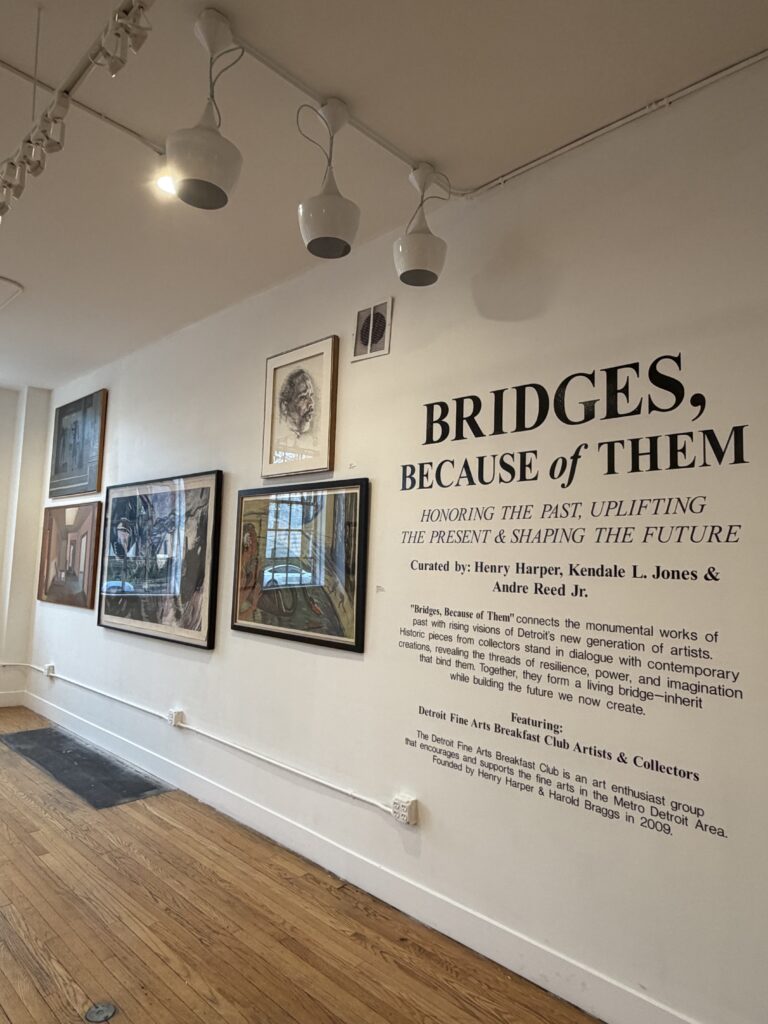
“Bridges Because of Them,” the exhibition Jones co-curated with Andre Reed Jr. at the Carr Center, brings together about 25 artists, work connected to about 26 collectors, and 62 pieces across three galleries. The show moves with intention—women and history first, then modern and contemporary voices toward the end—built to hold Detroit’s Black art lineage without shrinking it into a single era, a single style, or a single story.
“This exhibition allows you to come in and find yourself,” Jones said. “As we walk through the exhibition, you will see things that resemble… your childhood… certain things in history that we learned about it in school and maybe help you understand some new ideas as well.”
“Walking through this exhibition is really like an orchestra,” he said. “You have all these different pieces playing in concert with each other.”
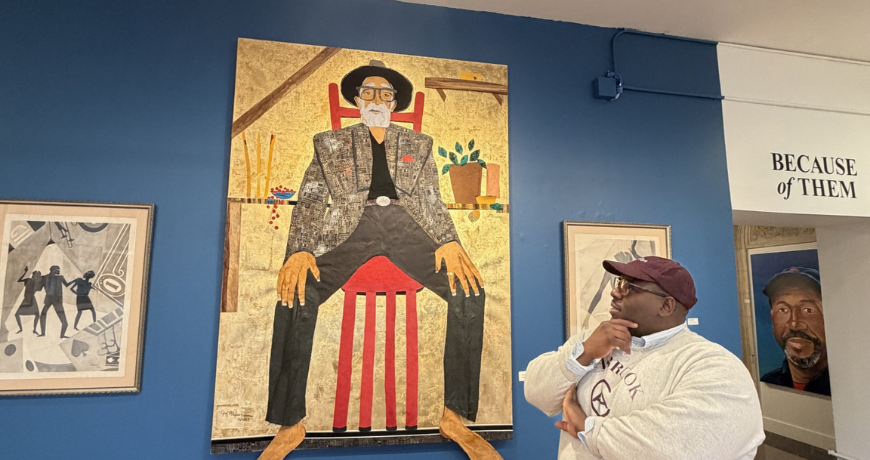
A left turn inside the gallery brings you face-to-face with a Judy Bowman piece that catches you like a familiar face—an older Black man rendered larger than life, looking outward with that steady Detroit kind of calm. People walk past, then come back. The pause gets longer. Somebody leans in like the paint is talking. Stand there long enough and it stops being “a work on the wall” and becomes what it’s holding: Black memory in plain sight.
Jones didn’t grow up inside this world and frankly, he doesn’t pretend he did.
“Like I wasn’t exposed to art at all,” he said.
Detroit still raised him in culture. This city hands you rhythm before it hands you rules. It teaches you how to see before it teaches you what to call what you’re seeing. Culture has never been scarce here—sound, style, story, survival. What’s been uneven is access to the formal “art world” and the playbook that sits behind it: who learns how to buy, how to price, how to keep, how to insure, how to pass down. People learn how to spend. Fewer learn how to turn spending into inheritance.
Jones built his eye through the places Black Detroit has always built taste—film, music, and the visuals of Black life that don’t require permission to be real.
“I watch a lot of movies from the 90s,” he said. “Spike Lee is my favorite director.”
“Almost like how you like to pair your wine with food, right?” he said. “Music is my pairing to what I’m actually really into in terms of art.”
He named Love Jones when he talked about poetry and Black interior life. He named Boomerang when he talked about aesthetics—Black professional imagery rendered with intention and self-possession. Those references didn’t hand him a museum map. They trained him to recognize care and story on sight, then trust what moved him before he had the vocabulary to explain it.
“The moment I knew I fell in love with art is when I walked in front of a piece a few years back, a Judy Bowman piece specifically,” Jones said. “And I looked at it for maybe 10 or 15 minutes… I couldn’t articulate why I liked the piece, but it moved me in a way.”
“Sometimes you may not have the sophistication to talk about the medium or the technique, but it actually stopped me,” he said.
“One thing I love about art is it actually slows you down because I can sit there and consume something that doesn’t move,” he said.
That slowing down matters for someone whose day job rewards speed and certainty. Strategy asks for answers. Finance asks for decisions. Art asked him to sit with feeling, to sit with history, to sit with the truth that Black life has always been documented—and too often controlled by somebody else. That’s where collecting stopped being about taste and started becoming about responsibility.
“Maybe I should consider being a cultural steward and not just an art collector,” Jones said. “Because being an art collector, it is just collecting things. I think my mission is to make sure we own our culture.”
The name of the exhibition came the same way the show did—through conversation, through trying to put language on something bigger than a single gallery run. Jones said he and Reed kept circling ideas, trying to find a title that honored the people who built the path without turning their legacy into a slogan.
“We couldn’t figure out the name,” Jones said.
He remembered the moment it clicked, it came from the elder who had been helping him understand the art world from the inside out.
“Mr. Harper said, well, I’m trying to say bridges because of them,” Jones recalled.
The phrase held what Jones and Reed were trying to make visible—artists whose hands kept working even when institutions didn’t look their way, collectors who protected the work in private when public validation lagged, and a Detroit lineage that made a show like this possible in the first place. It also held Jones’ own path: a man raised in culture who had to learn the architecture behind it.
Jones is quick to give credit for how he learned the art world’s rules and language, and he points to Henry C. Harper.
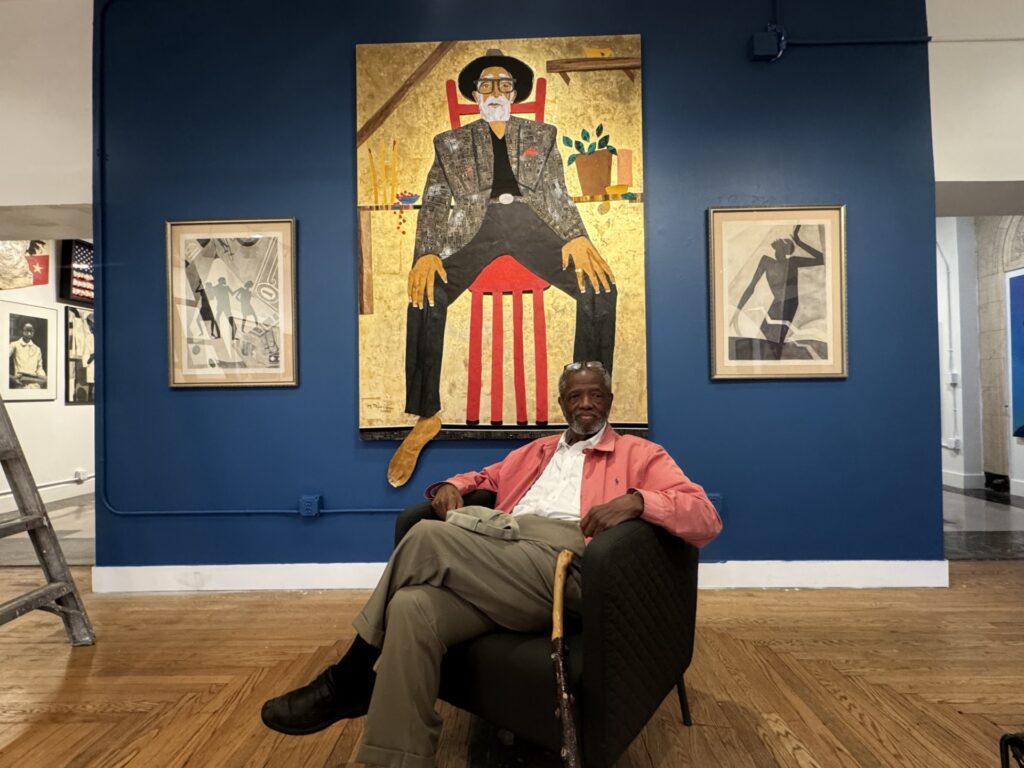
Photo: Henry C. Harper at Carr Center, Bridges Because of Them exhibit
Harper is a fine art advisor and certified appraiser with 55 years in the art and antique business, a man who has advised families and built collections in Detroit long enough to see patterns repeat.
“Building personal wealth is something I’ve done for 50 years and work for some of the most prominent families in all of Detroit,” Harper said.
“I’ve been particularly happy working for African-American families, building African-American wealth because that’s something we don’t know anything about,” he said.
“We have to become culture keepers,” Harper said. “Keeping our own culture by buying our own art support and our own artists.”
“We’re into Gucci, Louis Vuitton and all that stuff,” he said. “That stuff is not investment worthy.”
In Detroit, that critique lands with a hint of complexity. Style here has never been shallow—style has been language and armor, artistry and defiance. Harper is naming a system that trains Black people to consume status while leaving the pathways to legacy behind a gate, then challenging Black Detroit to move differently with what we earn.
“You don’t have to be into art to enjoy this exhibition,” Jones said. “If you’re into culture, if you’re into history even just aesthetics, you can find a place and a piece that resembles you.”
The range is deliberate, built to carry multiple time periods at once without flattening Detroit’s Black art history into a single mood.
“We wanted to go big and powerful and important,” Jones said. “We wanted to have a mixture of artists who represented certain time periods as well, all the way down to artists who are in their first year and you have some self-taught artists.”
“It starts off with women, and it starts off with history,” he said. “And then as you go to the end of the exhibition, because there’s three galleries, you would see more of the modern and contemporary artists.”
Detroit has needed that kind of bridge because the city’s Black artists have been producing, innovating, and shaping visual language for generations while fighting for consistent visibility and infrastructure. The record is not new. A key reference point sits in 1969, when Detroit Artists Market director Gloria Whelan asked Charles McGee to curate an all-Black exhibition because Black artists weren’t getting visibility in the city’s broader arts ecosystem. The show, “Seven Black Artists,” became a hinge point that helped lead to McGee opening Gallery 7—another Detroit bridge built by Black hands when the main road wasn’t built for us.
Collecting has a Detroit lineage too.
The Detroit Institute of Arts’ exhibition “Detroit Collects: Selections of African American Art from Private Collections” described a long regional history of private collectors collecting African American art, making collectors part of the story rather than treating them like a footnote. That context matters because it pushes back against the lazy myth that Black people don’t invest in art or don’t preserve. Black Detroit has been doing that work. The question has been how widely the knowledge and access get shared.
Harper has been building one of those entry points through the Detroit Fine Arts Breakfast Club, which meets on Mondays at the Marygrove Conservancy. The business of art becomes less mysterious when the language is shared out loud in community, when the questions get asked without shame, when people who are still learning sit next to people who have been doing this for decades.
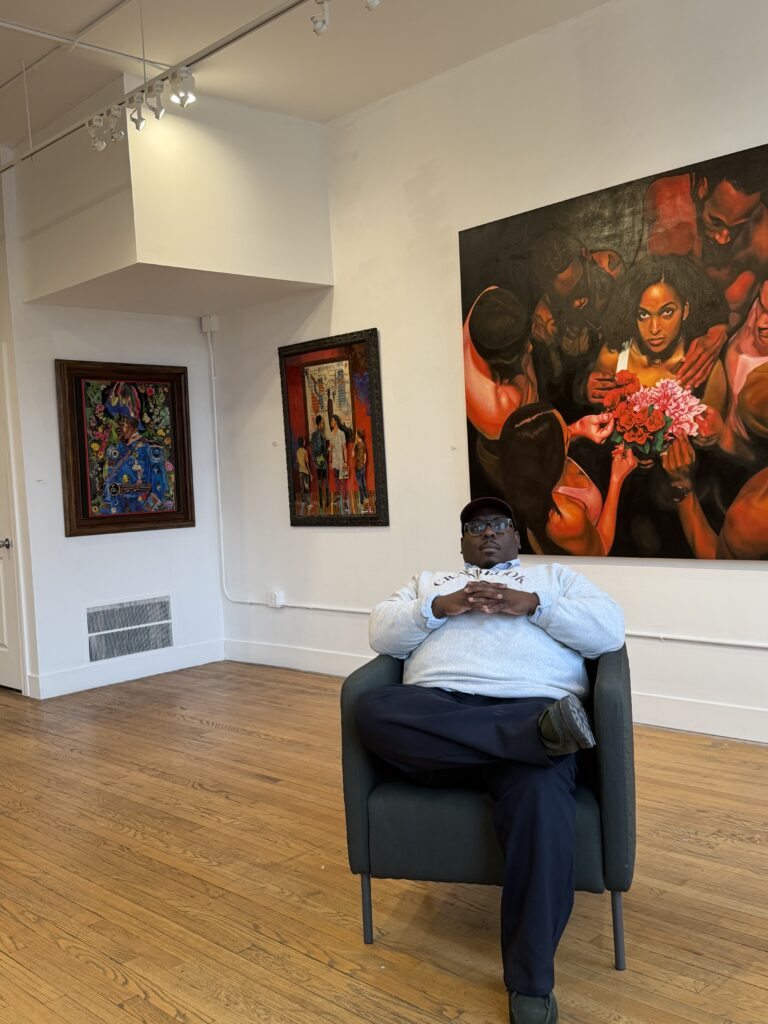
Photo: Kendale L. Jones at Carr Center, Bridges Because of Them exhibit
“What’s going on right now in the political systems, it’s important for us to be able to tell stories as they are silencing voices,” Jones said. “Art has always been political and they can’t take a painting off your wall, right? They can’t stop you from displaying the work that has a message.”
Detroit knows how quickly narratives get rewritten when power shifts. It knows how often Black history gets reduced, distorted, packaged, or erased. A piece on your wall becomes something else under that pressure—proof, testimony, a record you control.
That’s what makes Jones’ arc feel less like a personal reinvention story and more like a lesson about what curiosity can become when it meets an elder with a blueprint. He built stability in the safest lanes available, then let himself be pulled by something that demanded more of him.
The “Bridges Because of Them” exhibit is the visible outcome: a public room where Black Detroit can stand in front of its own record, recognize itself across generations, and leave with a clearer sense of what it means to keep what we create.