
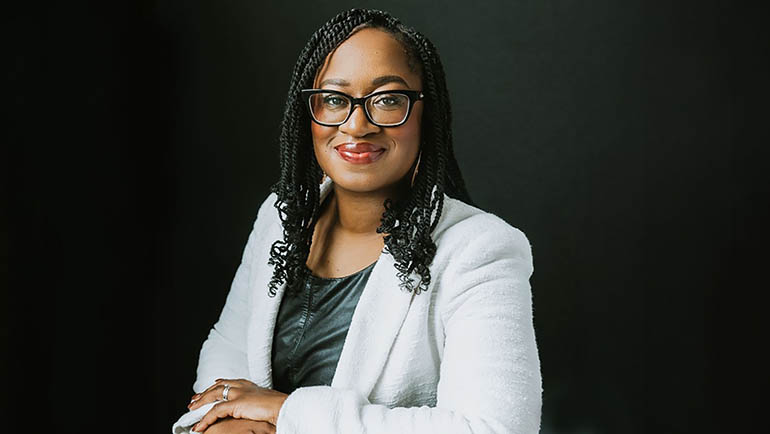

As the nation prepares to shine a spotlight on the life and legacy of Dr. Martin Luther King, Jr. as part of the annual celebrations of the civil rights leader’s birthday, Brown University historian and Africana Studies professor Dr. Keisha N. Blain is ready to peer into the shadows.
While many celebrations will rightly center on King’s life and work, Blain — who will give the keynote address at Wayne State University’s Martin Luther King Day Tribute on Jan. 16 — will turn her attention to the countless women who toiled largely in obscurity and behind the scenes to make the Civil Rights Movement of the 1950s and ‘60s a success. Blain’s keynote will be in keeping with this year’s theme for the annual MLK celebration, “Women of the Movement: Then and Now.”
Ahead of her appearance on campus, Blain took time to reflect on the importance of broadening our collective memory of the Civil Rights Movement, the legacy of Black women activists in Detroit and what today’s movements can learn from figures like Fannie Lou Hamer.
When people think of the Civil Rights Movement, Dr. King is often centered. Why is it essential, especially today, to foreground the women who organized, strategized and sustained the movement?
Dr. Keisha N. Blain: We need to expand the scope of how we envision the Civil Rights Movement because highlighting only one leader distorts our understanding of history. Mainstream accounts tend to elevate Dr. King and other men, and while their contributions were important, no movement succeeds because of one individual — no matter how influential.
Social movements are successful when a diverse group of people contribute in different ways. The Civil rights Movement would not have achieved what it did without countless activists working at every level. Fannie Lou Hamer is a powerful example. She was a Black woman sharecropper with limited formal education and resources, yet her passion for justice led her to join the Student Nonviolent Coordinating Committee, which embraced group-centered leadership inspired by Ella Baker.
Hamer’s work — from grassroots organizing to her unforgettable 1964 speech at the Democratic National Convention — helped pave the way for the Voting Rights Act. Expanding our understanding to include people like her offers a far more accurate picture of how movements are built and sustained.
Many women of the movement worked behind the scenes rather than at podiums. How did that invisibility shape both the success of the movement and the way history has remembered it?
Blain: Black women have long occupied a uniquely marginalized space, experiencing racism, sexism and classism simultaneously. For much of the nineteenth and twentieth centuries, they were excluded from formal halls of power dominated by white men. Yet, even without institutional backing, Black women found ways to advance their political agendas through creative, pragmatic collaborations.
They relied on alternative spaces — churches, sororities, Black women’s clubs — to organize and assert influence. Because this work often took place outside traditional political arenas, it has frequently been sidelined or erased in mainstream historical narratives.
My scholarship is part of a broader effort to correct these distortions and to show how Black women’s political engagement, though unconventional, was central to both national and global struggles for justice.
Detroit has a deep history of Black women leading struggles for labor rights, housing and education. How does that legacy intersect with the national Civil Rights Movement?
Blain: Detroit was a critical site of Black political organizing in the early twentieth century. During the Great Depression, Black women in the city developed survival strategies that emphasized economic self-sufficiency and community empowerment. One example is the Housewives’ League of Detroit, founded in 1930, which mobilized thousands of women to support Black-owned businesses and employers who hired Black workers.
I’ve also researched lesser-known organizers like Pearl Sherrod, whose activism helped shape political movements in the city. These women laid the intellectual and organizational groundwork for the civil rights and Black Power movements that emerged nationally decades later. Detroit’s legacy reminds us that local activism often fuels national transformation.
How can universities like Wayne State honor the contributions of women in social justice movements beyond commemorative events like MLK Day?
Blain: Higher education is at a precarious moment. Efforts to advance social justice are increasingly targeted for erasure and backlash. Honoring the legacy of women activists requires more than symbolic recognition — it requires protecting the people and principles those women fought for.
Universities must recognize their collective power to push back against rollbacks of civil rights protections, whether through attacks on faculty, funding cuts or the dismantling of affirmative action. Honoring past sacrifices means defending inclusive spaces for learning today.
In what ways do you see the influence of women from the 1950s and 1960s in today’s movements for racial, gender and economic justice?
Blain: The women of the Civil Rights Movement understood that democracy in the United States was — and remains — incomplete. While there have been significant gains, racism and white supremacy persist. We can see a direct line from the Civil Rights Movement to today’s struggles, especially around voting rights.
At the grassroots level, leaders such as Stacey Abrams, LaTosha Brown and Aimee Allison are continuing the fight against voter suppression and building on the foundations laid by earlier generations. Their work reflects the enduring influence of women who never accepted partial freedom as enough.
As we commemorate Dr. King’s legacy through the lens of “Women of the Movement,” is there a figure you wish more people truly understood?
Blain: Fannie Lou Hamer remains deeply instructive for our current moment. Her life demonstrates the power of moral conviction and truth-telling. There were few indicators that she would rise to national prominence, yet she transformed American politics by organizing at the grassroots level.
Her declaration “Nobody’s free until everybody’s free” captures a vision of justice rooted in empathy and collective liberation. Those five words still offer a roadmap for the ongoing struggle for civil and human rights.