
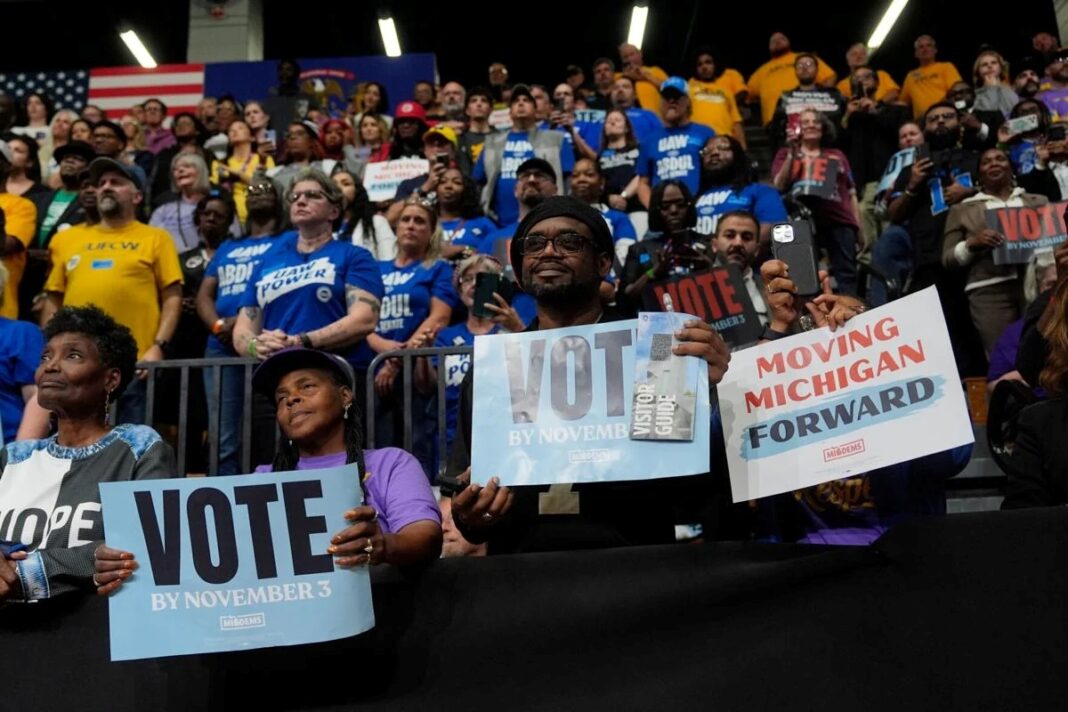


Michigan voters appeared poised to deliver a powerful message at the ballot box as Democrats moved toward a potential sweep of the state’s four most closely watched statewide contests, including governor, U.S. Senate, secretary of state and attorney general.
The emerging results suggested a significant night for Michigan Democrats, with the party positioned to retain its hold on the state’s executive leadership while potentially strengthening its influence in Washington.
Just before 1 a.m. the morning after Election Day, with roughly 63 percent of precincts reporting, Democratic candidates were projected to win all four statewide contests, according to the Associated Press election results.
The projected victories would represent a significant political achievement for Democrats in a state that has become one of the nation’s most consequential electoral battlegrounds.
The four contests carried implications extending well beyond Michigan’s borders. The governor’s race would determine the state’s direction for the next four years. The U.S. Senate contest could influence the balance of power in Washington, while the secretary of state and attorney general races would determine who oversees critical election administration and legal responsibilities.
Benson Leads Democratic Push for Governor
Democrat Jocelyn Benson, Michigan’s current secretary of state, faced Republican U.S. Rep. John James in the race to succeed term-limited Gov. Gretchen Whitmer.
A Benson victory would mark a continuation of Democratic leadership in the governor’s office and give the party an opportunity to build upon the policies and priorities advanced during Whitmer’s administration.
Benson’s campaign centered on protecting voting rights, strengthening Michigan’s economy, expanding opportunities for working families and preserving access to reproductive health care.
James, who represents Michigan in Congress, sought to capitalize on Republican support and concerns surrounding the economy, inflation, public safety and the direction of state government.
The contest attracted considerable national attention because Michigan remains a critical swing state in presidential and congressional elections.
A Democratic victory would also make history as Benson sought to become Michigan’s next governor following her tenure overseeing the state’s election administration.
El-Sayed’s Senate Bid Delivers National Stakes
The U.S. Senate contest between Democrat Abdul El-Sayed and Republican Mike Rogers represented another defining moment of the evening.
The open seat became one of the country’s most closely watched Senate races following the retirement of Democratic Sen. Gary Peters.
El-Sayed, a physician and former Wayne County health director, campaigned on an economic and healthcare agenda emphasizing affordability, expanded healthcare access and money out of politics.
Rogers, a former congressman and former FBI agent, sought to return to Washington with Republican backing and a platform emphasizing economic growth, national security and conservative priorities.
A Democratic victory would provide the party an important opportunity to defend Michigan’s Senate seat and strengthen its position in the closely divided U.S. Senate.
The contest represented more than a choice between two candidates for Michigan candidates. It was a referendum on the direction of federal policy and the state’s influence in national decision-making.
Gilchrist Positioned to Become Michigan’s Next Secretary of State
Democrat Garlin Gilchrist, Michigan’s lieutenant governor, faced Republican Anthony Forlini, the Macomb County clerk, in the secretary of state contest.
The office carries enormous responsibility, particularly in a politically competitive state where election administration, voting access and public confidence in election results remain major issues.
Gilchrist’s candidacy represented an opportunity for Democrats to maintain continuity in an office that has been led by Jocelyn Benson.
As lieutenant governor, Gilchrist brought statewide political experience and familiarity with Michigan’s executive branch.
Forlini, meanwhile, campaigned on his experience administering elections at the county level and his perspective on election operations.
A Democratic victory would preserve the party’s control of the office responsible for overseeing voter registration, elections and the administration of Michigan’s motor vehicle services.
For Detroit and communities across the state, the outcome could have significant implications for how voters interact with the election system in coming years.
Savit Victory Would Extend Democratic Control of Attorney General’s Office
Democrat Eli Savit, the Washtenaw County prosecutor, faced Republican Doug Lloyd, the Eaton County prosecutor, in the race for attorney general.
With Democratic Attorney General Dana Nessel unable to seek reelection because of term limits, the contest offered voters an opportunity to determine whether the office would remain under Democratic leadership.
Savit campaigned on his prosecutorial experience and commitment to consumer protection, civil rights and accountability.
Lloyd sought to present himself as an alternative focused on public safety, prosecutorial independence and conservative legal priorities.
The attorney general serves as Michigan’s chief legal officer, representing the state in legal matters and enforcing laws affecting consumers, businesses and residents.
A Democratic victory would extend the party’s leadership of the office and potentially maintain continuity in its approach to civil rights, consumer protection and state-level legal challenges.
Detroit and Michigan’s Changing Political Landscape
The emerging Democratic performance underscored the importance of Detroit and other urban communities in determining statewide election outcomes.
Detroit voters, along with residents in Wayne, Oakland, Genesee, Washtenaw and other counties, play an important role in shaping Michigan’s political direction.
Black voters in Detroit and surrounding communities have historically represented a critical constituency for Democratic candidates. Their participation, alongside support from suburban voters, younger voters and organized labor, can help determine the outcome of statewide contests.
The election also came at a time when Michigan families continue to confront concerns about housing costs, healthcare affordability, education, employment opportunities and the future of the state’s manufacturing economy.
For many voters, these issues represented everyday concerns affecting household budgets, neighborhood stability and the opportunities available to future generations.
The results will offer political leaders an important indication of which messages resonated with voters and which issues will demand immediate attention.
A Defining Night for Michigan Democrats
If the four Democratic victories are confirmed, Tuesday’s election will represent a substantial achievement for the party and provide its leadership with a renewed mandate to govern.
The potential sweep would place Democrats in control of the governor’s office, secretary of state and attorney general positions while defending Michigan’s open U.S. Senate seat that has national implications.
However, early election-night numbers should be interpreted cautiously. With only a portion of precincts reporting, substantial numbers of ballots remain to be counted. Results from Detroit, suburban communities and other major population centers could change the margins as additional precincts report.
Michigan election officials will continue counting ballots, and the Associated Press will update its results and race calls as additional information becomes available.
For now, the developing election-night picture points toward a consequential moment in Michigan politics.
From Detroit to Lansing and from communities across the Lower Peninsula to the Upper Peninsula, voters have helped shape the state’s political future.
If the projected results hold, Michigan Democrats will have delivered a message that reaches far beyond Election Day: the state’s political direction remains firmly in contention, and voters have chosen to give Democratic leadership another opportunity to deliver.