
Detroit’s Black press has always understood that policy conversations mean very little if they never touch the people living with the consequences.
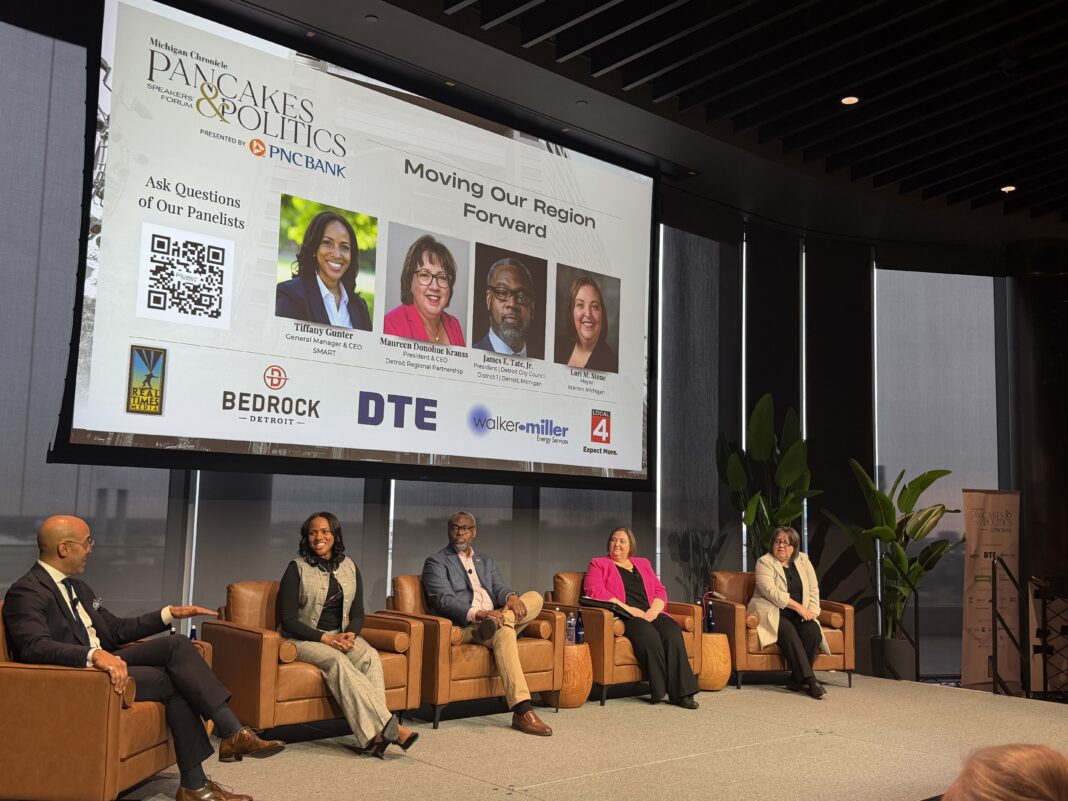
That truth sat at the center of Michigan Chronicle’s first Pancakes & Politics forum of the season, where regional leaders gathered inside the top floor of One Campus Martius to talk plainly about what it will take to move Southeast Michigan forward.
Now in its 24th season and as Michigan Chronicle marks 90 years of telling the stories of Detroit’s Black community, the forum opened with a timely theme: moving our region forward. Highlighting regional progress, public transit, neighborhood investment, and whether this moment of collaboration can actually deliver for the people who need it most.
Since 1936, Michigan Chronicle has stood at the forefront of Black journalism in Detroit, carrying news, advocacy, and accountability reporting rooted in the lived experiences of Black communities. That legacy was acknowledged Wednesday morning as Hiram E. Jackson, President of Real Times Media and Publisher of Michigan Chronicle, reflected on the paper’s founding and the deeper purpose behind the Pancakes & Politics series.
“John H. Sengstacke the founder of Chicago Defender sent Louie Martin with $10 in cash and a one way ticket to Detroit,” Jackson said. “The Michigan Chronicle sought to tell the stories and advocated for the Black community. 90 years later we still face adversities but within a spirit of community and likeminded people together, we can push forward. That’s why Pancakes and Politics is so important.
“We still carry the fight of Louie Martin, 90 years later. Thank you for supporting the principles that Louie Martin started in 1936.”
Martin, widely known as the Godfather of Black politics, built a platform that connected journalism to power and power to community. That history mattered in the room Wednesday, especially with so many elected officials in attendance and so much of the conversation centered on access, equity, and whether the region is finally ready to stop treating shared progress like an abstract concept.
Dennis Archer Jr., who moderated the opening forum, got right to one of the region’s longest-running pressure points: transportation.
He began by asking Tiffany Gunter, general manager and CEO of SMART, about the role transit plays in moving the region forward and why Southeast Michigan continues to lag when it comes to a truly connected system.
“Regional transit has been stuck here in Southeast Michigan,” Archer said. “There’s a ballot initiative that allows some communities to opt out, what are those initiatives.”
Gunter said the timing of the question was fitting.
“Today is national transportation day, so this is a perfect topic right now,” Gunter said.
She did not sugarcoat the challenge.
“We do not have a comprehensive transit system but we do have the opportunity to do so today,” she said. “We are up 40% when it comes to users since last year. I credit it to my team. My focus is back to the basics. Its not uncommon to see me or my leaders in the garages at 3:45 in the morning with our drivers. We are at 77% on time for stops right now and that’s still not enough but it is progress.”
Gunter said the ballot initiatives are central to the future of public transit because they serve as baseline funding and help position the system to leverage state and federal dollars. She pointed to Wayne County in particular.
“In Wayne County they’re pushing this initiative because there will be no opt outs,” Gunter said. “This will be historic, given the success in August to have a comprehensive transit system.”
Archer brought up a truth that often sits underneath conversations about regional transit in Southeast Michigan but does not always get said out loud.
“Race plays a huge role as to why this isn’t moving,” Archer said. “But I’m happy to see that we have three county executives that are partnering with you and making this happen.”
That tension between history and opportunity continued throughout the discussion. Maureen Donohue Krauss, president and CEO of the Detroit Regional Partnership, said the outside world often assumes Detroit already has the kind of transit system expected of a major city.
“It’s an expectation that we have it but we have to explain that we’re motor city and we’re built on cars,” Krauss said. “Companies around the world think that Detroit is a world class city so they should have a world class transit system but we don’t. We can be the motor city and still have a quality transit system. It doesn’t have to be one or the other.”
Warren Mayor Lori Stone said transit matters well beyond Detroit’s borders.
“I’m very proud that Macomb has been a leader in public transit,” Stone said. “There’s a significant number of residents in our community who relies on transit.”
Detroit City Council President James Tate Jr. made clear that the stakes are especially high for Detroit residents, many of whom depend on public transportation to reach jobs, schools, and opportunity.
“The ballot initiative is huge for the City of Detroit from our perspective,” Tate said. “I called DDOT and asked what is it going to take to have a world class system in Detroit and they began to give me budget numbers for this year but I pushed back to say no, we have to think beyond this year. We cant just put band aids on the situation.”
Tate said higher wages have helped produce some improvements, though more work remains.
“We have to ensure that the talent that are in our local communities have the opportunity to use the transit system to get to the jobs,” he said.
He added a message aimed at people who may not see themselves in transit debates.
“Even if you’re not a transit rider it is important that we stick behind this ballot initiative,” Tate said.
That point landed because transit was not discussed as a side issue. It was discussed as economic infrastructure. It was discussed as workforce access. It was discussed as a regional test of whether leaders are truly prepared to share responsibility for shared outcomes.
Archer later asked Tate how Detroit can continue to grow downtown while equitably distributing investment across the city’s neighborhoods.
“The investment that we make downtown is different than our neighborhoods,” Tate said. “With the neighborhoods, it’s quality of life focused but when we talk about downtown its already attracting so there’s some assistance that we will continue to add but our investments in the neighborhoods are very important.”
He pointed to the city’s financial position as a sign that Detroit has room to think beyond short-term fixes.
“Our balance sheet reflects $550M in reserve so we can think bigger and we’re going to do that to make sure our programs are accessible and visible to our residents,” Tate said.
Stone was asked about regionalism in a more direct way, including why major cultural and economic activity too often appears to stop at Eight Mile. She responded by talking about the need to build up every corner of the community while embracing a broader partnership with Detroit.
“It is imperative that we are building on economic development in every corner of the community and people are excited about downtown Detroit which is exciting but in Warren we have some challenges,” Stone said. “Having to revisit our zoning, we have over 200 vacant lots that are in desperate need of housing.”
She said Warren is also rethinking what commercial and mixed-use space can look like as the city plans for the future.
“We benefit when Detroit prospers because that spreads throughout the entire region,” Stone said. “During our previous administration Warren was insular, and only wanted to take care of their own. It’s diverse now. These partnerships creates community impacts. Take the NFL Draft for instance. It made people see the impact nationally.”
The conversation also turned to how construction and development opportunities can be distributed more equitably.
Tate said the city is trying to move closer to residents and potential vendors instead of expecting them to navigate systems on their own.
“We are now going out and having workshops within neighborhoods,” Tate said. “That’s the impact of exposure and tools. So those who want to can actually acquire contracts because they now know how because now, we go to them. That’s our focus getting deep into our community.”
Gunter echoed that point from the transit side, noting that public agencies must become more intentional about opening doors for small businesses.
“Buses aren’t cheap, they’re just as much as your Lamborghinis,” Gunter said. “We spent $50M in 2024 in Michigan alone just buying widgets. But what we haven’t done was reach out to small businesses but we do now have a small business outreach to bring in the community.”
She said there is significant opportunity ahead, both inside the organization and through future investment.
Technology also surfaced as a key part of forward mobility. Gunter said transit agencies are working to modernize both rider experience and service delivery.
“SMART and DDOT combined carriers 23 million people per year,” she said. “We do have an app, its the transit app, you can see real time when your ride is arriving. All of those are important and we offer wifi on our fast routes. All around the region you’ll start to see that SMART looks better. Our shelters are better and now we can take it to the next level.”
She pointed to the NFL Draft as proof that transit systems can rise to meet major regional moments.
“SMART carried almost 30k people for the NFL Draft weekend alone,” Gunter said. “If we can coordinate with planning we can do the same with the resources we have now. Federal dollars can be competed for and brought here.”
One of the strongest applause lines of the morning came when Gunter announced a coming effort to support student riders.
“We are rolling out a program in the coming weeks that students can ride for free,” she said. “I want to make sure kids have access to transportation. And we’re doing so in partnership with the City of Detroit as well. If they have a student ID they can get on the bus.”
Tate confirmed Detroit is moving in the same direction.
“We’re doing the same with DDOT,” he said. “That’s coming up in the budget, students will ride free.”
By the end of the conversation, the panel shifted from diagnosis to responsibility. Archer asked what people in the room could do to help move each leader’s work forward.
Gunter kept it simple.
“Take the bus, experience the system,” she said. “I have had the experience to see what my riders are experiencing, it’s front door service, give it a shot, try a bus. We want to engage with organizations so ask us those questions, challenge us, we’re here for you and we want to hear from you.”
Tate called for investment and deeper engagement with Detroit’s young people.
“Invest, Detroit is open for business,” he said. “We want you to provide your energy and we have challenges like any other city but we are in position looking for partners. We want to continue to keep that line of communication open and ensure that we are exposing our youth to exposure and opportunities. Take some time to spend some time with our young folks.”
Stone urged the region to stop wasting energy competing against itself.
“Let’s work smarter not harder,” she said. “We spend a lot of time competing at the expense of others, but what we find is in times where every economic demand is felt across our country we are looking at how do we work smarter and not alone.”
Krauss closed on a similar note, framing this moment as a rare opening for the region to change both its internal culture and its external reputation.
“An issue I’ve been thinking about is how this region has spent a lot of energy competing and fighting with each other,” Krauss said. “Its really the image of how outsiders view us. If they see us always fighting with each other no one wants to deal with it. I have never seen a region like this moment right now where everyone gets along. I am excited with this opportunity of actually getting along and actually working together. We will go much further along as a world class region, with a mantra that, you can be successful here.”
Ninety years after Louie Martin arrived in Detroit with little more than purpose and a one-way ticket, Michigan Chronicle is still convening the kind of room where power has to answer to people. That remains the value of Pancakes & Politics. It is not just who shows up. It is what gets said when the region is forced to confront whether it is truly ready to move together.