
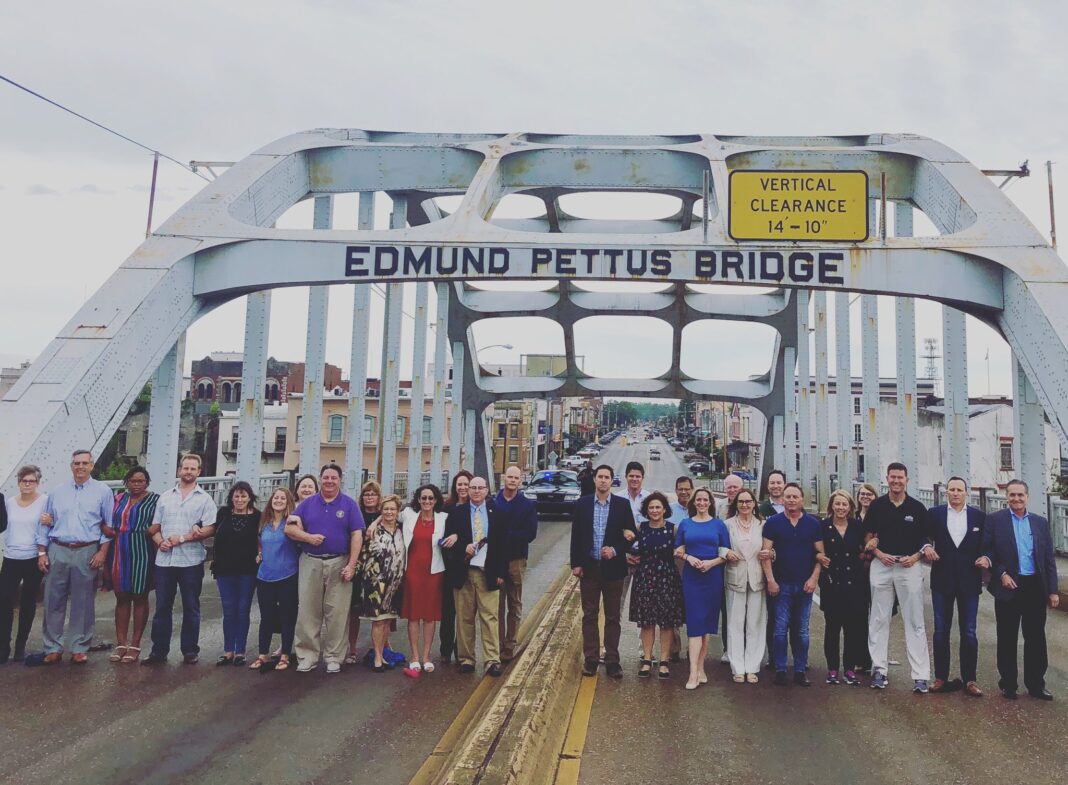

Michigan Secretary of State Jocelyn Benson, the frontrunner to become the Democratic nominee for governor, is spending the weekend in Selma, Alabama for the annual celebration of Civil Rights leaders who fought for the right to vote.
As Michigan’s elections chief, Benson has championed the work of Black voting rights activists of the Civil Rights era, who she says are a central inspiration to her work. She’s been going to Selma to walk the Edmund Pettus Bridge to honor them for 30 years.
Voting rights remains the unfinished work, Benson said in an interview Thursday with Michigan Chronicle from inside Detroit homeless and treatment shelter, Mariners Inn.
Benson is one of two Democratic candidates for governor, with Genesee County Sheriff Chris Swanson. Lt. Gov. Garlin Gilchrist backed out of the race to run for Secretary of State earlier this year.
On Sunday, she’ll join nationwide advocates in the annual march across the Edmund Pettus Bridge. It’s the site of Bloody Sunday, March 7, 1965, where peaceful demonstrators were terrorized by police who rode horses while striking marchers with batons and tear gas.
Six decades later, the annual march serves as an emotional reminder of the country’s racist past and the sacrifice of Civil Rights activists who risked their lives and freedom to demand equal voting rights for Black Americans.
“I started working down there in Alabama in the late 90s and I go back personally every year,” said Benson, who started her career at the Southern Poverty Law Center investigating hate crimes in Alabama.
“I even went back during covid, when John Lewis made the final track in his casket in July of 2020 — I didn’t tell anyone,” She said. “I drove down and wanted to be there for that moment because it’s personal for me. I’ve heard incredible stories that oftentimes aren’t told about what it was really like to organize and march and how scary it was.”
It’s one thing to stand on the Edmund Pettus Bridge on the day of the anniversary, it’s another to be there just any other day, Benson said.
“You see the poverty, you see the isolation, you see how scary it could be to stand against Alabama state troopers who are standing there ready with their tear gas and batons to stop people from marching for voting rights,” Benson said.
Benson told the Chronicle that in prayer amid crossing the bridge during her 1999 visit, she dedicated herself to continuing the work toward racial equality.
“All I ever wanted to be in that moment and through my life was someone who would have stood at the foot of that bridge and been courageous enough to march forward anyway,” Benson said. “And that created my whole life, everything I’ve done. The reason I moved to Detroit was to clerk for Judge Damon Keith — so that I can learn from him about what the unfinished work of that movement was.”
Benson compared the current GOP effort to eliminate the state’s affidavit option for voters unable to provide ID at the polls to tactics used in the past to prevent Black Americans from voting. Under the constitutional amendment passed in 2022, voters without ID can cast a ballot by signing an affidavit confirming their identity. It’s a crime to lie on an affidavit, but election officials can’t undo the vote after it’s cast.
On Thursday, the GOP-backed Citizens Only Voting constitutional amendment campaign submitted 750,000 signatures to the state’s Bureau of Elections moving forward their effort to place the proposal on the ballot. The proposal’s language states that for voters unable to prove citizenship or obtain a photo ID, a process would be put in place to ensure access to a state ID free of charge.
The group needs to collect 446,196 valid voter signatures to put its proposal before voters this fall.
Michigan conservatives seized on the news last year that an MDOS review identified 15 non-citizens that cast a ballot in the 2024 General Election. However, Benson recently shot down allegations of widespread fraud by noncitizens voting, saying the findings from Macomb County Republicans showing hundreds of potential noncitizen votes were the result of misread data.
“The fact that you have people using misinformation to try to potentially make it more difficult for for citizens to vote,” Benson said. “Michigan citizens vote — layers and layers are in place to ensure only eligible citizens are voting in our elections. It gets very, very difficult when you see partisan and politically driven changes to our elections that are not designed to make voting easier and more convenient, but are only designed to make people afraid to vote and create more hoops, not unlike the poll taxes and literacy tests of years past.”
Voting rights advocates say the proposal would create unnecessary barriers for voters to cast their ballot.
“What it will do is make it more difficult for all of us to register and vote, resulting in the disenfranchisement of tens of thousands of eligible American citizens across the state,” Promote the Vote Action’s Micheal Davis, Jr. said in a statement. “It’s voter suppression, pure and simple, and we’re confident Michigan voters will see this effort for what it really is.”
At last year’s jubilee in Selma, Benson met the sister of Viola Liuzzo, who was killed by Klansmen after driving from Detroit to Selma to join the hundreds of marchers that Sunday in 1965.
She was shot while driving Leroy Moton, a Black civil rights volunteer, back to Selma.
Liuzzo, a mother of five who was married to a Teamsters union organizer, is known as the only white woman killed during the Civil Rights movement.
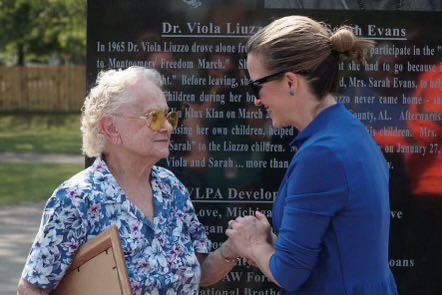
Mary Liuzzo Lilleboe, Liuzzo’s daughter, died last year at 77, the Free Press reported.
As a student at Cooley High School in Detroit, Mary Liuzzo witnessed the targeting of her family by local racists who shot through her home and littered garbage on their lawn. At one point, they burned a wooden cross in front of their home.
Viola stands memorialized in statue form at Liuzzo Park on Detroit’s west side, where a playground and memorial park are dedicated in honor of her and her friend, Sarah Evans.
You can view this year’s Selma Jubilee’s weekend event lineup here.
This year’s event is capped by a tribute to late Civil Rights icon Rev. Jesse Jackson, who died last month.