
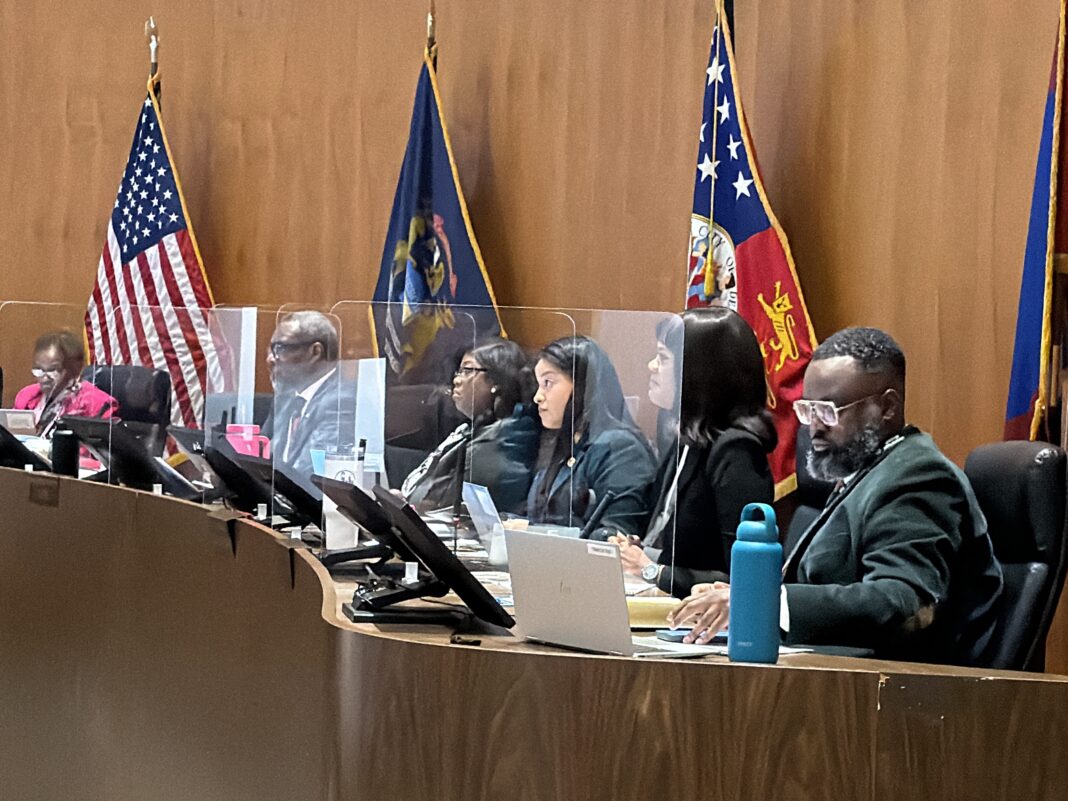

Detroit City Council began a new year with new members Tuesday in their first regular session after electing James Tate and Coleman A. Young II as council president and president pro-tem during a special session Monday.
This is the fourth council by district instead of an entirely at-large body, in which members represented residents from all parts of the city. Since 2013, the body has assigned one member to represent around 90,000 people based on geography.
When council members served entirely at-large, community members would engage them based on personal relationships, shared goals and values. Today, constituents are expected to reach out to the member who represents the district where they live.
New and returning council members have new residents this year as a result of citywide redistricting effort approved by council in a 8-1 vote in 2024.
The district boundaries approved then resulted in the least amount of changes, but was opposed by some Grixdale Farms residents in District 2. Their council member, Angela Whitfield-Calloway, the lone “no” vote.
District 4 councilwoman Latisha Johnson made the only acknowledgment of the changes Tuesday in announcing her first community coffee hour would be held in tandem with new District 5 council member Renata Miller, as the coffee shop sits on the district border.
Johnson, who chairs the planing and economic development standing committee, invited all District 4 and 5 residents to the coffee hour, set for Jan. 16 at 8am at the Commons, 7900 Mack Avenue. She also invited new council members to engage her with questions or concerns.
“So happy to offer any assistance because I remember four years ago, how things were just beign a newly elected official having never served in an elected position prior,” Johnson said. “I think it was differnet for us than it was for our colleagues who came from the state Legislature. I just wanted to let you all know I’m here and available.”
Here’s what to watch out for from Detroit City Council this year:
City Council’s relationship with the mayor’s office
The relationship between Detroit City Council and the mayor’s office requires collaborating to implement new policies to benefit residents. Detroit’s city council serves as the city’s legislative body approving budgets and ordinances proposed by the mayor’s office.
Former Detroit Mayor Mike Duggan is touting the positive relationship he had with council as he travels the state campaigning for governor as an independent. Duggan says prior to 2013, Detroit residents used to tape record council session broadcast on public television to watch it as entertainment because of how much infighting occurred.
Mayor Mary Sheffield has also talked about the disfunction prior to her first term on council in 2013 and amid the city’s municipal bankruptcy.
All signs point to another four years with a productive relationship between council and the mayor’s office. With so many familiar faces, including Sheffield, it would be a notable surprise if the relationship between the body and the office were to deteriorate.
The progressive vs. pro business factions
Council members don’t run with a party label next to their name as the city of Detroit’s elected offices are nonpartisan. However, special interests supporting candidate’s campaigns with large donations dictate the political perspectives and motivations of members.
Democratic Socialists of America and Working Families Party members powered Denzel McCampbell’s victory in District 7, defeating state Rep. Karen Whitsett, D-Detroit, who is viewed as a conservative Democrat. McCampbell joins Gabriela Sanitago-Romero and Johnson, whose stated values earned the support of one or both of those groups during their reelection campaigns.
On the other side of that coalition are Scott Benson, Mary Waters and Renata Miller. Miller during her remarks Tuesday thanked Benson and Mary Waters for helping her campaign for council. Miller, the daughter of a retired fire captian and nurse, defeated former Board of Police Commissioner Willie Burton in what became a contentious race to replace outgoing District 5 council member Mary Sheffield, who was sworn in as mayor last week.
She was supported by labor groups including the UAW, the Regional Council of Carpenters, while also receiving donations from several members of developer Gary Torgow’s family. She has advocated for “truly” affordable housing, which includes recalculating the formula for determining Area Median Income to better reflect Detroit residents.
While Waters hasn’t previously been viewed as pro-business, she has actively been stumping for Mayor Mike Duggan’s independent gubernatorial campaign during media appearances. Michigan Democrats have disavowed anyone who has broken with party ranks to support Duggan. Being a former Democratic leader in Lansing, Waters can expect similar treatment from her party.
It’s even less clear how new president James Tate, Angela Whitfield Calloway and Coleman Young will vote on issues that test members’ values.
What does appear clear is that Gabriela Santiago-Romero and McCampbell will support most if not all of each other’s proposals. Both candidates were backed by the Democratic Socialists of America and Working Families Party, which knocked thousands of doors to propel their candidates victories over two longtime state legislators in November.
Santiago-Romero, the chair of the health and safety committee, defeated state Rep. Tyrone Carter, a longtime state lawmaker who was criticized for his acceptance of corporate PAC dollars, specifically from the Maroun family, which owns and controls the Ambassador Bridge.
Monday’s vote isn’t necessarily a sign of the political direction of the council, but it did reflect a victory for the body’s more progressive members who have touted lofty proposals, some that would require legislative action in the state Legislature.
“This council can work together, I wouldn’t read much into that vote went down,” McCampbell said in an in an interview following council Tuesday.
Potential budget constraints
How much the city has left from the American Rescue Plan Act and how they plan to replace that funding once it’s gone is one of the most talked about issues facing Detroit city government.
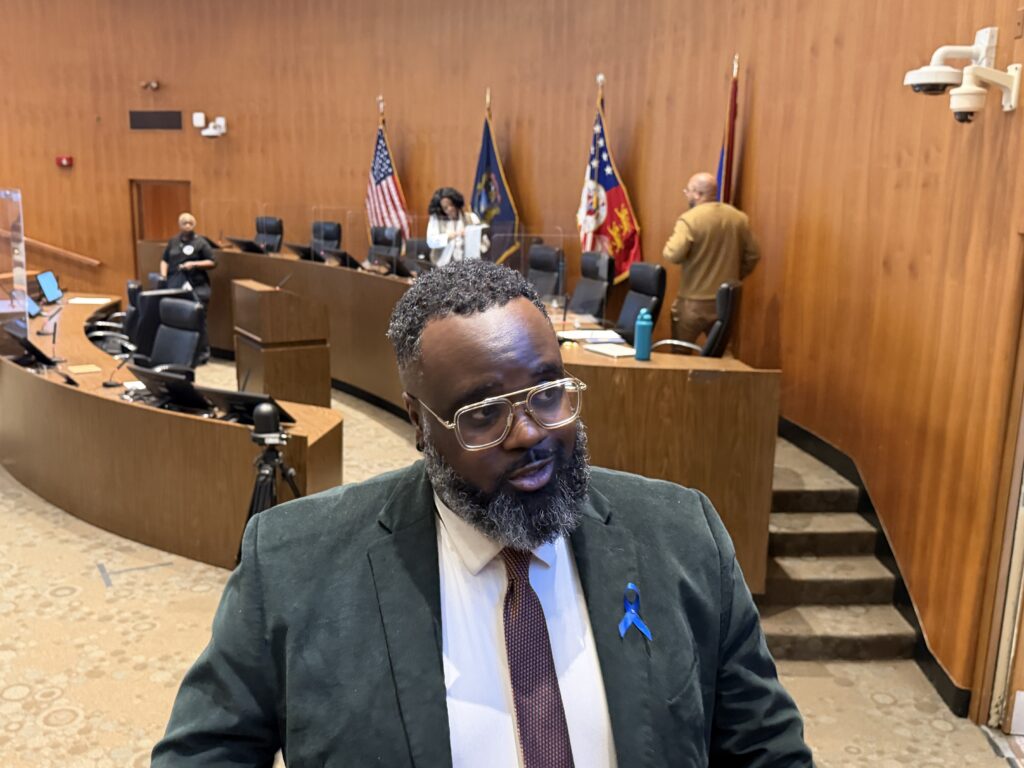
McCampbell, named the new chair of the budget, finance and audit committee, requested Tuesday the city’s legislative policy division to draft a report on ARPA funded programs and services and whether or not the city can fund them through general fund dollars.
“I want to make sure we’re thinking about this in the long term and engaging folks early on, including administration, and not just waiting until April,” the new west side council member told reporters.
Mayor Sheffield is inheriting a $105 million surplus, city leaders announced last month in one of Duggan’s final appearances as Detroit mayor. Duggan said the city’s reserve funds, made up of various pots meant for sustaining the city’s financial responsibilities, including the city’s new corporate income tax fund.
Duggan said in September last year the new fund would mean council doesn’t have to deal with cutbacks or deficits.
In total, the city reports $548 million in reserve funds.