
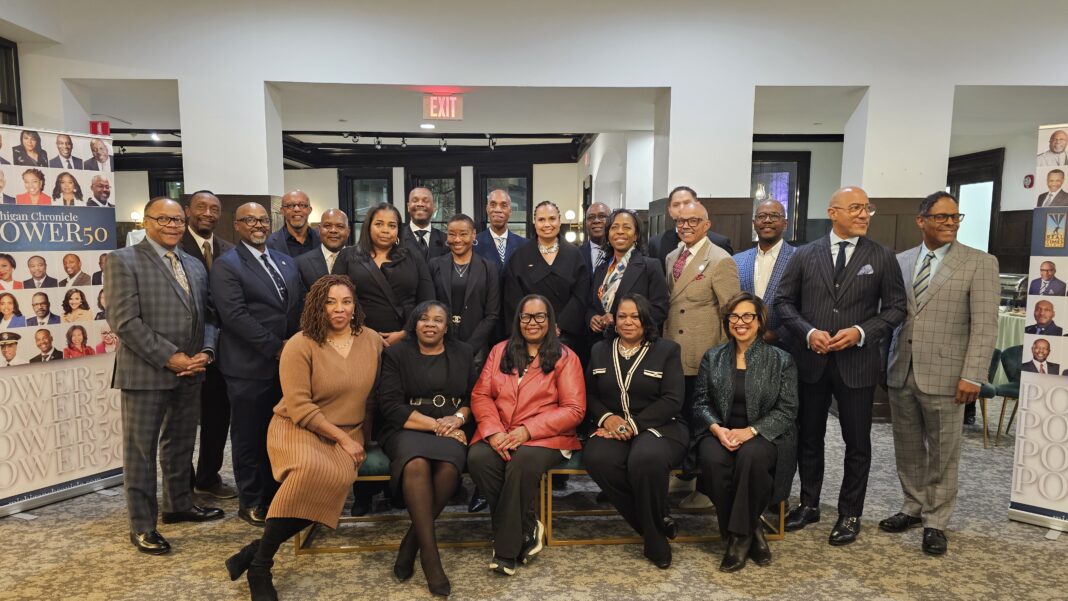

A powerful mix of Detroit’s most respected voices gathered at the historic Harmonie Club on Wednesday night for the Michigan Chronicle’s Power 50 dinner, creating a rare moment where influence, strategy, and community responsibility met at one table. It brought together a constellation of Black leadership rarely seen in a single space, convened by Michigan Chronicle Publisher and Real Times Media CEO Hiram E. Jackson with a specific charge: to reckon with the forces shaping Detroit’s future and to commit to the work that real change demands.
“This is a really special opportunity for us, bringing together 50 of Southeastern Michigan’s most powerful Black leaders,” said Jackson. “It’s not often that this many influential leaders are in the same room, but Michigan Chronicle and Real Times Media are all about highlighting African American excellence. Our celebration of the Power 50 group is one of the many ways we continue building on that legacy.”
The dinner drew leaders whose work shapes the political, economic, and social landscape of Southeast Michigan. Dennis Archer Jr. represented the city’s business leadership and civic engagement. Latrice McLendon of the Knight Foundation brought a philanthropic lens focused on informed communities and equitable investment. Chief Todd Bettison joined the conversation from Detroit’s public safety leadership. Michigan Supreme Court Justices Kyra Bolden and Noah Hood added judicial perspectives shaped by Detroit’s legal and civil rights legacy.
State-level leadership was also present through Michigan State Police Director James Grady, offering insight on statewide public safety systems. Wendy Jackson of the Kresge Foundation, long known for neighborhood and arts investments, contributed a view from one of Detroit’s most active philanthropic institutions. Political strategy also had a seat at the table through Butch Holloway, Chief of the Mayor-Elect Mary Sheffield “Rise Higher” transition team. The room held far more names than the list suggests, representing every sector that touches the daily lived experiences of Detroiters.
“The city is in a pivotal transition period with a new mayor being elected, and this is the perfect time for the Power 50 to come together and figure out how this amazing group of lawyers, doctors, philanthropic leaders, supreme court justices, and other leaders can have a collective impact,” Jackson said.
The evening functioned less as a dinner and more as a diagnostic.
Conversations turned to the tension between real estate development and economic development, a debate that has defined Detroit for decades as projects rise while questions of ownership and opportunity remain unresolved. Leaders examined the condition of Detroit’s education systems and the sustained work required to support young people. They discussed youth success not as a slogan but as a continuum shaped by schools, safety, mentorship, and opportunity. Intergenerational poverty, one of the city’s most enduring structural barriers, prompted discussion of policy, investment, and community-led solutions.
These issues have shadowed Detroit across administrations, funding cycles, and decades of reinvention. The difference on Wednesday night was the composition of the room: Black leaders with the authority to act, the expertise to shape policy, and the lived understanding of why these challenges persist.
Jackson has made it clear that convenings like this are not ceremonial. They function as checkpoints in an ongoing process of accountability. The Michigan Chronicle has long held space for Detroit’s Black leadership to confront the forces that shape the city’s trajectory. It has also served as a witness to the consequences when decisions ignore the realities of Black communities.
“So, it’s important for people to understand that Power 50 isn’t just a list,” said Jackson. “Being a part of Power 50 comes with a responsibility that all the honorees are familiar with. Throughout the year, we’re going to engage them in conversations and ask for their help in curating tangible solutions for some of Detroit’s most pressing issues. I’m excited to celebrate their accomplishments and to provide a platform for these leaders to bring about positive results.”
The Power 50 Dinner illustrated what it looks like when influence meets responsibility. Leaders gathered not for recognition but for alignment. The goal is to continue these conversations with clarity and purpose, returning to the table with progress to report and work still to be done.
Detroit’s future is shaped by people who understand the stakes and stand ready to act. The Power 50 Dinner offered a glimpse of that leadership in motion. It showed a network of Black leaders uniquely positioned to drive solutions and commit to the work required. It also affirmed the Chronicle’s long-standing role in holding space for Black excellence, civic engagement, and community-driven progress — a role it continues to meet with purpose.