
Developers have new plans for the long abandoned auto factory viewed as a symbol of the city’s decline that intend to honor the underground community that kept the Packard Plant alive while it was uninhabited.
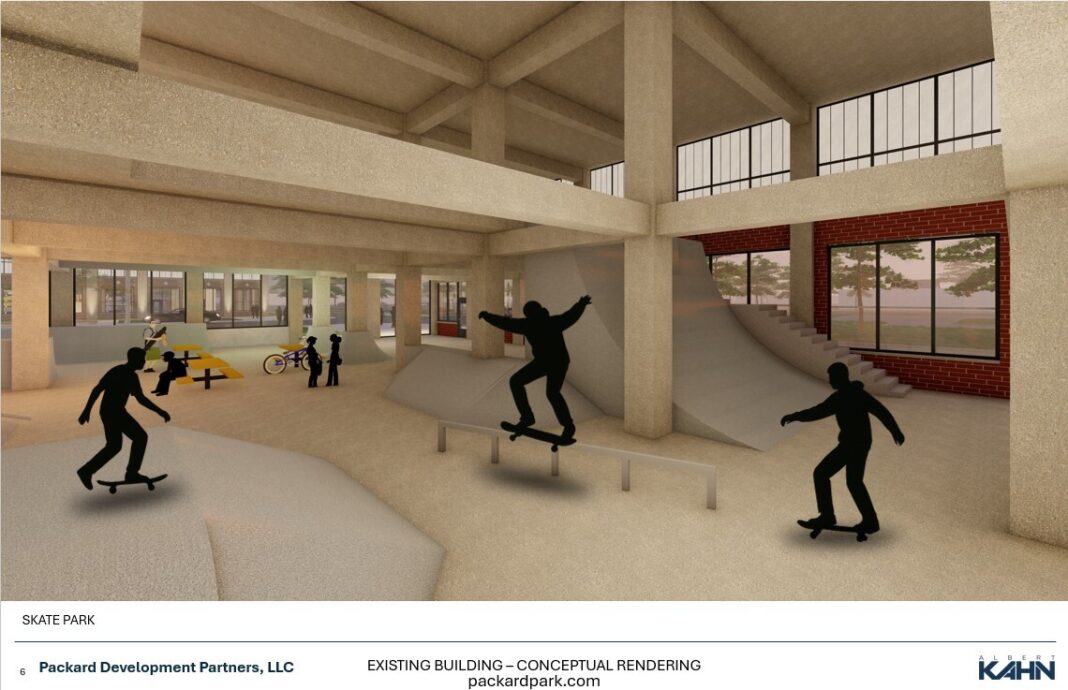
Developers want to make more than two acres of indoor/outdoor public space and recreation areas, build 42 “make/live” affordable housing units, construct Detroit’s first indoor skate park and the Museum of Detroit Electronic Music.
Electronic music parties became a staple at the plant in the 1990s, four decades after the plant had shut down during a time when the complex was still in use by commercial tenants for storage space.
Decades ago, several companies occupied portions of the building south of Grand Boulevard, while inside the complex there was a paint ball range and secured storage areas.
Detroit Mayor Mike Duggan announced Monday at a press conference at the abandoned plant the city signed a letter of intent with developers Mark Bennett and Oren Goldenberg to reactivate 28 acres of the former Packard Plant, including a Albert Kahn building along W. Grand Blvd.
“Five years ago, the Packard Plant was still standing as Detroit’s most iconic ruin, continuing to drag down the surrounding neighborhood. It took an incredible amount of work to gain title to the property and tear down everything that could not be saved in hopes for a day like this,” Duggan said in a statement. “A challenging development like this takes people who think outside of the box to create something really special and that is what Mark and Oren have done here.”
Bennett has developed six multi-family and mixed-use developments in Detroit, while Goldberg is the developer and co-owner of the $30 million Dreamtroit project on Holden St., which also hosts a lively after-hours spot, Lincoln Art Park. It used to be the site of a Lincoln Motor Factory plant.
The redevelopment opened in 2024 and includes residential apartments, office units, and 38,000 square feet of retail and entertainment space.
Developers say the Packard Park redevelopment will create jobs, preserve history, establish new housing options and build culture and community.
The goal is to construct a new $50 million 393,000 square foot industrial building designed to create 300 permanent good-paying manufacturing jobs, plus construction jobs.
The skate park and electronic music museum would go inside the renovated, 117,000 square foot Albert Kahn Building.
“As stewards to the city, we will work together with neighbors, creators and our P4 partners, to complete this purpose-driven development that will bring culture, housing and jobs to the city for this generation and beyond,” Goldenberg said in a release.
“Packard Park” will be a 28-acre mixed adaptive-reuse Public-Private-Philanthropic Partnership, led by Packard Development Partners, LLC, alongside the City of Detroit, DEGC, the Albert Kahn Legacy Foundation and the Detroit Regional Partnership.
The regional partnership provided significant acceleration through its VIP Site Readiness Grant Program, the city said in a news release.
“For more than 60 years this site sat idle. Today, we declare that those days are over. The Packard Park will be a symbol of what is possible when Detroiters, public partners, and committed developers work together with imagination and purpose,” said Mayor-elect Mary Sheffield. “This is how we honor our past while building our future — by preserving history, creating jobs, expanding housing, and investing in culture and community all at once.”
Demolition crews have made the rusted and crumbling Packard Plant a shell of what used to stand in the east side neighborhood.
The plan announced Monday is the latest of a handful of redevelopment announcements that never materialized.
The city has spent nearly 17$ million razing the site since 2022, according to officials.
The city had successfully received clearance from a court to demolish the site after a judge sided against the plant’s final private owner, Fernando Palazuelo, of Peru.
Palazuelo won control of the plant in 2013 during a tax foreclosure auction for $405,000 after late businessman Dominic Cristini lost ownership of the plant he says he went to prison to save.
Cristini’s Detroit News obituary claims he sold drugs after losing so much money to save the plant.
“I lost nearly everything, but I’m pretty proud that I gave the city way more than they ever bargained for,” Cristini told the News the year before he died.